Four Switches, One Mechanism: What Stem Geometry Actually Changes
The Durock T1, the Boba U4T, the Holy Panda X, and the Gateron Lanes have spent four separate deep-dives citing each other as comparison points. None of those pieces stopped to say the obvious thing: all four generate their bump the same way. The leg geometry is the whole story.
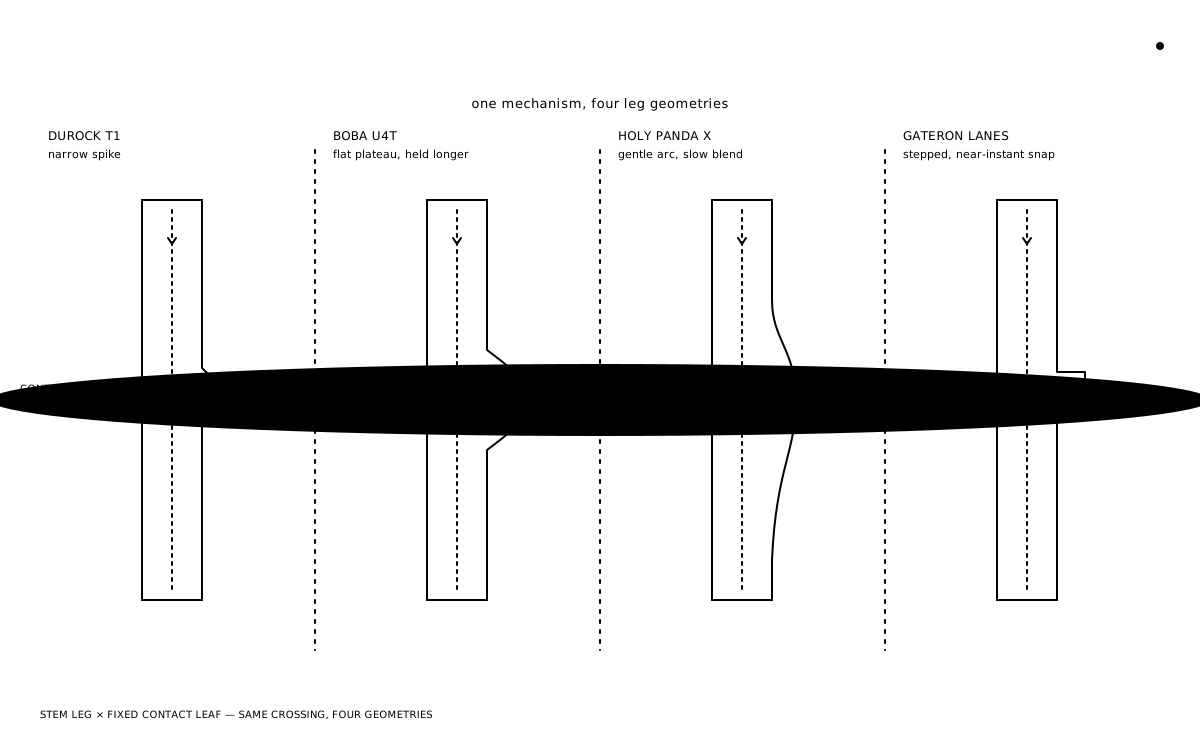
Four deep-dives in this publication have now cited each other without ever naming what they all have in common. The Gateron Lanes piece placed the Durock T1 "between" the Boba U4T's long plateau and the Lanes' own near-instant snap. The Durock T1 piece grouped the T1 and the U4T together as leaf-crossing tactiles, set against Topre's dome-collapse as the thing that isn't. The Boba U4T piece borrowed the T1's spring numbers to make a point about spread, then pointed at the Lanes as "an entirely different mechanical lineage" in the same breath. The Holy Panda X piece sketched three bump shapes — sharp, D-shaped, rounded — and placed itself in the third category without naming the other two switches that belong in the first two.
Here's the thing none of those four pieces said plainly: they're all describing the same mechanism. A stem leg approaches a metal contact leaf partway through the stroke, deflects it, and releases it. That's it. That's the whole tactile event, in every one of these four switches. If the mechanism is identical, the obvious question is why the Durock T1, the Boba U4T, the Holy Panda X, and the Gateron Lanes feel like four distinct switches rather than four variations on a theme that should collapse into one. The answer is leg geometry — the shape of the part doing the crossing — and it's worth looking at all four side by side, because no single-switch deep-dive is positioned to make that comparison honestly.
One mechanism, not four
Every MX-compatible tactile switch — the Durock T1, the Boba U4T, the Holy Panda X, the Gateron Lanes — generates its bump the same way. A POM stem rides down the housing on two rails. Partway through the stroke, a leg molded into the stem's side approaches a thin metal leaf mounted inside the housing. The leg pushes the leaf aside, holds it briefly deflected, then lets it spring back past the leg's trailing edge. The finger feels that push-and-release as the "bump." Nothing about which switch this is changes that sequence. What changes between switches is entirely contained in the shape of the leg: how steep its leading face is, how long it keeps the leaf deflected before releasing it, and where in the overall stroke that crossing happens to sit.
It's worth being precise about what this mechanism is not, because two of the comparisons already circulating in this publication's own prose reach outside it. Topre's switches don't cross a leaf at all — the electrocapacitive deep-dive is explicit that a Topre keypress collapses a rubber dome over a conical spring and reads the resulting change in spring position as a capacitive signal, with "no metal-on-metal contact anywhere in that stack." The T1 piece's own Topre comparison holds up precisely because it never claims shared architecture — it claims shared register, a stiff spring and a muted housing that happen to feel similarly serious under the finger. And the Alps SKCM Orange, the switch the Lanes chases without pretending to replicate, doesn't cross a leaf either: its tactile event comes from "a resonant slider body that physically interrupts its own travel path," an internal snap rather than a leg-and-leaf crossing, as the Lanes deep-dive lays out. A third adjacent family deserves the same precision: click-bar and click-jacket clickies generate a deliberate click event that's separate from any bump at all, a different design goal from any of the four switches here — the clicky-switches deep-dive covers how those two mechanisms differ from each other, let alone from leaf-crossing tactiles. All three of those are real mechanisms, and all three are legitimately different from what the T1, the U4T, the HPX, and the Lanes are doing. The four switches this piece is actually about never left the leaf-crossing family. They just cut the leg differently.
Four legs, side by side
The Durock T1 cuts the steepest leading shoulder of the four. Its own deep-dive describes "a steeper leading shoulder" than the U4T's rounded one, with the leg reaching the leaf, crossing it over a short arc, and releasing "without the extended dwell" that gives the U4T its plateau. The event resolves fast. What makes that fast-resolving bump still register as serious rather than slight is what happens after it: a 55g actuation climbing to a 67g bottom-out, a 12-gram spread that is the widest of the four switches here, so the spring keeps loading well past the point where the leg has already let go of the leaf.
The Boba U4T goes the opposite direction on leg shape. Its POM stem "carries a rounded shoulder that maintains contact with the leaf across an extended arc rather than crossing it at a steep angle," and that extended contact is what turns a spike into a plateau — the finger reads "I am in the bump" for a measurable stretch rather than a single instant. Gazzew places that plateau high, in the upper third of a short 3.2mm stroke, and backs it with the narrowest spread of the set: 62g actuation to 68g bottom-out, just 6 grams. The heaviest single moment in this whole comparison arrives early and the spring barely climbs after it.
The Holy Panda X takes a third shape entirely — not sharp, not a flat plateau, but "a smooth, symmetric arc" descended from the old Halo True stem, with "gentler entry than the U4T, longer dwell than the Brown." The detail that actually separates it from the other three is the back edge: rather than releasing cleanly before bottom-out the way the T1's spike or the U4T's plateau do, the HPX's fall-off "blends into the bottom-out rather than dropping off cleanly first." Bump and bottom-out read as one continuous gesture instead of two discrete events. The spring — 60g actuation, 67g bottom-out, a 7-gram spread — is the middle number in every column of this comparison, which tracks with a switch whose whole design goal is continuity rather than a sharp peak or a long hold.
The Gateron Lanes is still an MX leaf-crossing switch — Gateron "is not shipping an Alps-socket switch," its own deep-dive is careful to say — but its leg carries "a pronounced step on its leading legs," a sharper drop-off than either the U4T's or the HPX's rounded shoulders. That step crosses the leaf fast and releases without a drag tail, chasing the Alps SKCM Orange's internal-snap character from inside an architecture that can't actually produce an internal snap. The spring does real work reinforcing that intent: 55g actuation to 62g bottom-out, a 7-gram spread, but a spring Gateron specs as "relatively stiff" for its weight class, which the review coverage credits for making the bump "register as more emphatic than the raw numbers would predict."
The spring is doing half the job the leg gets credit for
The pattern across all four switches is that leg geometry and spring tune are never independent decisions — each spring is tuned to reinforce whatever the leg geometry is already doing. The T1's fast-resolving spike needs the widest spread in the set to keep reading as substantial once the leg has already let go; without the climb to 67g, a sharp quick bump would feel slight. The U4T's long plateau front-loads the heaviest single breakpoint of any switch here, then can afford the narrowest spread, because the plateau itself is already doing the work of making the event feel unmissable — the spring doesn't need to keep adding resistance afterward. The HPX's small 7-gram delta keeps the back half of the stroke flat, which is exactly what a geometry built to blend bump and bottom-out into one gesture wants: nothing that reads as a second event. And the Lanes' stiff spring sharpens a leg shape that's already the sharpest drop-off of the four, stacking two decisions in the same direction instead of letting one offset the other.
The leg decides when and how the bump arrives. The spring decides how much is left to prove after it does. Read either number alone and the switch's actual character stays invisible.
That's the practical lesson for a builder comparing switches on a spec sheet rather than a bench. Actuation and bottom-out numbers alone don't predict feel — the Durock T1 and the Gateron Lanes share an identical 55g actuation weight, and feel nothing alike, because the leg decides whether that initial resistance resolves as a slow-building spike with 12 more grams still to come, or a sharp snap that's mostly over by 62g. A spec sheet is a summary of the spring curve. It is not a description of the leg, and the leg is where the character actually lives.
What this doesn't explain
It's worth being honest about the limits of this synthesis. Leg geometry explains why the tactile event itself differs across these four switches; it does not explain the acoustic differences that sit on top of it. The T1 and U4T both run all-nylon housings and read muted and deep; the HPX and the Lanes both pair a polycarbonate top with a nylon bottom and read brighter on the upstroke. Housing resin, not leg shape, drives that half of the comparison — the full acoustics stack, housing resin included, gets its own treatment separately — and it's a separate variable layered on top of the one this piece is isolating. Nor does leg geometry account for the HPX's shortened 3.4mm travel or the U4T's 3.2mm long-pole stroke, both of which change how much of the overall press the bump occupies independent of its shape. A fifth lever sits upstream of all four: stem-and-rail tolerance, the thing Cherry's own MX2A revision targeted directly without touching leg geometry at all — tighter rails cut wobble and make every unit feel more consistent, but they don't reshape the bump itself, only how faithfully each switch in the tray reproduces it. Geometry, spring, housing, travel, and tolerance are five separate levers that happen to get pulled together on any shipped switch, and this piece has deliberately isolated one of them because the corpus had never named it, not because it's the only one that matters.
What to watch next
The more interesting question going forward is whether factories start marketing leg geometry directly, the way spring weight and housing resin already get marketed. Right now a buyer reads "55g/67g, nylon/nylon" on a spec sheet and has to infer the leg shape from reviews, force-curve graphs, or — as this piece has done — cross-referencing four separate deep-dives that each only had half the picture. A spec sheet that named the leg shape plainly — sharp spike, D-plateau, rounded blend, stepped snap — would tell a builder more about how a switch will actually feel than either gram number does alone. None of the four manufacturers covered here currently do that. Given how much of each switch's identity the leg is carrying, it's a strange gap in an industry that otherwise lists travel distance to a tenth of a millimetre. Worth watching whether the next tactile launch closes it, and whether this publication's own comparison language — "sharp," "D-shaped," "rounded," "stepped" — ends up being the vocabulary that fills the gap in the meantime.
For the full detail on any one of these four switches — the lube protocols, the housing acoustics, the travel specs, the editorial verdict on who each one is for — the dedicated pieces are still the better read: the Durock T1, the Boba U4T, the Holy Panda X, and the Gateron Lanes. This piece exists to say the thing none of them said on their own: it was always one mechanism, cut four different ways.
Keep reading
- Deep Dives
Gateron Lanes: The Alps-Inspired Tactile Taking Over the Mid-Range
Gateron's Lanes draws its DNA from the Alps SKCM Orange — one of the most loved tactile mechanisms of the 1980s — and arrived in June 2026 with enough community conviction to sell out on first drop.
thock12 min read - Deep Dives
What a TMR sensor is actually measuring under a magnetic switch
Keychron's Q16 HE 8K and Cherry's XTRFY TMR boards get covered as a new switch generation. The real change sits a few millimeters below the magnet — a tunnel junction reading field strength through resistance instead of voltage, with a noise floor low enough to matter at the shallow end of the stroke.
thock11 min read - Deep Dives
The Boba Family: One Housing Blend, Five Switches, and the Sound thock Is Named For
Gazzew designs, Outemu molds, and a plastic softer than nylon does the rest. Every Boba is the same chamber with something deliberately left out — and the pattern of subtractions is the whole family tree.
thock10 min read - Deep Dives
How buckling-spring switches actually work
thock has already reached for the buckling-spring snap twice — once to describe a Topre dome, once to describe a click-bar's sharpness — without ever explaining what a buckling spring actually is. The mechanism predates both, and it is stranger and more mechanically honest than either.
thock10 min read