Why the Gazzew Boba U4T Rings Where the Boba U4 Stays Quiet
Same housing, same bump position — the U4T's whole personality comes down to what Gazzew left out. Pull the dampening pads from a Boba U4 and the bottom-out stops being polite.
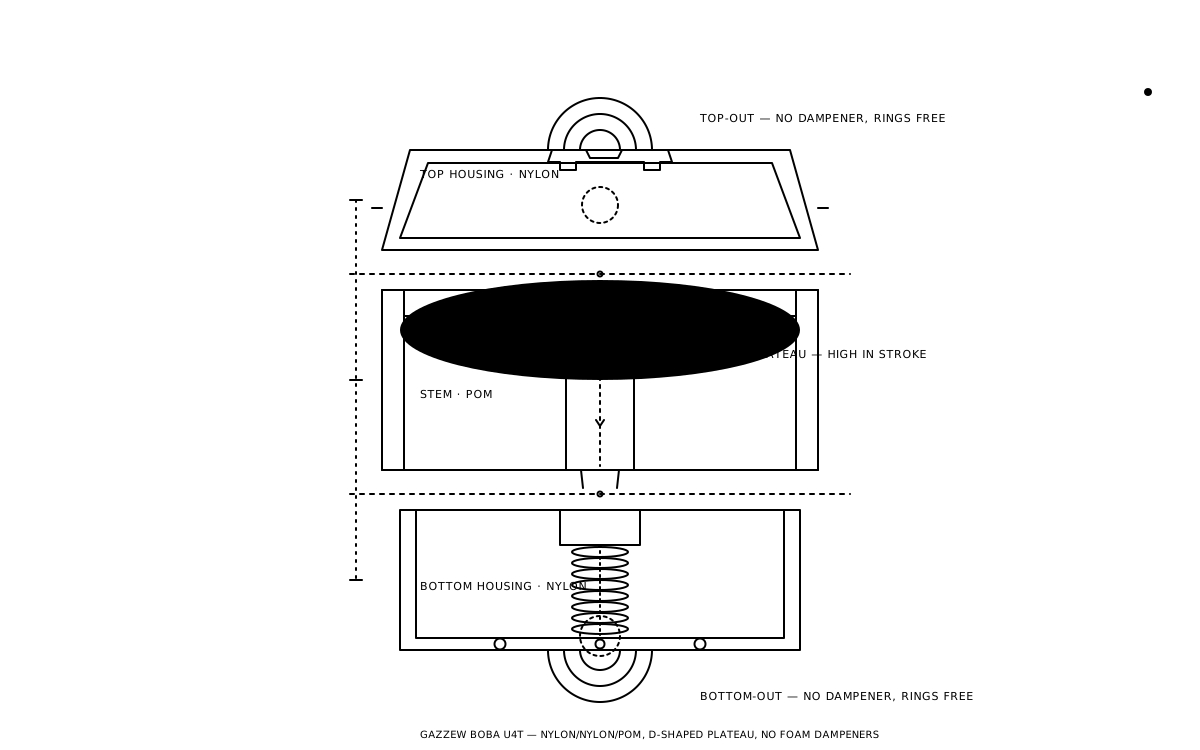
Two deep-dives already published in this corpus have reached for the Gazzew Boba U4T as a comparison point without ever explaining it on its own terms. The Durock T1 piece used the U4T's D-shaped plateau to locate the T1's sharper, faster-resolving bump. The Drop Holy Panda X piece cited its dry factory ship as the counterpoint to the HPX's asymmetric lube job. Both citations were accurate, and neither stopped to ask the more interesting question: why does a switch built on the same housing and bump geometry as its own quieter sibling end up sounding — and feeling — like a different switch entirely.
What's shared, what isn't
Gazzew's Boba line has run two versions of the same core switch since the Boba U4T reached NovelKeys in June 2020: the Boba U4, built with removable silicone dampening pads seated on the stem to quiet both ends of the stroke, and the U4T, the full-sound counterpart that ships without them. The nylon top and bottom housings are shared. The pronounced, rounded bump positioned high in the stroke — the trait every Boba review leads with — is shared too. What isn't shared: the U4T's stem uses a longer pole, which frees up the seats the pads would otherwise occupy and also trims total travel to 3.2mm against the standard-pole U4's 4.0mm.
That's still an unusually clean comparison for a hobby that rarely gets one, even if it isn't a pure single-variable swap. Most switch comparisons cross several variables at once — stem material, spring, housing resin — and any acoustic difference has to be untangled from all of them. The U4 and U4T narrow it to two changes that happen together: the dampening pads, present or absent, and the pole length that accommodates their absence. Everything the U4T is known for — the full-bodied thud, the bottom-out that "rings" instead of landing quietly — traces back to the pads, not the 0.8mm of travel the longer pole gives up.
The bump: why it sits where it does
The U4T's tactile event is a D-shaped bump: a steep climb on the leading edge, a flat plateau across the top rather than a sharp peak, and a controlled descent back to baseline pressure. That shape is a direct consequence of stem geometry — the POM stem carries a rounded shoulder that maintains contact with the leaf across an extended arc rather than crossing it at a steep angle, the way a Cherry MX Brown's stem does. A steep-angle crossing produces a narrow spike, over almost as soon as it starts. A rounded shoulder holding contact longer produces a plateau — the finger reads "I am in the bump" for a measurable stretch of travel rather than "I crossed a bump" in an instant.
Gazzew positions that plateau high in the 3.2mm stroke, in the upper third of the travel. The tactile event resolves early, and the rest of the downstroke — from the bump's back edge down to the 3.2mm floor — is functionally a quiet linear glide. That's a deliberate trade: placing the plateau lower, or stretching it further down the stroke, would blur the bump into the bottom-out, the way a Drop Holy Panda X blends its own rounded arc into one continuous gesture. The U4T keeps the two events distinct instead — bump, then a stretch of nothing, then a full-bodied landing.
The spring backs that separation up more than its numbers first suggest. At 62g actuation and 68g bottom-out, the U4T's spread is only 6 grams — among the narrowest of any tactile in this publication's comparison set, and, as the T1 deep-dive already noted, roughly half the spread the Durock T1 runs across its own 55g-into-67g curve. The U4T isn't asking the spring to keep loading meaningfully after the bump resolves; it's asking for the heaviest single moment of force right at the plateau, then coasting on a spring that's nearly done climbing. The heaviest breakpoint in the comparison set, delivered early, then very little left to prove.
What the dampening pads actually did
A dampening pad does one specific mechanical job: it inserts a compressible layer between two hard surfaces at the moment they'd otherwise meet directly. On the Boba U4, that layer is a removable silicone pad seated on the stem itself — one at the top, cushioning the stem's return against the housing ceiling, and one at the bottom, cushioning its descent against the housing floor. Both contacts still happen — what changes is the instant after contact. Instead of two hard surfaces ringing against each other and radiating that vibration as sound, the silicone absorbs the impact energy and converts most of it to heat. The keystroke still registers the same travel and spring resistance; it just doesn't make much noise doing it.
Pull the pads out and nothing about the actuation changes — the U4T isn't a different mechanism, it's the same mechanism with an acoustic absorber removed. The stem's top-out and bottom-out contacts are now hard-surface-on-hard-surface, and the nylon housing itself becomes the thing doing the ringing. Nylon is a comparatively soft engineering plastic as housings go, so it doesn't ring as brightly as polycarbonate would in the same configuration — the result isn't a sharp click, it's a deep, contained thud. The housing resonates at a lower register than a stiffer resin would, but it resonates, because nothing intercepts the impact before it has the chance to.
That's the entire mechanism behind the U4T's reputation. Builders describe the switch as sounding "full" or "rich" compared to its silenced sibling, and the plain engineering answer is that the U4 was never quiet because its housing couldn't ring — it was quiet because Gazzew seated something in the way before it could. The U4T just took the pads out.
The spring rattle nobody warns you about
The U4T's factory lube is real but narrow: Gazzew lubes the leaf and the spring's bottom coils, the surfaces that generate metallic noise, but leaves the slide rails and the rest of the spring untouched. That's a defensible choice on its own terms — a thick coat across the rails can gum the slide and change how the bump reads — but it has a predictable side effect. A stock spring, dry along most of its length, tends to chatter against itself on the upstroke as it decompresses, especially once the pads that would have otherwise muffled a stray vibration are gone. The result is a thin, metallic rattle riding on top of the switch's low thud — audible on a quiet board, more noticeable precisely because the U4T's acoustic signature is otherwise so deep and clean.
The fix the community settled on is mechanical, not exotic: a thin coat of a low-viscosity oil applied by hand to each spring, enough to damp coil-on-coil contact without adding drag to the compression stroke. It isn't a factory step, and it isn't optional in the way rail lube is — a U4T straight out of the bag will very likely need it before the acoustic picture matches what the switch is capable of. Builders who skip it are, in effect, judging the switch on an incomplete build. Contrast that with the Gateron Oil King deep dive, where the factory tune already extends past the rails to the stem legs — still no spring treatment, but a broader factory lube footprint than the U4T's rails-only approach at a similar price point.
Where the U4T sits against the field
Set against the two other tactiles this publication has already covered, the U4T occupies a distinct corner: the heaviest actuation weight in the set at 62g, paired with the narrowest spread to bottom-out at just 6 grams. The Durock T1 runs the opposite pattern — a lighter 55g actuation that climbs a full 12 grams by the time the stroke bottoms out, closing most of that gap by the floor of the press even though it starts well behind. The Holy Panda X splits the difference at 60g into 67g, a 7-gram spread that sits close to the U4T's own number despite a shorter 3.4mm travel and a different bump shape entirely.
The practical read: the T1 asks for escalating commitment through the stroke; the U4T asks for its heaviest commitment up front, then gets out of the way. Neither is more "correct" — they're different answers to the same brief of making a tactile feel substantial rather than casual. The U4T reads as a distinct, locatable event followed by a quiet finish; the T1 reads as a press that keeps costing more the deeper it goes. For a tactile built on an entirely different mechanical lineage, the Gateron Lanes deep dive traces an Alps-derived stepped-leg bump that has nothing in common with the U4T's rounded-shoulder plateau — worth reading as a reminder that "tactile" covers more than one mechanism.
ThereminGoat's review of the U4T lines up with that read, describing it as one of the more distinctly voiced tactiles on the market — a switch reviewers reach for specifically because the bump and the bottom-out both register clearly, rather than one overshadowing the other.
Who the U4T is for
The U4T rewards a typist who wants a tactile switch that also functions as an acoustic centerpiece — a board built to be heard as well as felt. It's a poor match for anyone building toward a quiet office setup; the entire design premise is a housing allowed to ring, and no amount of case dampening will make a U4T sound like a silenced switch without defeating the reason to buy it. It's a strong match for a builder coming from the plain Boba U4 who found the silenced version's restraint disappointing.
Builders should budget for the spring-oiling pass as part of the install, not as an optional upgrade — the switch as it ships isn't the switch as it's meant to be heard. And the housing choice deserves acoustic company: an all-nylon build already leans low and contained, so a case and plate that add brightness elsewhere in the stack, rather than muting the U4T further, will let its actual character come through.
What to watch next
The U4T has held its spec — 62g/68g, nylon/nylon, POM, 3.2mm — since its June 2020 release, and it remains in production through NovelKeys without a revision. That stability, alongside the T1's own six-year unchanged run, points at something durable about the heavy-tactile corner of the market: once a factory finds a spring tune and a housing pairing that reads as "serious" rather than merely "stiff," there's little incentive to touch it. The open question is whether Gazzew ever extends factory lube to the spring itself — the most obvious remaining gap between the U4T's factory tune and the full-lube standard the Holy Panda X has since set for the category. The HMX Cloud deep dive covers the same question from the linear side of the catalog — a similarly unglamorous switch that climbed the tracker on tuning discipline rather than a headline material.
Keep reading
- Deep Dives
The Boba Family: One Housing Blend, Five Switches, and the Sound thock Is Named For
Gazzew designs, Outemu molds, and a plastic softer than nylon does the rest. Every Boba is the same chamber with something deliberately left out — and the pattern of subtractions is the whole family tree.
thock10 min read - Deep Dives
Why the Durock T1's Bump Feels the Way It Does
The Durock T1 keeps turning up as the comparison point in other switches' deep-dives — the reference a reviewer reaches for when a bump needs to read as heavy and serious. It has never had its own.
thock10 min read - Deep Dives
Why the Drop Holy Panda X feels the way it does
The Holy Panda was a six-month frankenswitch project for most of its life. The Drop Holy Panda X is the first version where the geometry, the spring tune, the housing pairing, and the factory lube were the spec — not the mod.
thock13 min read - Deep Dives
What a silent switch actually silences — and what it can't
Every keystroke lands twice — once on the floor, once on the ceiling. Cherry molds an elastomer pad onto the stem to catch both; Gazzew fits a silicone one. The undamped Boba U4T shows what either approach is buying — about 14 dB on one tester's meter — and what it costs in travel, rebound, and a bump with nowhere left to go.
thock10 min read