The Boba Family: One Housing Blend, Five Switches, and the Sound thock Is Named For
Gazzew designs, Outemu molds, and a plastic softer than nylon does the rest. Every Boba is the same chamber with something deliberately left out — and the pattern of subtractions is the whole family tree.
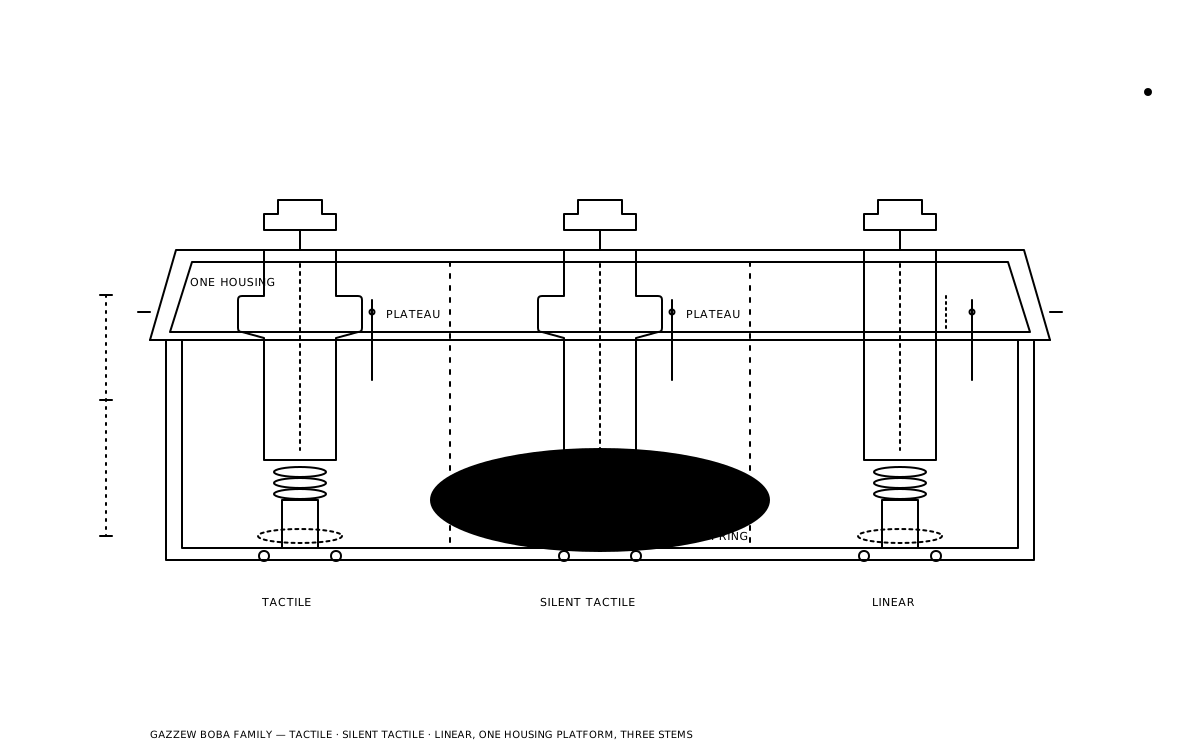
The word this publication is named for has a factory address. Plenty of switches get called thocky, but when builders reach for the canonical example of a deep, muted, full-bodied bottom-out, the one they name more often than any other comes out of an Outemu mold to a design by a single community member who goes by Gazzew. This piece is about that family as a whole: the housing blend every Boba shares, the bump geometry the tactiles share, and the handful of deliberate subtractions that turn one switch into five.
One designer, one factory
Gazzew is not a company. He is a long-time contributor to the hobby who spent years selling individual switch components — stems, springs, housings — before shipping a complete switch, which is part of why reviewers found his early work hard to assess. ThereminGoat's review of the Boba U4 frames the line as the culmination of iterative improvements to Outemu base designs: Gazzew specifies the geometry, the material, and the tolerances; Outemu cuts the molds and runs production. Vendor listings for the line routinely carry the two names in two separate slots — designer Gazzew, manufacturer Outemu — and the arrangement has held from the pre-production run through the V2 revision.
That first run is dated precisely. Gazzew sold pre-production Boba U4s on r/mechmarket on July 7, 2020, at $0.55 per switch. The U4T — the same housing with the dampeners left out and a longer-pole stem in their place — went out through NovelKeys the same summer. A linear followed (the LT, for "Linear Thock"), then a silent linear (the Bobagum), then the U4Tx, a tactile that splits the difference between the two original siblings. Somewhere in the middle the housing moved from a milky pearl to an opaque black, and the "Black Boba" label attached itself to the line. That is a housing revision, not a sixth switch; the section on divergence returns to it.
The housing is the instrument
Every Boba shares one housing material, and Gazzew has never published what it is. What is on record is how it behaves. ThereminGoat's pre-production notes describe a plastic that is "softer than Nylon" with "a higher melting point temperature than Polycarbonate," and Switch and Click's review calls it "a soft proprietary plastic blend that makes it softer than Nylon-66." Vendors list it as "Boba plastic" and leave it there.
Softer is the operative word. A switch housing is a resonant chamber, and how brightly it rings after the stem lands depends on how stiff its walls are. Polycarbonate is stiff and acoustically transparent; it passes the impact through with a high, quick ring. Standard nylon is softer and absorbs more, which is why the PC-top, nylon-bottom recipe became the default for premium linears — the acoustics deep-dive walks through that pairing layer by layer. The Boba blend pushes past nylon. More of the bottom-out energy is converted to heat inside the wall instead of radiated as sound, the fundamental drops, and the tail shortens. An all-Boba switch with nothing else in the way produces the rounded, low thud the hobby named itself after; the same housing with dampeners in it produces something close to nothing at all. ThereminGoat's verdict on the U4 was "no perceptible noises" at normal typing distance, with only a faint "leathery scratch" left over.
The higher melting point is the less-discussed half of that description; ThereminGoat's guess that it was chosen with factory soldering in mind is as far as the public record goes. Either way, soft does not mean loose: the tops have "absolutely no give" in any direction, a finding that shapes the film question below.
The stem most of them share
The tactile Bobas — U4, U4T, U4Tx — share a POM stem's defining trait: where it puts the bump. The pole length isn't identical across the trio, though — the U4T's stem runs longer than the U4's, trimming total travel to 3.2mm against the U4's 4.0mm. Switch and Click describes a "D-bump" that "starts at top, and ends very close to bottom-out," with actuation arriving after the bump rather than inside it; ThereminGoat locates the event "at the very start of the downstroke." The finger meets the leaf the instant the key moves, rides a rounded plateau rather than crossing a spike, and lands with most of the tactile work already done. The U4T deep-dive explains the stem-shoulder geometry behind that plateau and sets it against three other bump shapes covered in their own pieces: the Durock T1's sharper front edge (Durock T1 deep-dive), the Drop Holy Panda X's rounded arc (Holy Panda X deep-dive), and the Gateron Lanes' Alps-style snap (Gateron Lanes deep-dive); none of that is repeated here.
Two springs carry the tactile line: 62g and 68g bottom-out, Korean stainless steel. Switch and Click's read is that the lighter spring accentuates the bump while the heavier one smooths it, which tracks with the geometry — a bump at the top of travel reads as a larger fraction of total force when the spring beneath it is lighter. ThereminGoat's note on the pre-production 62g was that the bump sat "mid-range in terms of tactile strength" and lighter than the market expected — a caution for anyone who ordered Bobas after hearing the phrase "hammering a bump."
Five switches from one housing
The family reads as a matrix of subtractions rather than a lineup of designs.
The Gazzew Boba U4T is the reference point: tactile stem, no dampeners, the housing left to ring at its own low register. The Gazzew Boba U4 pairs the same housing and bump shape with a standard-pole stem and silicone dampening pads at top-out and bottom-out — removable, which is how Switch and Click tested them, noting that pulling them adds "a bit of pretravel before the bump." The U4Tx, the newest tactile, keeps the bottom-out loud and silences only the return stroke: splitkb's listing describes "silent rails which dampen the upstroke, so only the bottoming out will make sound," on a single 65g spring, in a revised material "which isn't prone to discoloration from using EVA foam." For the full mechanics of how those dampening strategies differ — pads, rails, stem-mounted rubber — the silent-switch damping deep-dive is the companion piece.
The linears swap the stem. The Gazzew Boba LT puts a smooth long-pole POM stem in the same housing, undampened, at 55g or 65g — RNDKBD's listing bills it as the "King of Thock Linears," which is a vendor talking, but the recipe is the U4T's recipe with the bump shaved off. The Bobagum is the LT's silent sibling: pink or clear-top, dampened, and offered at 52g, 62g and 68g. Set next to the Cherry MX2A Silent Black, which quiets its stroke with rubber on the stem inside a conventional nylon housing, the Bobagum starts quieter at the source before any dampener gets involved, because the chamber itself is softer.
The Black Boba is the material story running underneath all five. The original milky housing discolored where it touched EVA case foam — the reason splitkb's U4Tx copy leads with discoloration resistance — and the line moved to an opaque black blend. Pantheon Keys lists the milky U4T housing as discontinued with black as the standard, and the V2 revision added hard metal contact pins and a reshaped LED cutout. Same stem, same geometry, a housing that stopped staining.
What Gazzew already lubed, and what films cannot fix
The lube question has a clean answer once the runs are dated. The 2020 pre-production U4s shipped dry — Switch and Click found them unlubricated but acceptable as-is. The later runs carry a deliberate, partial factory lube: splitkb's U4Tx and Bobagum listings both specify factory-lubed leaves and spring bottoms while "the slide rails are not lubed," and RNDKBD's LT page describes springs "donut-dipped in lube to prevent ping," leaves "lightly lubed," and sliders "completely dry." The pattern is consistent: Gazzew treats the two surfaces that generate metallic noise — the leaf and the spring — and leaves the rail surfaces for the builder. Both vendors recommend typing on them unlubed first. On the tactiles that advice is load-bearing, because a pass of thick grease across the bump face softens exactly the plateau the stem was cut for.
Films are the other half of the question, and the answer is that they have little to do. A switch film exists to take up slack between the top and bottom housing; the Boba tops have none. ThereminGoat measured "absolutely no give" across every sample, RNDKBD sells the LT on its "no-wobble tops," and a Pantheon Keys reviewer complained that the top housing was excessively tight to pull apart for modding. Thock King will still film a Boba for $0.39 on top of the switch price; the tolerance stack just does not leave the service much to improve.
The arc, and the caveats
The Boba line's reputation ran in two phases. The first was the U4 as the silent tactile that finally earned the adjective — Switch and Click titled its review "Silent Uprising," and ThereminGoat's no-perceptible-noise finding was the line builders quoted. The second was the U4T eating the tactile conversation whole: Pantheon Keys could write "widely regarded as one of the best tactile switches available" in product copy without anyone objecting. The LT and Bobagum extended that trust to linears without generating the same heat. That reputation sits in a different lineage than the hobby's other tactile touchstone — the buckling-spring deep-dive covers the IBM Model M's spring-driven snap-through actuation, a mechanism that shares nothing with a soft resonant chamber beyond a permanent seat in the canon.
The honest caveats are three. Stem wobble exists — ThereminGoat called it "ever so slight" in both directions and unlikely to show under a keycap, and the tight tops do not fix it, because the slack is stem-to-housing, not housing-to-housing. Price climbed: $0.55 at pre-production became €0.82 per switch at splitkb, before any hand-lube or film service billed on top. And availability thinned at the edges. Pantheon Keys marked both the Boba LT and the Bobagum discontinued and sold down remaining stock, and splitkb's U4Tx listing showed sold out in mid-2026. The two tactile pillars — U4 and U4T — stayed in production; the outer branches did not.
Where the family goes next
The design has stayed stable for six years because the central idea is simple: make the housing the instrument, then subtract. The U4Tx proved Gazzew could still find an unclaimed square on that grid — loud floor, silent ceiling. The remaining empty squares are easy to name: a dampened-rail linear between the LT and the Bobagum, and a heavier U4Tx spring for builders who found 65g a step down from the 68g U4T. What to watch is whether the black blend becomes the only Boba material across the whole line, and whether Gazzew ever extends factory lube to the rails — the one decision that has stayed with the builder since July 2020.
Keep reading
- Deep Dives
Why the Gazzew Boba U4T Rings Where the Boba U4 Stays Quiet
Same housing, same bump position — the U4T's whole personality comes down to what Gazzew left out. Pull the dampening pads from a Boba U4 and the bottom-out stops being polite.
thock11 min read - Deep Dives
What a silent switch actually silences — and what it can't
Every keystroke lands twice — once on the floor, once on the ceiling. Cherry molds an elastomer pad onto the stem to catch both; Gazzew fits a silicone one. The undamped Boba U4T shows what either approach is buying — about 14 dB on one tester's meter — and what it costs in travel, rebound, and a bump with nowhere left to go.
thock10 min read - Deep Dives
Why the Durock T1's Bump Feels the Way It Does
The Durock T1 keeps turning up as the comparison point in other switches' deep-dives — the reference a reviewer reaches for when a bump needs to read as heavy and serious. It has never had its own.
thock10 min read - Deep Dives
How buckling-spring switches actually work
thock has already reached for the buckling-spring snap twice — once to describe a Topre dome, once to describe a click-bar's sharpness — without ever explaining what a buckling spring actually is. The mechanism predates both, and it is stranger and more mechanically honest than either.
thock10 min read