What a TMR sensor is actually measuring under a magnetic switch
Keychron's Q16 HE 8K and Cherry's XTRFY TMR boards get covered as a new switch generation. The real change sits a few millimeters below the magnet — a tunnel junction reading field strength through resistance instead of voltage, with a noise floor low enough to matter at the shallow end of the stroke.
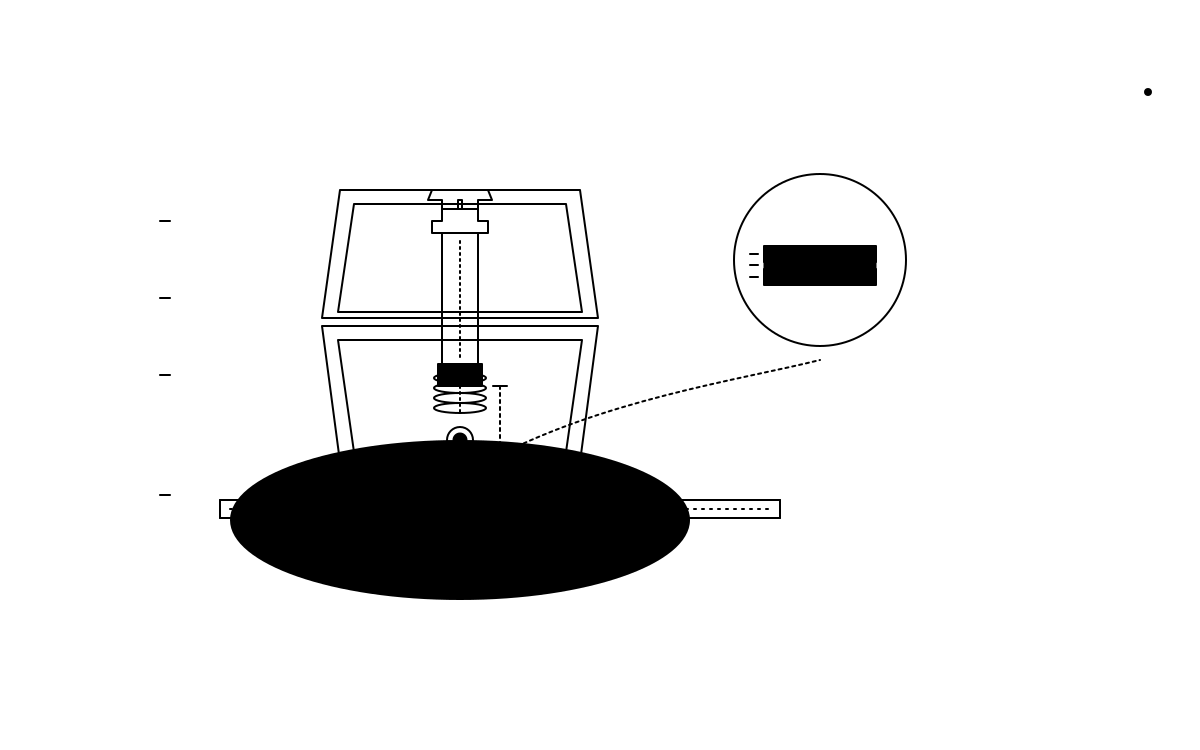
A TMR switch does not feel different from a Hall-effect switch sitting next to it in the same tray — same stem, same spring, same small magnet riding down the barrel on every press. How Hall-effect switches actually sense a keypress already covers that half of the mechanism in detail. What changes sits a few millimeters below the magnet: not a Hall sensor reading a voltage, but a magnetic tunnel junction reading a resistance. That's a smaller change than the marketing copy on Keychron's and Cherry's recent launches implies, and a more interesting one than "it's just a better Hall sensor" gives it credit for. Magnetic sensing isn't the only contactless path chasing that same goal, either — optical switches solve the identical contact-bounce problem with a beam of light instead of a field, a different physical mechanism aimed at a similar result.
Thock has covered TMR arriving on shipped hardware twice this year — Cherry's XTRFY-branded K5 Pro Compact in July and Keychron's ceramic-housed Q16 HE 8K in September — without either piece explaining what a tunnel junction is or why it reads a field differently than the Hall sensor the rest of the magnetic-switch market standardized on. This is that piece.
The same magnet, a different question asked of it
A Hall-effect sensor — the architecture covered at length elsewhere on this site — is a flat semiconductor element that develops a small voltage across itself when a magnetic field passes through it at right angles to the current flowing through the element. That's the Hall voltage. It's close to proportional to field strength across the sensor's working range, and a controller reads it directly: field strong, voltage high; field weak, voltage low.
TMR asks a structurally different question of the same field. Instead of reading a voltage the field generates, it reads the electrical resistance of a device whose resistance the field changes. DFRobot's technical overview describes the core element — a magnetic tunnel junction: two ultra-thin ferromagnetic layers separated by an insulating barrier a few nanometers thick, thin enough that electrons cross it by quantum tunneling rather than any classical conduction path. One layer is pinned in a fixed orientation as a reference. The other is free to rotate with whatever external field reaches it — in a keyboard switch, the field coming off the magnet descending with the stem.
Inside the junction
When the free layer's magnetization points the same direction as the pinned layer's, electrons tunnel across the barrier relatively easily and the junction's resistance is low. When the magnet's approach has rotated the free layer to point opposite the pinned layer, tunneling becomes far less probable — majority-spin electrons from one layer have to tunnel into minority-spin states in the other — and resistance rises sharply. The magnet's position doesn't generate a voltage directly; it changes an alignment, and the alignment changes a resistance the controller measures by pushing a known current through the junction and reading the voltage drop across it. DFRobot's overview puts that swing — the magnetoresistance ratio — as high as 100% in a well-built junction, calling it a substantially larger per-unit-field effect than the giant-magnetoresistance and anisotropic-magnetoresistance designs that preceded it, and multiples larger still than the plain Hall effect.
That ratio is the whole reason TMR gets talked about as a precision upgrade rather than a lateral move. The same DFRobot source lists TMR's field sensitivity at roughly 100 mV/V/Oe against roughly 0.05 mV/V/Oe for a standard Hall sensor — on the order of a two-thousand-fold difference in how much signal a given change in field strength produces at the sensor's bare output, before any downstream amplification. In keyboard terms: a switch's magnet produces a field that strengthens as the stem descends and weakens as it retreats, and a TMR junction converts a given step of that approach into a far larger swing in measured resistance than a Hall sensor converts into voltage. More signal per unit of magnet travel is, in the most literal sense, a finer-grained reading of where the stem actually is.
What the bigger number buys, and what it costs
Sensitivity alone doesn't settle the argument. DFRobot's comparison lists three more figures, and they don't all point the same way. Noise floor — how much of a sensor's own output is static rather than signal — also favors TMR: above 100 nT/√Hz for a Hall sensor against roughly 0.1–10 nT/√Hz for TMR, meaning a TMR junction's resting output is quieter relative to the field it measures, not just more responsive to it. Dynamic range inverts the advantage: Hall sensors tolerate fields up to roughly 10,000 Oersted before saturating, where TMR junctions saturate around 1,000 Oersted — a tenth of the headroom. Power draw favors TMR by a wide margin at the bare-component level — 5–20 milliamps for Hall against 0.001–0.01 milliamps for TMR — though that gap narrows once a board's signal-processing chain sits on top of the sensor.
None of the dynamic-range gap matters inside a keyboard switch specifically, because switch magnets were never going anywhere near 1,000 Oersted to begin with. Keychron's own comparison of the two technologies puts keyboard switch magnets in the range of roughly 50 to 1,000 Gauss — an order of magnitude or two below either sensor's saturation point. The tradeoff is real in applications that need to read genuinely strong fields; it's close to irrelevant a few millimeters from a small switch magnet. What carries over is the sensitivity and noise-floor advantage, and that pair of numbers is what keyboard makers are actually buying when they switch sensing architectures. None of it touches what the switch sounds like, either — the acoustic stack lives one layer up, in the spring, stem, housing, and plate this site has mapped in full separately, untouched by whichever sensor happens to be reading the field underneath them.
Where the extra headroom actually shows up
The Hall-effect deep dive flagged a specific weak point in that architecture: because field strength falls off rapidly with distance, the curve a Hall sensor reads is easier to resolve precisely near the bottom of the stroke than near the top, where the magnet is farthest away and the field at the sensor is weakest. That's also exactly where noise floor matters most — a weak signal sitting close to the noise floor is the hardest part of any curve to read cleanly. A sensor with a noise floor an order of magnitude or two lower has more usable signal left at that weak-field, shallow-travel end of the stroke before noise starts crowding out the measurement.
That headroom is exactly what rapid trigger's firmware loop is fighting when a sensitivity setting gets pushed toward its shallowest end. That piece described the failure mode directly: a tight reset delta has the firmware "watching for a signal barely larger than the noise floor it's swimming in," which is what produces a false double-fire from nothing more than a resting-hand tremor. A lower noise floor doesn't remove that tradeoff — the firmware still decides how much motion counts as a release — but it pushes the point where noise starts to dominate signal further down the travel. The Gateron Magnetic Jade, whose flux curve that rapid-trigger piece used as its working example — climbing from roughly 120 Gauss at rest to roughly 800 Gauss at bottom-out — is read today by a Hall sensor — the full mechanical teardown is in Gateron Magnetic Jade: the Hall-effect linear built to be argued about like a mechanical one. Gateron's tactile line runs a completely separate track: the Alps-inspired Lanes sells on feel alone, with no sensor story attached at all. A TMR switch reading the equivalent curve isn't reading a different magnet; it's reading the same field with more room between the signal and its own floor.
The skeptic's case
Set against all of that: Wooting, whose Wooting 60HE is the board the rapid-trigger category still measures itself against, published a direct rebuttal of the TMR-as-upgrade framing, titled, pointedly, "Hall Effect vs. TMR: Pause The Funeral." Its argument isn't that the sensitivity numbers are wrong — it's that raw per-sensor sensitivity isn't finished-keyboard performance. TMR sensors, Wooting notes, are typically mounted off-axis from the magnet rather than directly beneath it the way Hall sensors are, which introduces interference the higher marketed sensitivity has to compensate for in the first place — some of the headline advantage is paying for a harder mounting geometry, not winning outright on physics. Once a sensor of either type is calibrated for the field strengths a keyboard switch actually produces, Wooting argues, "both TMR and Hall effect sensors utilise the same sensitivity" in practice, and both can resolve movement as small as 0.02mm with well-optimized firmware. The company concedes the historical noise-floor gap was real — "pre-2020s Hall effect sensors had measurably worse noise performance than TMR sensors" — but says that gap "has largely closed" in current-generation parts, and that noise a user actually notices more often traces to unstable USB power than to the sensor itself.
The sensor choice is a real engineering decision with a real physical basis — it just isn't, on its own, the whole story a spec sheet wants it to be.
What's actually shipping
The commercial picture is still catching up to the physics. Keychron's own Hall-effect flagship, the Keychron Q1 HE 8K Marble, reached reviewers in April 2026 running the sensor architecture the company spent most of the year mainstreaming; its TMR counterpart, the ceramic-housed Q16 HE 8K, only opened its Kickstarter in September, and reviewer-verified numbers for the new sensor aren't published yet. Cherry's bet runs wider than the single XTRFY K5 Pro Compact this site covered in July — the company's MX 8.2 Pro TMR Wireless ships Cherry's own MK-series magnetic switches on the same TMR sensing family, with the product page claiming 0.01mm capture precision. That's a vendor figure, not an independently measured one, and it deserves the same skepticism thock applied to Keychron's own 8K polling claim at launch: a stated target until a reviewer's bench confirms it. Cherry is running that sensor push alongside a much quieter one: the same company's factory-lubed, tighter-tolerance MX2A mechanical-switch revision is still what most boards outside the magnetic category ship with, real engineering investment that generated far less discourse than either of its TMR launches.
Every magnetic-switch launch so far — Hall-effect and TMR both — is linear. The category hasn't produced a clicky variant, which leaves clicky switches' own constituency outside this particular race entirely, and the volume numbers still favor switches with no sensor story at all: HMX's Cloud shipped in half of this year's $120 prebuilts without a tunnel junction or a Hall sensor anywhere near it.
What to watch
Two threads matter more than any single board's spec sheet. The first is whether independent reviewers — not vendor pages — can actually measure the sensitivity and noise-floor gap DFRobot's component-level figures describe once it's buried inside a finished keyboard's firmware and calibration routine, the exact test Wooting's rebuttal says hasn't happened yet in TMR's favor. The second, flagged already in thock's look at the Hall-effect plateau, is whether sensor precision becomes the axis the next generation of magnetic-switch marketing actually competes on, now that adjustable actuation is table stakes everywhere. If TMR's physical advantage holds up on the bench the way it holds up on a datasheet, the Hall-effect default that took over the mid-premium tier this year has a genuine successor waiting. If it doesn't — if careful calibration keeps closing the gap the way Wooting argues it already has — TMR settles into a second architecture competing on price and housing material rather than sensor, and the camps framing the hobby already uses for Hall-effect versus TMR cools into the same kind of settled coexistence MX and Topre reached decades ago.
Keep reading
- Deep Dives
How Hall-effect switches actually sense a keypress
A Hall-effect switch is not a faster MX switch. It is a different sensing lineage — a magnet in the stem, a sensor on the PCB, and an analog voltage where contact closure used to be. The features the marketing pages lead with all unwind from that one architectural fact.
thock13 min read - Deep Dives
Gateron Magnetic Jade: the Hall-effect linear built to be argued about like a mechanical one
Pull a Magnetic Jade apart and the parts list reads like a mid-tier mechanical linear: polycarbonate top, nylon bottom, POM stem, factory lube. Where the leaf would be, there is a magnet. That one substitution explains the feel, the sound, and why it will not fit half the Hall-effect boards on the market.
thock11 min read - Deep Dives
Gateron Lanes: The Alps-Inspired Tactile Taking Over the Mid-Range
Gateron's Lanes draws its DNA from the Alps SKCM Orange — one of the most loved tactile mechanisms of the 1980s — and arrived in June 2026 with enough community conviction to sell out on first drop.
thock12 min read - Deep Dives
How optical switches actually sense a keypress
An optical switch replaces the metal contact with a beam of light. That one change eliminates contact bounce entirely, reshapes the latency math, and is why some optical boards can offer per-key actuation at 0.1mm granularity. The mechanism is simpler than the marketing makes it sound.
thock12 min read