Why the Durock T1's Bump Feels the Way It Does
The Durock T1 keeps turning up as the comparison point in other switches' deep-dives — the reference a reviewer reaches for when a bump needs to read as heavy and serious. It has never had its own.
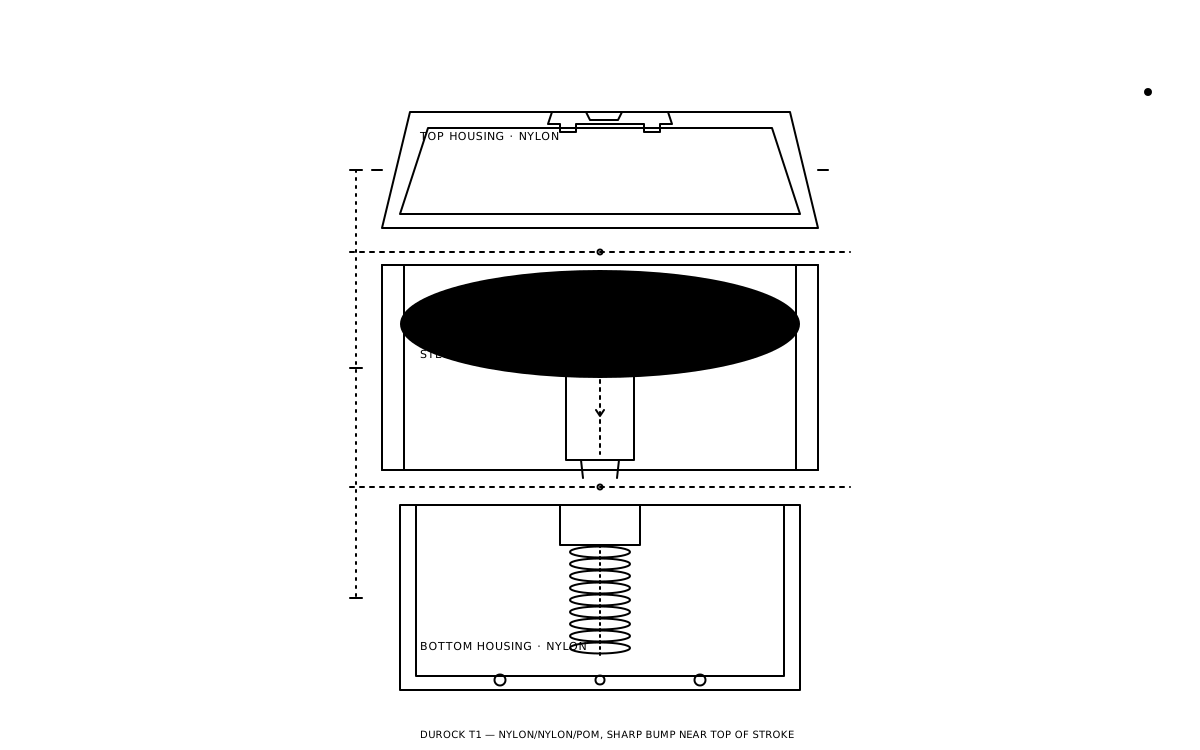
The Durock T1 has been doing quiet supporting work in this publication for weeks without ever getting billed. The Gateron Lanes deep-dive placed it "between" the Gazzew Boba U4T and the Lanes on the tactile map. The Drop Holy Panda X piece cited its spring tune as the heavy end of the modern factory-tactile range. Both citations were correct, and neither one stopped to explain why the T1 sits where it does — a switch released in March 2020 that has outlasted most of a hobby's worth of newer tactiles by staying exactly what it was on day one: heavy, deliberate, all-nylon, and unwilling to soften its bump for anyone.
A six-year-old switch that still sets the scale
Durock T1 shipped through CannonKeys in March 2020, already factory pre-lubed at a time when that wasn't yet the given it is now for switches like the Drop Holy Panda X or the Gateron Lanes. It is still in production in 2026, still sold by the same vendor, still spec'd identically to the switch that launched — which is unusual in a category where most tactiles cycle out within a year or two of release. The T1 has stayed relevant less by innovating and more by refusing to move: 55g actuation, 67g bottom-out, a 4.0mm travel, an all-nylon housing, and a POM stem, unchanged across six years while the rest of the field iterated around it.
That refusal to soften isn't a lack of factory attention, either. What the factory lube job doesn't touch is the bump face and the leaf contact itself — Durock's own guidance for a builder reaching for a supplemental pass is 205g0 on the housing rails only, because the bump is the one part of the switch a stock lube job is not allowed to touch twice.
The bump: a sharp front edge, minimal plateau
The T1's bump arrives with a sharp front edge and comparatively little plateau — a description this publication has already used once, in the Lanes deep-dive, to locate the T1 between the U4T's long D-shaped plateau and the Lanes' near-instant snap. The geometry behind that description is a POM stem with a steeper leading shoulder than the U4T's rounded one: the stem leg reaches the contact leaf, crosses it over a shorter arc, and releases without the extended dwell that gives the U4T its "you are now in the bump" plateau feel. The event is still unmistakably tactile — this is not a sharp-and-fragile Cherry MX Brown spike — but it resolves faster than the U4T's and with less of a flat top to linger on.
What keeps the bump legible despite that faster resolution is the spring. At 55g actuation and 67g bottom-out, the T1 doesn't run the heaviest actuation force in this publication's current comparison set — the U4T's 62g claims that — but no other tactile here climbs as far after the break: a 12-gram spread to bottom-out, roughly double the U4T's own 6-gram spread. The stem isn't coasting through the tactile event; the spring keeps loading meaningfully after the bump resolves, and that continued resistance is most of what gives the T1 its reputation as a "serious" switch rather than a sharp one.
Why builders reach for the Topre comparison
The switch's own canonical description invites a specific comparison: builders often describe the T1 as delivering something close to the Topre experience at a fraction of the cost. That claim is worth taking seriously rather than treating as marketing shorthand, and the mechanism comparison above is the reason why. A Topre keypress is not a leaf crossing at all — the electrocapacitive architecture collapses a rubber dome over a conical spring, and a capacitive PCB pad reads the change in the spring's position as the actuation signal. There is no metal-on-metal contact anywhere in that stack. The T1, an MX-format switch with a POM stem crossing a physical leaf, is mechanically unrelated to that architecture in every particular.
The comparison to Topre was never a claim about mechanism. It's a claim about what the hand feels — a stiff spring, a muted housing, and a bump that arrives with enough resistance to feel considered rather than casual.
What the two switches share is not architecture but the shape of the feedback. Topre's dome-collapse is sharp and early in the stroke, backed by a progressive spring that keeps demanding more force on the way to bottom-out; the T1's leaf-crossing bump is backed by a similarly climbing 55g/67g spring — a 12-gram spread that keeps adding resistance well past the break, closer to Topre's rising curve than to the flatter tunes most MX-format tactiles run. Both switches ask the finger to commit force through the entire press rather than glide past the tactile event on a light spring, and both land in an all-enclosing housing that keeps the sound low and contained rather than bright. The T1 cannot replicate Topre's two-part press-and-release asymmetry or its capacitive sensing, and this publication's own Topre deep-dive is explicit that no MX-format switch can. What the T1 replicates is the register — heavy, deliberate, muted — at a switch price instead of a board-architecture price, which is precisely the value proposition the switch's own spec sheet stakes its claim on.
Housing: all-nylon, and what that buys acoustically
The T1 runs an all-nylon housing — nylon top, nylon bottom — which by 2026 has become the minority recipe among the field's flagship tactiles. The Lanes and the Holy Panda X both pair a polycarbonate top with a nylon bottom, the same split Gateron uses on its Oil King linear: PC brightens and clarifies the upper part of the stroke, nylon absorbs and lowers the bottom-out. The T1 skips that split entirely. Both housing halves are nylon, and the effect is a switch that mutes itself end to end — the bump doesn't ring out with PC's clarity, and the bottom-out lands in the same low, contained register rather than resolving against a brighter top housing. Keyboard acoustics covers the mechanics of why resin choice shapes perceived pitch; the short version is that the T1's all-nylon commitment is the direct acoustic ancestor of the "deep and muted" language every description of the switch reaches for, and it is the same housing recipe the U4T uses, which is no coincidence — both switches are chasing a full, contained thud rather than a bright, articulated snap.
Where the T1 sits against the field
Set against the three other tactiles this publication has already covered in depth, the T1 occupies a distinct corner: the widest actuation-to-bottom-out spread in the set, at 55g into 67g, paired with a bump shape that resolves faster than the U4T's long plateau. The U4T asks for more force at the top of the stroke — its 62g actuation is the heaviest breakpoint in this comparison, backed by a D-shaped bump designed to be caught at any typing angle and any cadence — but its spring barely climbs after that, a 6-gram spread to 68g bottom-out. The T1 starts lighter and finishes heavier: by the floor of the stroke it has closed most of that gap, asking for more incremental force through the second half of the press than any switch here. The Lanes, at 55g/62g, is both lighter overall and faster-decaying, chasing an Alps-adjacent snap rather than a muted thud. The Holy Panda X, at 60g/67g and a shortened 3.4mm travel, trades a moderate spread and bump duration for a rounded arc that blends bump and bottom-out into one continuous gesture.
None of the other three switches closes as much ground between actuation and bottom-out as the T1 does. That is the switch's whole identity: not the heaviest breakpoint on the market, not the loudest, but the one that makes every millimetre of the back half of the stroke feel like it costs more than the last, all the way to the bottom.
Who the T1 is for
The T1 rewards typists who want deliberate, effortful feedback over a fast or forgiving one. It is not the switch for a builder coming from a light linear who wants an easy introduction to tactility — the 55g actuation floor climbs to 67g by the time the stroke bottoms out, and the switch will fatigue a typist accustomed to 45g-and-under spring weights well before a session is over. It is the switch for the builder who has tried a lighter tactile, found it insubstantial, and wants the keyboard equivalent of a heavier tool: a Topre-curious typist who can't justify an HHKB, or a U4T owner looking for a faster-resolving bump without giving up the weight.
Acoustically, the T1 wants a build that doesn't fight its muting. A dense foam-dampened board will compound the all-nylon housing's natural quiet into something close to silent, which some builders want and others find featureless. An aluminum case with a firmer plate lets the low, contained thud read clearly without adding brightness the housing was never built to produce — the acoustic stack governs the outcome here as much as the switch does, and plate material choice is the lever most builders reach for first.
ThereminGoat's review of the T1 frames it, in line with the broader community reception, as a switch that trades acoustic complexity for actuation seriousness — a tactile that isn't trying to be interesting to listen to, only to be unmistakable to press.
What to watch next
Six years is a long run for a switch spec to stay unchanged in this hobby, and the T1's continued relevance says as much about the category's stability at the heavy end as it does about the switch itself. The one place CannonKeys got ahead of the field early — shipping the T1 factory pre-lubed before that became a category expectation — is also the one spec that's never needed a second look; six years on, nothing about the lube job has changed, because nothing about it needed to.
The more durable question is whether the T1 keeps its role as the hobby's default answer to "what does a heavy tactile feel like." Two separate deep-dives in this publication have already used it as a reference point without any coordination beyond consistent specs and a well-earned reputation. That kind of staying power is rare in a category that replaces its flagship switches every eighteen months, and it's worth watching whether a newer heavy tactile finally displaces the T1 from that role — or whether the T1 simply keeps being the switch every new heavy tactile gets measured against.
Keep reading
- Deep Dives
The Boba Family: One Housing Blend, Five Switches, and the Sound thock Is Named For
Gazzew designs, Outemu molds, and a plastic softer than nylon does the rest. Every Boba is the same chamber with something deliberately left out — and the pattern of subtractions is the whole family tree.
thock10 min read - Deep Dives
Why the Gazzew Boba U4T Rings Where the Boba U4 Stays Quiet
Same housing, same bump position — the U4T's whole personality comes down to what Gazzew left out. Pull the dampening pads from a Boba U4 and the bottom-out stops being polite.
thock11 min read - Deep Dives
How buckling-spring switches actually work
thock has already reached for the buckling-spring snap twice — once to describe a Topre dome, once to describe a click-bar's sharpness — without ever explaining what a buckling spring actually is. The mechanism predates both, and it is stranger and more mechanically honest than either.
thock10 min read - Deep Dives
Gateron Lanes: The Alps-Inspired Tactile Taking Over the Mid-Range
Gateron's Lanes draws its DNA from the Alps SKCM Orange — one of the most loved tactile mechanisms of the 1980s — and arrived in June 2026 with enough community conviction to sell out on first drop.
thock12 min read