Gateron Lanes: The Alps-Inspired Tactile Taking Over the Mid-Range
Gateron's Lanes draws its DNA from the Alps SKCM Orange — one of the most loved tactile mechanisms of the 1980s — and arrived in June 2026 with enough community conviction to sell out on first drop.
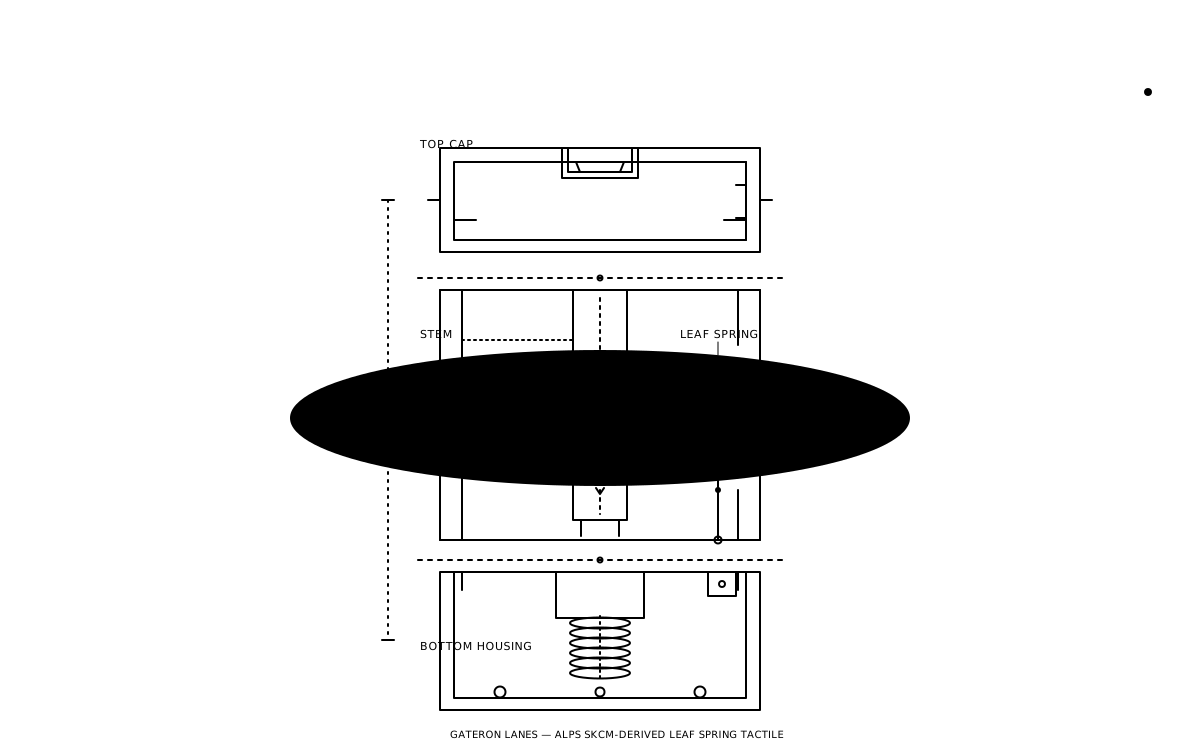
A switch earns its heritage claim or it does not. Calling something "Alps-inspired" in 2026 is marketing phrasing until the mechanism is on the bench and the tactile event either delivers or deflates. The Gateron Lanes arrived in mid-June with that claim front and center — and the reaction on KeebTalk and Reddit suggests the mechanism holds up under scrutiny.
What Alps SKCM Orange was
Before the Lanes make sense, the SKCM Orange does.
Alps produced its SKCM-series switches through the 1980s and early 1990s in keyboards that aged out of mainstream use but never aged out of enthusiast reverence. The Orange variant — "SKCM" is the Alps housing-series designation, "Orange" refers to the slider color — is the tactile member of that family: a self-contained mechanism that generates its bump not through a leaf that a stem leg crosses, as every MX-compatible switch does, but through a resonant slider body that physically interrupts its own travel path. The Alps tactile event is a snap, not a crossing. The slider compresses a small spring inside the housing, the spring releases, and the bump arrives as a discrete interruption that the finger feels as a clean, singular click-like event without acoustic click.
That mechanism produces a tactile character that MX-compatible switches have historically failed to replicate. The bump on an Alps SKCM Orange sits high on the travel, arrives quickly, and decays without drag — there is no bump-to-bottom-out blurring of the kind that makes a Boba U4T feel "long" or a Cherry MX Brown feel "imprecise." The bumps are also remarkably consistent across a board, because the mechanism is a property of the slider body rather than a tolerance-dependent crossing of a metal leaf. The SKCM Orange was never cheap and it was never common, and for roughly twenty years it was the tactile standard that every MX-format designer invoked without quite reaching. The SKCM family also produced click-jacket clicky variants that built a different constituency of typists; for that mechanism and its legacy, see why clicky switches still have a constituency.
How the Lanes draw from that heritage
Gateron is not shipping an Alps-socket switch. The Lanes is an MX-compatible 5-pin switch — fits any MX PCB, works in any MX-compatible board — so the fundamental mechanism is still a stem leg crossing a contact leaf. That constraint is real and it matters to the comparison. The Alps mechanism cannot be reproduced exactly inside an MX housing footprint.
What Gateron did instead is engineer the stem geometry to front-load the bump event in the way an Alps slider does. The Lanes stem carries a pronounced step on its leading legs — a sharper drop-off on the front face of the tactile element than the rounded shoulders that Boba U4T-style or Tecsee Sapphire-style stems carry. That step changes the profile of the leaf crossing: rather than a gradual build and gradual release (the D-shaped bump profile), the stem leg reaches the leaf, crosses it quickly, and releases with a snap-like immediacy. The bump arrives in a narrower window of travel, decays without a drag tail, and in the hand reads closer to the Alps "interruption" character than to the typical MX bump-and-return.
ThereminGoat's review — the community catalyst that drove the first wave of sell-outs — describes the event as "more tactile than it looks on a force curve," which is a precise observation: the Lanes does not have an especially tall bump on a force-displacement graph, but the sharpness of the step makes it register as more emphatic than the raw numbers would predict.
The Lanes also runs a relatively stiff spring — Gateron specs the switch at 55g actuation with a 62g bottom-out — which contributes to the perceived sharpness. A bump is more legible when the surrounding spring weight is enough that the stem doesn't coast through it.
Switch specs
The Lanes ships in a nylon bottom housing with a polycarbonate top, the same resin split that Gateron uses on the Gateron Oil King — for how that recipe shapes the linear acoustic character, see the Oil King deep-dive. The top housing provides clarity and a slight hardness to the upstroke; the nylon bottom handles the bottom-out, converting what would be a sharp impact into a lower, more contained register. The POM stem is a different geometry from the Oil King's linear stem — the tactile step on the leading legs is the load-bearing difference — but the material choice is consistent across Gateron's current flagship lineup.
Travel is 4.0mm full stroke, 2.0mm actuation. That's the standard MX-format spec, which puts the Lanes in the same travel class as the Durock T1, longer than the Drop Holy Panda X's 3.4mm, and longer still than the Gazzew Boba U4T's shortened 3.2mm long-pole stroke. The 5-pin PCB mount delivers the reduced wobble that became an expectation across the mid-tier since 2022.
Gateron ships the Lanes lightly factory-lubed — rail contacts only, with the bump face and the leaf contact left dry. The approach mirrors the asymmetric-lube discipline that made the Drop Holy Panda X the first factory-tactile that didn't arrive needing a corrective hand-lube pass: protect the smoothness without muting the event. Out of the bag, the bump is present at full sharpness.
Sound and feel profile
The acoustic signature that community reports consistently point to is a dry, mid-pitched snap followed by a quiet, contained bottom-out. The polycarbonate top housing contributes brightness to the upstroke; the snap of the tactile event is audible as a brief tick separate from the main bottom-out event. The nylon bottom contains the landing without muffling it. The overall character reads as "crisp" rather than "deep" — less of the thocky low-register presence of an Oil King, more of the rapid, articulated sound a builder reaches for in a polycarbonate-plate 65-percent.
Compared against the reference tactiles currently in wide circulation:
The Boba U4T delivers a D-shaped bump — pronounced, plateau-like, designed to be felt unambiguously on every keystroke at every typing speed. It is louder by default, heavier in hand, and more forgiving of typing angle, because the bump is long enough that the finger always catches part of it regardless of how squarely the key is pressed. The Lanes is sharper and lighter-feeling, which means it rewards a squarer press more but delivers less of the "hammering a bump" sensation that U4T partisans are after.
The Durock T1 sits between those two profiles — a sharp front edge to the bump, less plateau than the U4T, with a sound character that runs slightly brighter than the U4T in a polycarbonate build. The Lanes is in the T1's weight class but with a faster decay and a cleaner acoustic separation between the bump event and the bottom-out.
Neither comparison captures the Alps dimension exactly. The Lanes is doing something the T1 and the U4T are not: the bump arrives and is over before the bottom-out is a question. There is no ambiguous zone between the tactile event and the landing.
The community verdict
The Gateron Lanes entered thock's tracker in W24 — the week of June 9, 2026 — at 38, the same week ThereminGoat's review circulated widely on KeebTalk and Reddit. The initial sell-out cycles drove the urgency that W24's tracker note describes as "strongest new tactile story entering mid-June." That kind of review-driven demand spike is familiar terrain: a trusted reviewer calls a switch worth your attention, builders who were on the fence click through, and vendor stock runs dry inside a week.
The more interesting data is the W25 and W26 stability. Restocks landed across Prototypist, Bowl Keyboards, Delta Key Co, Keybay, and Pantheon Keys in the second week — a notably wide distribution for a switch only a few weeks into the market. The score moved one point, to 39, on restock news, then settled back to 38 in W26 as Prototypist carried units with three-day shipping and the initial urgency normalized. A switch that sells out and then holds at 38 after wide restocking is maintaining genuine demand rather than riding a single review spike. The Lanes are down slightly on the tracker heading into the third week of availability, consistent with a new switch finding its steady-state community appetite.
The ThereminGoat review resonated for two reasons visible in the community responses. First, the Alps comparison gave the switch a frame of reference that the hobby has been waiting to apply for years — "this is what Alps-inspired actually feels like" is a more compelling hook than a force-curve graph. Second, the review was honest about the limits of the comparison: the Lanes is not an Alps switch and doesn't pretend to be. That honesty gave the review credibility and the switch a fair landing in community discussion.
Who the Lanes are for
The Lanes reward builders who type in a controlled, even cadence rather than hunters-and-peckers who need a bump that catches the finger from any angle. The front-loaded event is sharper and more legible at full-speed typing than it is at slow deliberate key-by-key presses, which is the inverse of the U4T's behavior. A builder who has tried a U4T and found it "too much" — too heavy, too present, too deliberate — will likely find the Lanes more comfortable over a session.
Acoustically, the switch wants a brighter build context. A polycarbonate plate in an aluminum case, or a POM plate in a polycarbonate case, gives the snap the space to read without the build absorbing it; for the full acoustic stack that governs how those choices interact, see the physics of thock. Pair the Lanes with a dense foam-dampened steel-plate board and the tactile character gets swallowed; pair them with a thin polycarbonate tray and the snap arrives clearly on every keystroke. Gasket-mount boards in the 65-percent to 75-percent range are the natural home.
The switch is not for builders who specifically want the Boba U4T's "hammering a bump" feel or the Holy Panda's rounded, continuous arc. The Lanes is a precise, high-resolution tactile — satisfying to the finger that is looking for a defined event per key, less satisfying to the typist who wants the bump to be a constant presence through the stroke.
At current pricing — available through Prototypist, Bowl Keyboards, Delta Key Co, Keybay, and Pantheon Keys, with Prototypist carrying in-stock units shipping within three days as of W26 — the Lanes land in the mid-range switch tier, above the utility brackets but well below boutique territory.
Where the Lanes land on the tactile map
The tactile category entered 2026 with its conversation centered on two poles: the U4T as the heavy-hitter, the Holy Panda X as the refined rounded-bump reference. The Lanes add a third shape to that map — the sharp, front-loaded, Alps-adjacent event — and they do it without asking the builder to swap out their PCB or hunt for specialty sockets.
The Alps SKCM Orange will never be exactly reproducible inside an MX footprint. The mechanism is different enough that a 1:1 translation is not available. What the Lanes demonstrate is that the character — the clean, decisive snap that arrives and is over — can be approached through careful stem geometry, even within the MX-leaf format's constraints. The community response, the restock pattern, and the tracker arc across W24 through W26 all read as a switch that earned its comparison rather than one that borrowed a name for marketing purposes.
What to watch: whether Gateron ships a spring-weight variant of the Lanes at 62g/70g for builders who want the same bump geometry with a heavier landing, and whether the restocking cadence across the five current vendors holds as the initial review momentum fully normalizes. A switch at 38 on the tracker after two weeks of wide availability is a switch the market is accepting at its baseline price and supplying at a sustainable rate. The Lanes look like they have a long shelf life.
Keep reading
- Deep Dives
What a TMR sensor is actually measuring under a magnetic switch
Keychron's Q16 HE 8K and Cherry's XTRFY TMR boards get covered as a new switch generation. The real change sits a few millimeters below the magnet — a tunnel junction reading field strength through resistance instead of voltage, with a noise floor low enough to matter at the shallow end of the stroke.
thock11 min read - Deep Dives
Gateron Magnetic Jade: the Hall-effect linear built to be argued about like a mechanical one
Pull a Magnetic Jade apart and the parts list reads like a mid-tier mechanical linear: polycarbonate top, nylon bottom, POM stem, factory lube. Where the leaf would be, there is a magnet. That one substitution explains the feel, the sound, and why it will not fit half the Hall-effect boards on the market.
thock11 min read - Deep Dives
The Boba Family: One Housing Blend, Five Switches, and the Sound thock Is Named For
Gazzew designs, Outemu molds, and a plastic softer than nylon does the rest. Every Boba is the same chamber with something deliberately left out — and the pattern of subtractions is the whole family tree.
thock10 min read - Deep Dives
How buckling-spring switches actually work
thock has already reached for the buckling-spring snap twice — once to describe a Topre dome, once to describe a click-bar's sharpness — without ever explaining what a buckling spring actually is. The mechanism predates both, and it is stranger and more mechanically honest than either.
thock10 min read