How Topre's electrocapacitive switches actually work
Topre is not just another switch — it is a third sensing lineage, parallel to the MX-style contact switches and the Hall-effect newcomers. Understanding why HHKB and Realforce typists pay what they pay starts with the fact that a Topre keypress does not close a circuit at all.
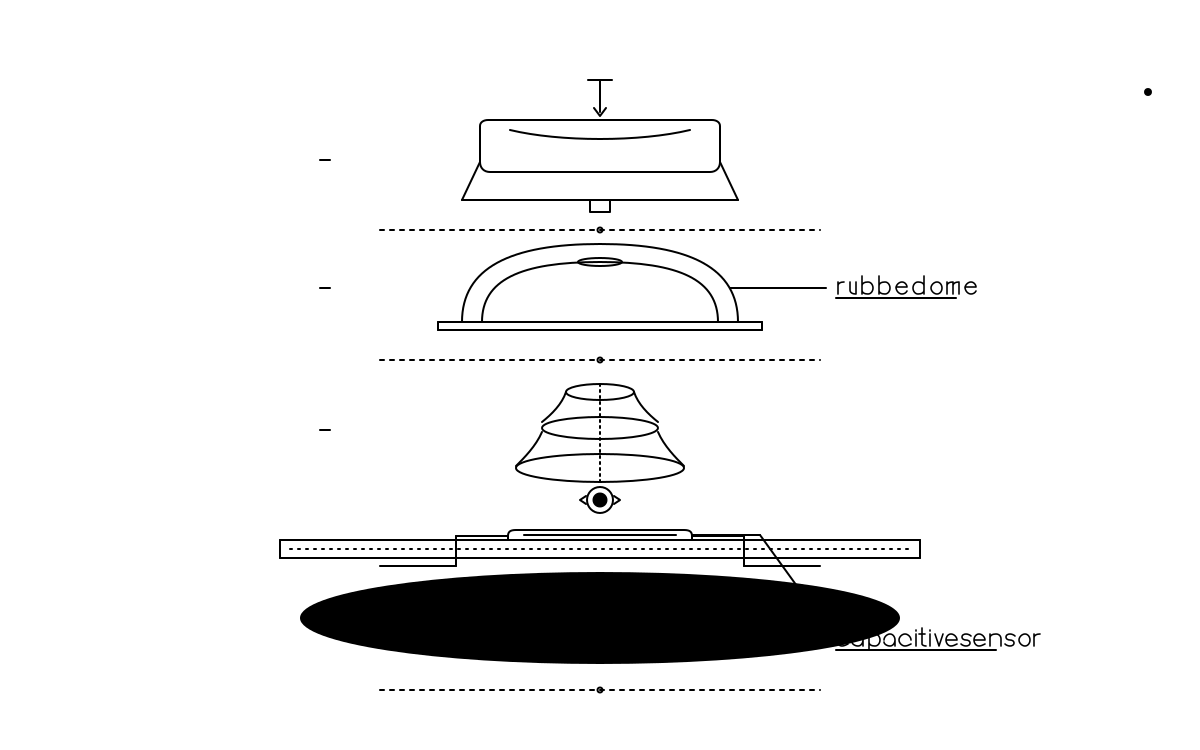
The Topre switch does not actually close a circuit. That is the load-bearing fact, and almost every editorial confusion about why HHKB and Realforce boards command the prices they do unwinds from it. A keypress on a Cherry-lineage switch is a binary electrical event — two pieces of metal touch, the controller sees the new contact, a key registers. A keypress on a Topre is an analog measurement. A capacitive pad on the PCB watches the dielectric environment above it change as a small conical spring compresses against it, and somewhere along the compression curve the firmware decides the change is large enough to call that key pressed. There is no make. There is no break. There is a number that crossed a threshold.
That distinction has consequences in every part of the build, from the feel under the finger to the price on the spec sheet to the shape of the modding scene that grew up around the architecture. It is also why Topre has not been displaced by the wave of Hall-effect and analog switches the rest of the field has converged on in the last three years. Capacitive sensing is its own third lineage, and the niche it occupies is not interchangeable with any of the others.
The architecture, precisely
A Topre key position has four parts stacked vertically. At the bottom is the PCB, with a printed circular trace at every key position that functions as one plate of a capacitor. Sitting on the PCB at each position is a small conical spring — wound tighter at the bottom than at the top, which gives it its progressive force curve — and the bottom turn of the spring is in contact with the trace. Above the spring is a rubber dome, moulded into a sheet that covers the entire board; the dome collars over the spring and holds it upright. Above the dome is a plastic slider that engages a standard MX-compatible stem on the keycap side.
When the user presses the keycap, the slider pushes the top of the rubber dome down. The dome resists, then collapses — the tactile event most Topre users describe as a "snap" near the top of the travel. With the dome collapsed, the slider is now pressing directly on the conical spring, which begins to compress against the PCB. As the spring compresses, the geometry of the wire coils sitting over the capacitive pad changes — more turns of wire are pressed closer to the pad, the local dielectric environment shifts, and the capacitance reading at that pad changes measurably. The controller scans every pad several hundred times a second, watches each reading, and reports an actuation when a reading crosses the per-board threshold.
The rubber dome is the part of this stack the casual reader gets wrong most often, because rubber domes are also what cheap membrane keyboards use, and the membrane-keyboard reputation drags the perception of Topre down with it. The two architectures share a part name and almost nothing else. A membrane keyboard's dome is the sensor — it carries a conductive pill on its underside that completes a circuit when the dome collapses. A Topre dome is not the sensor. It is a mechanical element: it holds the spring straight, it provides the tactile event, and it damps the bottom-out. The sensing happens below it, in the spring-and-pad capacitive geometry. Calling Topre a "rubber dome keyboard" is technically accurate and editorially misleading in roughly equal measure.
Why the feel survives
The tactile event on a Topre sits earlier in the travel than on most MX tactiles. The dome collapses near the top of the press, well before the spring has compressed enough to actuate, and the collapse itself is sharper than the bump on a Boba U4T or a Holy Panda derivative — it is closer in character to a buckling-spring snap than to a rounded MX tactile bump. After the dome collapses, the remaining travel is essentially linear, governed by the conical spring's progressive force curve. That curve gets stiffer as the spring compresses, so the bottom-out is met by an increasing resistance rather than a wall.
The bottom-out itself is then damped by the rubber dome, which has flattened against the housing and absorbs the strike. The result is a muted, thick acoustic event — the sound HHKB and Realforce reviewers reach for adjectives like "thock" and "thunk" to describe, but which is genuinely distinct from the deep bottom-out a modern MX gasket build produces. The Topre bottom-out has more low-frequency content and a faster decay; the MX gasket build has a longer ring and more midrange. They are different sounds with different physics behind them, and a typist who has lived with both can usually identify which is which from one keystroke played back through a phone speaker.
The architecture also means the press and release feel asymmetric in a way most MX switches do not. The dome collapse on the downstroke is a single sharp event; the return on the upstroke is the dome re-inflating against the spring, which is smoother and slower than the snap. That asymmetry is part of what typists who switch from MX to Topre describe as the first-day strangeness, and it is also part of why long-time Topre users find MX boards feel undifferentiated in the other direction. There are two acoustic events on a Topre press and only one of them is sharp; an MX press has one acoustic event at bottom-out and the tactile bump, where it exists, is felt and not heard.
Weighting and the variant landscape
The canonical Topre weight is 45g, which is the dome force across most of the HHKB Pro lineup including the Hybrid Type-S. Realforce ships a 55g uniform variant on its premium boards and a variable-weight option — 30g at the pinky positions, 45g in the middle of the board, 55g under the index fingers — that is the most-cited Topre weighting for long typing sessions. The Realforce R3 and the more recent Realforce GX1, released in late 2025, both offer the variable-weight configuration as well as uniform options.
The numbers are not directly comparable to MX spring weights. An MX switch's "45g actuation" refers to the force required to push the stem to the actuation point, which sits part-way down a spring with an approximately linear force curve. Topre's 45g is the dome force — the peak force required to collapse the dome at the top of the press — and the spring underneath has a progressive curve, so the force at the actuation point is different from the force at bottom-out and different again from the dome-collapse peak. A 45g Topre and a 45g MX linear feel substantially different at every point in the press, and the spec sheet does not flag the distinction. Most first-time Topre buyers describe a 45g HHKB as feeling heavier than a 45g MX linear in the dome-collapse region and lighter in the bottom-out region; both perceptions are correct.
The closed-standard problem
Topre has no socket. The slider geometry, the dome sheet, the spring dimensions, and the capacitive PCB are all proprietary and have stayed essentially unchanged since the early 2000s. There is no equivalent to the MX-compatible footprint that allows a builder to drop Kailh, Gateron, and Cherry switches into the same PCB; there is no equivalent to the Holy Panda lineage where a stem from one manufacturer's switch lives inside another manufacturer's housing. A Topre board is a Topre board, end to end.
The modding scene that grew up around this constraint is narrow and well-defined. Dome swaps are the main lever: BKE Redux domes and the various Hasu-supplied alternatives change the dome-collapse force and the tactile sharpness without touching the spring or the PCB, and they are the closest thing Topre has to a switch swap. Silencing rings — small O-rings that sit between the slider and the housing — are the other common modification, and they damp the bottom-out further without altering the actuation. Spring swaps exist but are rare; they require disassembly past the dome sheet, which on a Type-S board is glued in place.
What does not exist is the deep ecosystem an MX modder takes for granted. There are no Topre films — the housing geometry has no place to put one, and the switch-films analysis on the trade-off between housing tightness and acoustic character has no analogue on a Topre stack where the dome sheet seats the spring directly against the PCB. There are no aftermarket housings. There are no premium stems. The closed-standard nature of the architecture is the reason the feel does not drift across modders — a stock HHKB Hybrid Type-S sounds and feels essentially the same as the one the next typist owns — and the reason an enthusiast who likes spending a Saturday tuning a build will find Topre frustrating. The two facts are the same fact.
The premium-price math
A Hybrid Type-S sits around $340 in 2026. A Realforce R3 lands between $260 and $330 depending on layout and weighting; the GX1 prices in the same band. Set against a fully built MX custom — boutique case, premium switches, doubleshot keycaps, all in — at $400 and up, those Topre numbers are competitive. Set against a Keychron at $90 or a budget-tier MX prebuilt, they are not. The comparison most people reach for when they ask whether Topre is "worth it" is the Keychron comparison, and the answer that comparison drives is that the architecture itself is what the buyer is paying for.
A premium MX build's price is mostly parts: machined aluminium, doubleshot PBT, a small-batch switch run, a gasket-mount internal stack. The Topre board's price is mostly the architecture — the capacitive PCB, the dome-sheet manufacturing, the closed-system economics of a market that does not allow third-party undercutting. The buyer who picks Topre over a comparably priced MX custom is not buying better materials; they are buying a different sensing physics. Whether that trade is worth several hundred dollars depends entirely on whether the feel under the finger is sufficiently distinct to matter, and the people who answer yes have stayed in the niche for two decades.
Where Topre fits in 2026
The non-MX category has expanded considerably in the last three years. Hall-effect switches have moved into the mid-premium default at the prebuilt level, analog progressive-actuation switches have shown up in gaming-adjacent boards, and even the boutique custom scene has begun to ship Hall-effect-compatible PCBs alongside the MX ones. None of those movements has displaced Topre. The architectures do not occupy the same space.
Hall-effect is magnetic — a Hall sensor on the PCB reads the field of a small magnet in the switch stem as the stem moves. Analog progressive switches generalise that idea: actuation point becomes a software setting, rapid-trigger becomes a feature, the press is a continuous signal. Optical switches interrupt a light beam — no metal contacts, no contact bounce — and occupy the same non-contact lineage without the analog output ceiling that Hall-effect provides. Topre is capacitive — no magnet, no sliding leaf, just a spring deforming over a pad. The press is also a continuous signal in principle, but Topre boards have historically thresholded it to a binary actuation rather than exposing the curve, which means the user-facing feature set is closer to MX than to Hall-effect even though the underlying physics is closer to analog.
The constituency reflects the architecture's stability. HHKB Hybrid Type-S remains the keyboard journalists and writers reach for as a reference, in part because the layout has not moved since the early 2000s and in part because the feel does not. Realforce's late-2025 GX1 release showed Topre's continued investment in the premium tier — the GX1 is not a redesign of the architecture, it is a new chassis around the same sensing stack. Neither of those facts reads as "winning." They read as "still here," which is what a third architecture that survives without an obvious comparator does. The MX market is contested every quarter. The Hall-effect market is in active expansion. The Topre market is the same size it was three years ago, made up mostly of the same people, and the manufacturers seem comfortable with that.
The buyer who picks up an HHKB in 2026 is not buying into a trend. They are buying into a sensing architecture that has been quietly sitting alongside MX for the entire run of the modern hobby, occupying a niche the rest of the field has never quite reached. The thing to watch is not whether Topre grows. It is whether the next generation of capacitive boards exposes the analog curve the way Hall-effect has — whether the architecture's continuous-signal nature finally gets a firmware to match. If it does, the niche may widen. If it does not, the niche will stay exactly where it has been, and that has not been a problem for anyone shipping into it.
Build sheet
Keep reading
- Deep Dives
What a TMR sensor is actually measuring under a magnetic switch
Keychron's Q16 HE 8K and Cherry's XTRFY TMR boards get covered as a new switch generation. The real change sits a few millimeters below the magnet — a tunnel junction reading field strength through resistance instead of voltage, with a noise floor low enough to matter at the shallow end of the stroke.
thock11 min read - Deep Dives
PCB flex cuts, explained: a flex budget milled straight into the board
No plate change, no gasket, no case redesign — just a slot routed through the fiberglass near a switch hole. Flex cuts are the cheapest lever a designer has for adding give to a board that otherwise has none, and the cheapness is exactly why they show up where they do.
thock10 min read - Deep Dives
Rapid trigger is a firmware algorithm, not a switch spec
A rapid-trigger switch is not a special switch. It is an ordinary analog sensor wired to a polling loop that redraws its own actuation point every cycle — and that loop, not the sensor, is where the real engineering happens.
thock9 min read - Deep Dives
Gateron Magnetic Jade: the Hall-effect linear built to be argued about like a mechanical one
Pull a Magnetic Jade apart and the parts list reads like a mid-tier mechanical linear: polycarbonate top, nylon bottom, POM stem, factory lube. Where the leaf would be, there is a magnet. That one substitution explains the feel, the sound, and why it will not fit half the Hall-effect boards on the market.
thock11 min read