How Hall-effect switches actually sense a keypress
A Hall-effect switch is not a faster MX switch. It is a different sensing lineage — a magnet in the stem, a sensor on the PCB, and an analog voltage where contact closure used to be. The features the marketing pages lead with all unwind from that one architectural fact.
A magnetic keyboard switch does not close a circuit. That is the architectural fact the rest of the category unwinds from, and it is the same shape of fact as the one that opens the Topre piece — a sensing lineage defined by what it measures rather than by what it touches. An MX-lineage switch is a binary electrical event: two metal leaves meet, the controller sees the new contact, the key registers. A Hall-effect switch is an analog measurement: a small magnet rides the stem down past a Hall sensor on the PCB, the sensor reports a voltage that tracks the magnet's distance, and somewhere along that voltage curve the firmware decides the key is pressed. There is no make. There is no break. There is a continuous signal that crosses a threshold the firmware owns.
"Magnetic switch" is not a marketing tier or a performance bracket. It is a description of how the PCB knows a key moved. The features that sell the category — rapid trigger, per-key actuation depth, analog throw to games that accept HID-formatted joystick axes — are all consequences of having an analog signal to work with rather than a binary one. They are not consequences of magnets being faster, or of the switch feel being different. The feel can be tuned to anything the spring and housing geometry allow. The sensing architecture is the load-bearing change.
How the Hall-effect sensor reads the press
The physics is older than the keyboard hobby by a wide margin. A Hall-effect sensor is a small semiconductor element that produces a voltage across one axis when current flows along the other and a magnetic field passes through it. The output voltage is proportional to the field strength at the sensor — in practical keyboard terms, in the millivolt range — and the relationship is close enough to linear within the operating window that firmware can treat the voltage as a direct readout of how strong the field is at that moment.
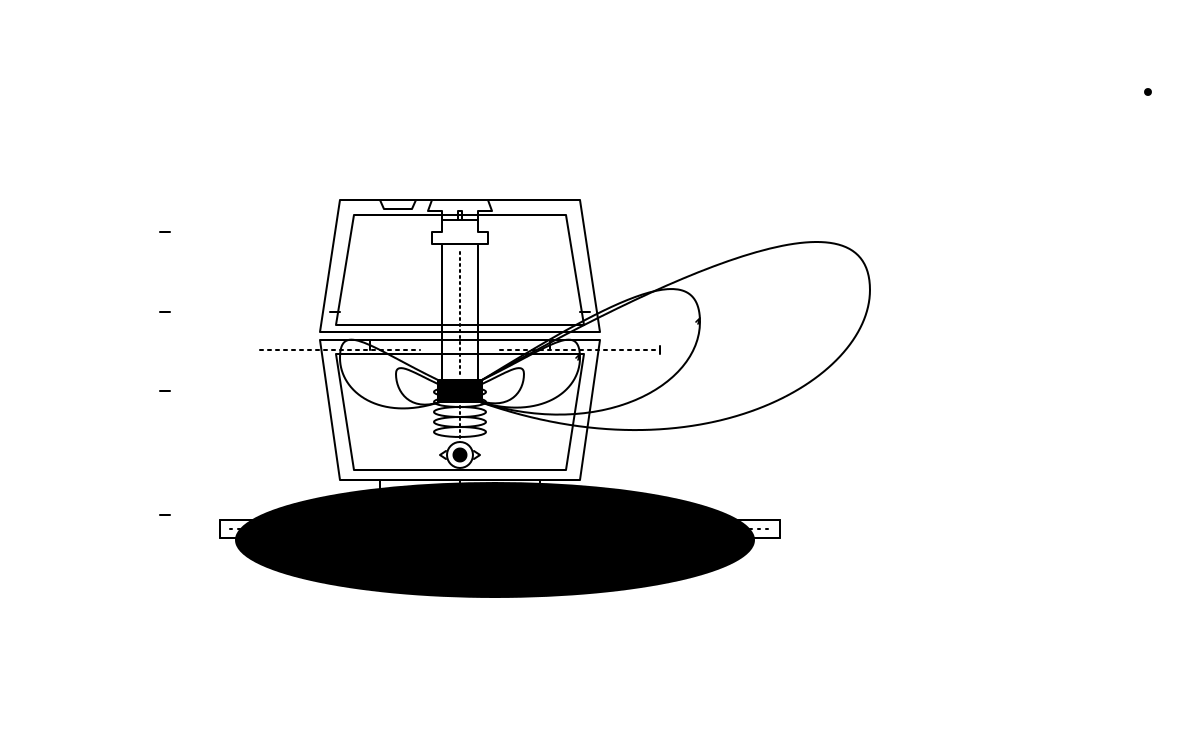
A Hall-effect keyboard switch puts a small permanent magnet in the bottom of the stem and a Hall sensor on the PCB directly underneath. At rest, the magnet sits at the top of the switch travel, the field at the sensor is weak, and the voltage is low. As the user presses the keycap, the stem descends, the magnet approaches the sensor, the field at the sensor strengthens, and the output voltage rises. The microcontroller samples that voltage hundreds of times a second on every key position, compares the reading against a configured threshold, and emits an actuation when the reading crosses it. On the release stroke the magnet retreats, the field weakens, the voltage falls, and a second threshold — usually lower than the actuation threshold, to give the press some hysteresis — triggers the release event.
The geometry has consequences a builder gets quickly used to and a reviewer often understates. The voltage curve is steeper near the bottom of the press than near the top, because magnetic field strength falls off rapidly with distance. That means actuation set deep in the travel is more precisely positioned than actuation set shallow — the sensor can distinguish 2.9mm from 3.0mm more reliably than it can distinguish 0.4mm from 0.5mm. The marketing copy that promises 0.1mm actuation resolution is technically true and practically optimistic at the shallow end of the travel; it is more like 0.1mm resolution near bottom-out and noticeably coarser near the top.
What linear output unlocks that contact closure can't
The single design decision that defines the user-facing feature set is whether the controller exposes the analog curve to the host or thresholds it locally to a keypress event. MX-lineage switches never had a choice — contact closure is binary at the switch, and the controller never sees a curve to expose. Hall-effect switches have a continuous voltage available at every poll, and a firmware that wants to use it can.
The most-cited consequence is per-key actuation depth. Because the actuation threshold is a number in firmware rather than a fixed geometric feature of the switch, a user can set it to anything within the operating window. A WASD cluster configured to actuate at 0.5mm for first-shot speed and a function row configured to actuate at 2.5mm to avoid stray brushes is a configuration a magnetic-switch board can express directly. The keys sit on the same board, made of the same parts, with the same spring weight. Only the firmware threshold is different. The same lever explains rapid trigger and SOCD reset behavior: because the firmware can watch the curve fall on the release stroke, it can decide a key has "released" as soon as the voltage drops by a configured amount, without waiting for the stem to rise back through some fixed point. The lag between physical lift and registered release shrinks from millimeters of travel to whatever delta the firmware is configured to read.
The third consequence — analog throw to games — is less talked-about and architecturally cleaner. A Hall-effect keyboard can map a key's voltage curve directly to an analog axis on a USB HID gamepad descriptor, so the host sees the keypress not as a button event but as a joystick deflection. A racing game that accepts gamepad input can read the W key as a continuous throttle, the A and D keys as a continuous steering axis. Wooting's boards are the reference implementation of that mapping; the Keychron Q1 HE, the Drop CSTM80 HE, and the various Razer V3 Pro variants offer similar functionality with varying configurator depth. None of those features are available on an MX-lineage board at any price, because the sensor at the bottom of the stack never produced a curve to begin with.
The tradeoffs the marketing pages don't lead with
The honest read on Hall-effect needs the other column of the ledger, and it is longer than the configurator pages suggest.
The first item is calibration drift. A Hall sensor's reading depends on the absolute distance between the magnet and the sensor element. That distance is set by the switch housing geometry, the PCB seating, and the long-term mechanical settling of the stem and the magnet within the switch. Over months of use, the rest position can shift by tens of microns, the voltage at rest drifts, and the actuation threshold the firmware was calibrated against no longer corresponds to the same physical depth. Magnetic-switch boards address this with periodic recalibration routines — sometimes automatic, sometimes triggered by a key combination — that re-zero the rest voltage at every key position. The recalibration is fast and most users never notice it. The fact that it is necessary is what an MX builder is not used to thinking about.
The second item is inter-switch magnetic interference. Every magnet in every stem produces a field that does not stop at the boundary of its own switch housing. On a sparse layout — a TKL or full-size with normal key spacing — the field from one key's magnet at the position of its neighbor's sensor is small enough that the firmware's per-key calibration absorbs it cleanly. On dense layouts — 40% boards, macropad clusters, custom layouts with adjacent keys on tight pitch — the cross-talk gets larger, and a strongly pressed key can shift its neighbor's resting voltage by a measurable fraction of an actuation. Boards that sell into the dense-layout market either ship with shielding between switch positions or calibrate the firmware to look at relative changes rather than absolute thresholds. Both work; neither is free.
The third item is factory tolerance on the magnet. The magnet is a small permanent element pressed or moulded into the stem during switch assembly, and its position relative to the stem's bottom surface is set by manufacturing fixtures with finite precision. A 0.1mm shift in the magnet's seating across the field of a single board shows up as a 0.1mm shift in the effective actuation depth of the affected keys — the firmware can compensate with per-key calibration, but the compensation is bounded by what the sensor can resolve at that depth, and the variance is visible to a user who plays games that depend on identical key behavior across the WASD cluster. Magnetic-switch makers that sell into the competitive-gaming tier publish tighter tolerance specs than the ones that sell into the typing tier, and the price difference reflects the manufacturing-yield difference.
The fourth item is firmware complexity. A magnetic-switch board is doing more work per key than an MX-lineage board — sampling an analog voltage, comparing against per-key thresholds, running release hysteresis, optionally streaming the curve to the host as a HID axis. The state per key is larger, the memory footprint is larger, and the surface area for firmware bugs is correspondingly larger. Early shipments in the category have had a higher rate of edge-case reports — sticky keys after rapid trigger configuration, calibration routines that fail on specific key positions, host-side configurator software that loses state on disconnect — than equivalent MX-lineage launches at comparable price points. The category is maturing; the historical reliability gap is closing; the gap has not yet closed.
Where Hall-effect sits in the four-lineage taxonomy
The current generation of keyboards sits across four sensing lineages, and each one makes a different set of tradeoffs visible to the buyer.
MX contact-closure is the default and has been for forty years: a metal leaf bent by a stem, a contact closing, a binary keypress event. The architecture is cheap to manufacture, the feel space is vast — the switch field is dominated by tactile and linear variants tuned to a degree that no other lineage approaches — and the firmware is simple. The ceiling is that the press itself is binary, and every feature the category gets at the firmware layer has to be built out of binary events. The clicky corner of the MX family — click-jacket and click-bar mechanisms with their own acoustic goals — sits within the same contact-closure architecture but serves a distinct constituency; that story is covered in why clicky switches still have a constituency.
Topre electrocapacitive — covered in the Topre piece — reads spring compression as a change in capacitance over a printed pad. The press is analog at the sensor in principle, but Topre boards have historically thresholded the reading to a binary actuation rather than exposing the curve, so the user-facing feature set looks more like MX than like Hall-effect. The architecture commands a price premium because the feel is genuinely distinct and the closed-standard manufacturing keeps the field narrow.
Hall-effect magnetic is the analog-output lineage covered in this piece: a magnet on the stem, a Hall sensor on the PCB, a continuous voltage available to the firmware. The feature ceiling is the highest of the four — per-key actuation, rapid trigger, HID analog axes — and the cost is firmware complexity, calibration drift, and the tolerance discipline the manufacturing chain needs to hold.
Optical light-gate is the fourth lineage and the one that gets confused with magnetic most often. A beam of light from an LED on one side of the switch is interrupted by a blade or slot on the stem as it descends; a photodetector on the other side registers the break. Most optical implementations have been binary, which puts the user-facing feature set on the MX side of the family even though the sensor is non-contact. Implementations that expose the partial-occlusion curve as an analog signal exist but are rare, and the optical category has not converged on the analog feature set the Hall-effect category has built around.
The mid-premium volume the category measures itself by has moved into Hall-effect over the last two years — the Hall-effect market piece covers the trajectory of that move — and the structural reason is that magnetic was the only lineage with the architecture to close the analog-output gap MX never had. Topre had the analog signal and did not expose it; optical exposed it only in rare implementations; MX never had it. Magnetic shipped the firmware that did, and the prebuilt tier with $100–$230 price points was the slot the feature set fit into.
What this means if a builder is switch-shopping
The decision framework is short. If the spec sheet lists rapid trigger, per-key actuation depth, or analog output to USB HID, the board is Hall-effect and the features are doing real work. If those features matter to the buyer — competitive shooters, driving simulators, layouts that need to express different actuation depths on different fingers — the magnetic lineage is the only one that delivers them, and the cost premium is paying for the architecture, not just for marketing.
If those features do not matter — if the build is a typing board, a writing setup, an office keyboard, a boutique custom valued for sound character and bottom-out feel — contact-closure switches remain the right answer at lower cost. The MX field is mature in every dimension Hall-effect is still building out: tuning depth, factory consistency, modding ecosystem, firmware reliability. The current generation of tactile engineering in that mature field — exemplified by the Alps-inspired Gateron Lanes with its front-loaded snap geometry — illustrates how much feel-space remains unexplored in contact-closure design alone. The thing magnetic does that MX cannot is expose the curve. The thing MX does that magnetic is still working on is everything else.
The story to watch is whether the next generation of magnetic switches narrows the feel gap with the boutique linear bench, or whether the two lineages settle into the two-tier configurator partition the prebuilt category is already moving toward — Hall-effect on the performance side, MX on the feel side, the buyer picking which axis the build is optimised against. The architectures are different enough that the partition is structurally honest. The buyer who knows which side they are on saves money on the side they are not.
Build sheet
Keep reading
- Deep Dives
What a TMR sensor is actually measuring under a magnetic switch
Keychron's Q16 HE 8K and Cherry's XTRFY TMR boards get covered as a new switch generation. The real change sits a few millimeters below the magnet — a tunnel junction reading field strength through resistance instead of voltage, with a noise floor low enough to matter at the shallow end of the stroke.
thock11 min read - Deep Dives
Gateron Magnetic Jade: the Hall-effect linear built to be argued about like a mechanical one
Pull a Magnetic Jade apart and the parts list reads like a mid-tier mechanical linear: polycarbonate top, nylon bottom, POM stem, factory lube. Where the leaf would be, there is a magnet. That one substitution explains the feel, the sound, and why it will not fit half the Hall-effect boards on the market.
thock11 min read - Deep Dives
Rapid trigger is a firmware algorithm, not a switch spec
A rapid-trigger switch is not a special switch. It is an ordinary analog sensor wired to a polling loop that redraws its own actuation point every cycle — and that loop, not the sensor, is where the real engineering happens.
thock9 min read - Deep Dives
Gateron Lanes: The Alps-Inspired Tactile Taking Over the Mid-Range
Gateron's Lanes draws its DNA from the Alps SKCM Orange — one of the most loved tactile mechanisms of the 1980s — and arrived in June 2026 with enough community conviction to sell out on first drop.
thock12 min read