Hall-effect stopped climbing. That's not the same as cooling off.
The Hall Effect/Rapid Trigger category has held flat at 97 on thock's trends tracker for two straight weeks, after climbing from 82 in late June. A flat line at the top of the chart looks like fading interest if you're reading it as a stock ticker. Read as a market snapshot, it says something closer to the opposite.
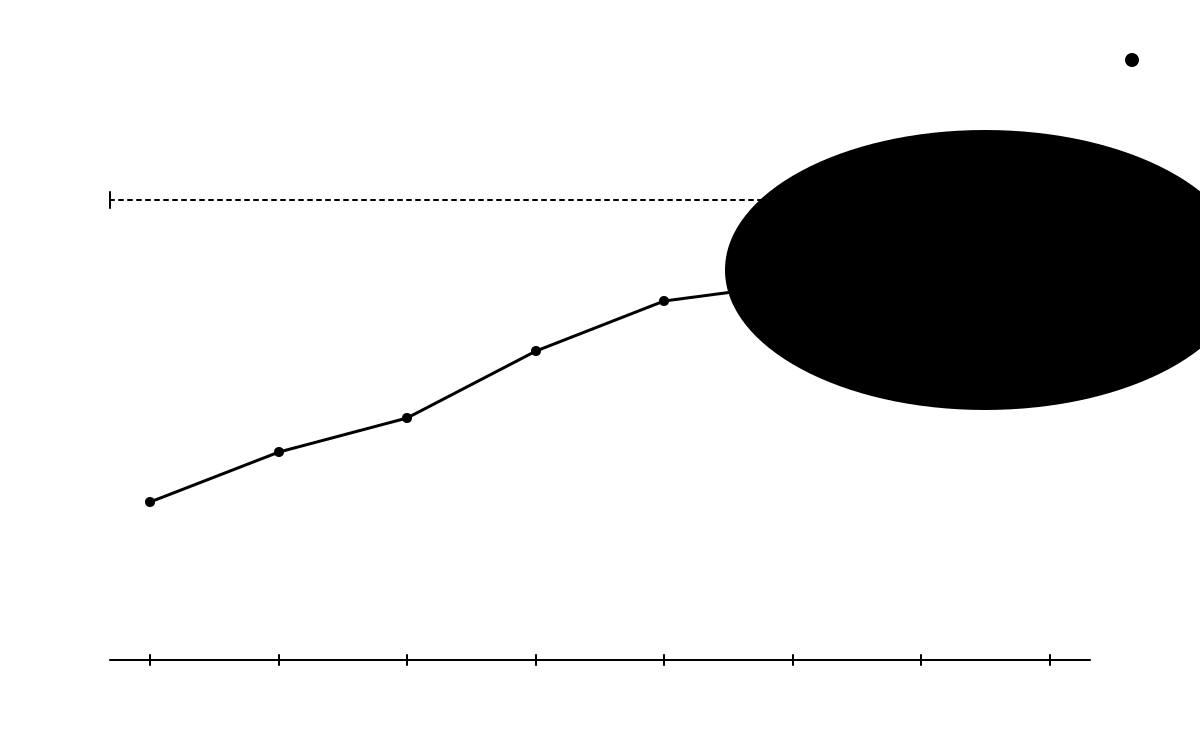
Eight weeks of tracker data tell a clean story up to a point: 82, 85, 87, 91, 94, 95, 97, 97. The Hall Effect/Rapid Trigger row climbed hard through July and then, in the last two weeks, stopped. Two flat readings at 97 look, on a chart, exactly like the top of a bell curve about to tip over. They're not. They're the top of a market that's finished converting.
The signal: flat at the ceiling isn't the same as flat in a trough
A tracker score is a proxy for how much of the week's coverage, launches, and buyer attention orbit a category relative to everything else being tracked. When that number is climbing from the 80s toward the high 90s, it's measuring a category converting skeptics — every week, some slice of the audience that hadn't already priced in Hall-effect switches encounters a new reason to. Per the 2026-W33 Trends Tracker, that conversion has run its course: the note for this week credits Keychron's V6 Ultra HE Kickstarter entering its third week near a funding plateau, alongside Gamakay's Q2 and XTRFY's MK Crystal TMR, for keeping magnetic switches "the dominant switch story." None of those are signs of a category losing the room. They're three different vendors, at three different price tiers, all still actively shipping into it.
What "flat" means at different altitudes
The tracker logs several rows as directionally flat this week, and they are not telling the same story. Sitting them next to each other is more informative than reading any one of them alone.
Hall Effect/Rapid Trigger is flat at 97 after climbing 15 points in seven weeks — a category that arrived and stayed. The Gateron Oil King is flat at 40, and has held in a tight 37-to-40 band for eight straight weeks, because — per the tracker's own note — the lineup and stock at Gateron, KBDfans, and Divinikey haven't changed since an early-2026 expansion. That's a genuinely quiet week for a switch with nothing new to say. Cherry MX2A is flat at -46, having spent the same eight weeks oscillating in a band between -36 and -50 while, per the tracker note, "Cherry's own XTRFY TMR push continues to pull spec-sheet attention away from MX2A." That's a switch line still shipping as the default across mainstream boards, but losing the attention argument every week to its own sibling's magnetic pivot — a dynamic thock covered in detail when the XTRFY TMR pivot first moved the Cherry brand line. A flat score at 97, a flat score at 40, and a flat score at -46 are three different kinds of stillness. Only one of them is a category that just finished winning.
The next axis wasn't going to be actuation forever
The reason adjustable actuation stopped being a differentiator is the same reason it became one in the first place: it was easy to copy once the supply chain matured. thock's coverage of Hall-effect's move into the mid-premium tier tracked that maturation directly — a vendor that wants an HE variant in 2026 doesn't need to design a sensor PCB from scratch, and the gaming-crossover piece showed a gaming-mainstream board and a boutique-adjacent enthusiast board converging on identical sensor specs from opposite starting points. Once every major vendor ships some version of a digitally adjustable actuation point, "our switch is adjustable" stops being a pitch. It's a checkbox.
Three axes are visibly filling the gap. The first is sensor precision itself: tunneling magnetoresistance, the sensing method behind XTRFY's MK Crystal TMR, reads the stem magnet's field through a different physical effect than a standard Hall sensor, and Cherry has been routing its own magnetic bet through that architecture rather than the Hall-effect approach the rest of the field standardized on. The second is housing material and switch feel — the axis magnetic switches were weakest on when the category was new. The Gateron Magnetic Jade is a useful example of the shift: a rare-earth magnet sits in the stem in place of a leaf spring, the actuation point adjusts digitally in supporting boards, and the switch is built and marketed on the same PC-top, nylon-bottom feel vocabulary the mechanical linear bench already argues in, down to a jade colorway that deliberately echoes the Kailh Box Jade. That's a magnetic switch competing on bottom-out character and smoothness, not just on whether the actuation point moves. The third axis is software — per-key curve tuning, the depth of the configurator behind the sensor. Whether that tooling stays behind proprietary stacks or lands in open firmware is the same open question raised when Hall-effect first crossed into gaming boards, and it still hasn't been answered.
What to watch
Two things would tell whether the plateau is a resting point or the actual ceiling. The first is whether the Cherry brand line — which the tracker put at -2 this week, up from deeply negative readings earlier in the summer, on the strength of the same TMR story — keeps closing the gap toward positive territory as sensor precision becomes a marketed feature rather than an engineering footnote. The second is whether Keychron's V6 Ultra HE Kickstarter, sitting near its own funding plateau in week three, converts into a shipped product distinctive enough on feel or software to give the tracker something new to climb on — the board's Nova Socket hybrid design, which lets mechanical and TMR switches share one footprint, is exactly the kind of distinctiveness that question is asking about. A category that's already table stakes doesn't need a new entrant to survive. It needs one to be interesting again.
Keep reading
- Trends
TMR is closing the gap on Hall-effect. It hasn't caught it.
TMR switches have climbed every week on thock's trend tracker from W38 through W42 — 55, 63, 71, 85, 90. That's the second-highest score on this week's board, and the gap behind Hall-effect's ceiling has gone from 42 points to 10 in five readings.
thock6 min read - Trends
How Hall-effect quietly became the new mid-premium default
The polling-rate hype is loud and easy to wave off — 8K, 32K, numbers chasing each other up the spec sheet. The quieter story is that the magnetic-switch tier has stopped being a Wooting-shaped niche and has settled into the $100–$230 prebuilt slot the scene actually buys from. The volume has moved, not just the marketing.
thock7 min read - Trends
Hardware caught up to Wooting. Firmware hasn't.
Wooting's 80HE+ preorder is the top mover on thock's 2026-W39 trends tracker, climbing from a score of 40 to 80 over eight weeks. The switch hardware behind it isn't the reason — Hall-effect sensing is table stakes across the category by September 2026. The firmware behind it still isn't matched.
thock6 min read - Trends
Nova Socket: Keychron's bet on not choosing a switch technology
A single hot-swap socket that accepts a standard mechanical switch or a TMR magnetic switch, decided per key, is a strange thing for a mainstream prebuilt brand to ship. It's also exactly the move Keychron has been building toward all year.
thock8 min read