Lubing switches: what to use, how much, and what to skip
Four lubes, four application points, and one rule that prevents most mistakes: over-lubing is irreversible, under-lubing is not. Here is the practical reference.
The board cost $200. The switches are stock. A vendor order arrives with a 10g pot of Krytox 205g0, a brush, and an instruction set assembled from four contradictory forum threads. One says to coat everything. One says to never touch the legs on a tactile. One says factory lube is fine and hand-lubing makes things worse. One links a YouTube video that takes forty minutes to explain twelve seconds of work.
The forum anxiety is real but the underlying decision is simple. Lube changes three things: it quiets plastic-on-plastic friction, it dampens spring resonance, and on tactiles, it can eliminate the very feature that made the switch worth buying. The skills that matter are knowing which lube goes where, understanding why tactile legs are different from everything else, and recognizing when the pot should stay closed.
The most important calibration before starting: over-lubing is the only irreversible mistake. Too little lube leaves a switch underperforming; it can be corrected at any time. Too much lube on tactile legs destroys the bump; the only fix is a solvent wash and a full restart. Err light. Always.
The four you actually need
The switch lube market has dozens of products, but builders converge on four workhorses for a reason. Each has a specific role.
Krytox 205g0 is the standard for linear switches. It is a thick, high-viscosity grease that coats stem rails and housing rails with enough body to stay in place across months of use. The viscosity that makes it ideal for linears is the same property that makes it wrong for tactiles — a full 205g0 application on a tactile stem leg flattens the bump into something that feels like a slightly sticky linear. On linears: stems, housing rails, and nothing else.
Tribosys 3203 is the conservative pick for light tactiles. It is meaningfully thinner than 205g0 — closer in behavior to a light oil-grease hybrid — and that lower viscosity preserves more of the tactile character when applied carefully to the stem legs. The tradeoff is that it provides less noise reduction than 205g0 and needs to be applied more precisely. If the goal is a tactile that feels smoother without losing its bump, 3203 on the legs at a barely-there application is the right starting point.
Tribosys 3204 sits between 3203 and 205g0. It is thicker than 3203 but more forgiving on light tactiles than 205g0. Builders who want slightly more coverage than 3203 gives without committing to the full 205g0 weight often land on 3204 as a middle option. It also works well on linears where 205g0 feels like it adds too much damping — polycarbonate-housed switches in particular can become over-dampened under 205g0, and 3204 gives a lighter result.
Dielectric grease belongs in this list because it shows up in the same vendor orders and causes confusion. It is not a switch lube. Dielectric grease is for stabilizer wires — the thick coat on the wire ends that eliminates rattle and reduces the metallic ping from the wire moving in the stabilizer housing. Applied to a switch stem or housing rail, it is far too thick and will mute the switch almost completely. Keep it in its own container and use it only at the stabilizer wire ends.
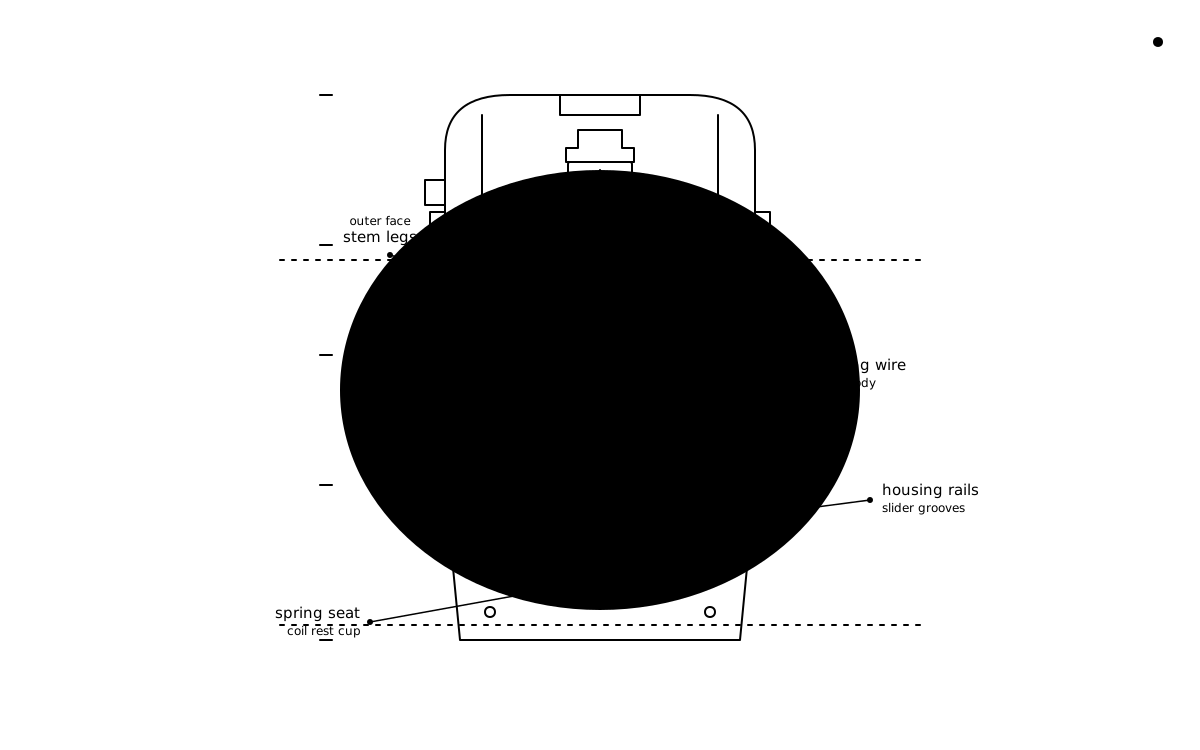
The application points across all four lubes map to four locations in the switch: the outside faces of the stem legs, the bottom housing rails where the stem skirt rides, the spring wire itself, and the spring's base contact. GPL 105 is the standard spring lube — thin enough to apply via bag-shake method, effective at eliminating spring ping, and light enough that it does not migrate to the electrical contacts. The contact leaves inside the lower housing are the one surface that must never receive any lube from any of the four products listed here.
What happens to tactiles
A tactile switch's bump is a physical interference. The two legs on the bottom of the stem catch on the leaf spring as the stem travels down; that catch creates the tactile event. The height, sharpness, and character of the bump all come from the geometry of that interaction — how abruptly the legs ramp over the leaf, how quickly the leaf snaps through.
Lube on the legs reduces the coefficient of friction at that interference point. A thin coat of 3203 softens the snap slightly, rounding the bump's leading edge without erasing it. A moderate coat of 3203 makes the bump feel noticeably lighter. Krytox 205g0 on the legs of most tactiles eliminates the bump almost entirely — the legs slide over the leaf without the characteristic catch, and what the finger registers is a slightly springy linear.
The rule that holds across tactile types: the stem legs get zero to barely-there application, and everything else follows linear protocol. The housing rails, the spring, the non-leg surfaces of the stem — all of those surfaces are the same as a linear. The legs are the single exception, and the decision on the legs is essentially binary: skip them entirely, or apply the thinnest possible coat of 3203 and test before proceeding.
The Gazzew Boba U4 is the clearest illustration of this split. The bump on the Boba U4 is high on the stroke and pronounced enough that it survives a light 3203 application on the legs with most of its character intact. The housing rails and spring benefit from the same treatment as any linear. Builders who have tried 205g0 on U4 legs universally describe the result as a ruined switch — the bump that made it worth buying simply disappears.
Drop Holy Panda X is the opposite end of the risk spectrum. The Holy Panda bump is sharp and distinct, and it is that sharpness that makes the switch polarizing in both directions. Any lube on the legs at all pushes the character toward a generic heavy tactile. Builders who buy Holy Pandas for the bump typically skip the legs entirely and lube only the housing rails and spring.
The factory-lubed problem
A significant share of popular switches arrive factory-lubed. Gateron Oil King ships with a POM stem in a nylon/PC housing combination and a machine-applied lube job that produces a notably smooth, deep result out of the bag. The coverage is sometimes uneven compared to a careful hand application, but the Oil King's reputation for being excellent stock is well-earned.
The Gateron Ink V2 Yellow is a case where factory is genuinely better than hand-rework for most builders. The polycarbonate housing amplifies feel inconsistencies; a clumsy 205g0 application over factory lube introduces irregularities the PC housing makes immediately obvious.
Three paths exist with a factory-lubed switch. Lube over the existing application — fine, expect a slightly different feel than a clean job. Wash and re-lube — acetone bath strips everything cleanly; the result is the purest possible hand application at the cost of the factory character. Leave it — for switches like the Oil King, this is a legitimate choice: the factory job is good enough that the marginal hand-lube improvement may not justify the afternoon. The HMX Cloud belongs in the same camp: its factory tune arrives close enough to a careful hand application that most builders type it stock and note no regret.
When to skip it entirely
Clicky switches are the clearest case. The click mechanism depends on the tactile-plus-audible event from a click jacket or click bar; stem and housing lube damps exactly the mechanism that produces the click. Some builders apply 205g0 to the spring only to kill ping without touching anything else — that is the right call on a clicky. The stem and housing rails should stay dry.
Silent switches present a milder argument for skipping. The dampening pads already address most of what lube would address acoustically; lubing is not harmful but the delta is small, and pads interact unpredictably with some viscosities.
The highest-skill case is recognizing premium factory-lubed switches where hand-lubing makes things worse. The Gateron Ink V2 Yellow is the consistent example: the polycarbonate housing makes imprecision audible, and builders who apply 205g0 over factory lube without washing first frequently report a result that is less consistent than stock. When the factory job is genuinely good, the default is to leave it.
Application mechanics
Brush size controls outcome more than most builders expect. A brush with too much lube on it at first contact will deposit a visible bead — more than ten switches' worth of coverage in a single stroke. Load the brush lightly, wipe the excess on the inside of the pot lid, and start with less than feels necessary. The application should look slightly wet, not coated.
Direction matters on the housing rails. The correct stroke is linear — one pass down the rail in the direction of stem travel, then lift. Circular strokes or back-and-forth passes deposit uneven coverage and create ridges that the stem will feel on its way through. Two passes on the stem legs (if lubing tactile legs at all); one pass on each housing rail; one pass on the bottom of the stem skirt that contacts the housing.
Spring lubing has two methods. Bag-lube with GPL 105 is the standard: three drops into a small bag, springs in, seal and shake for ten seconds. The coverage is light and consistent across every spring in the bag. The alternative is a manual application of 205g0 on each spring coil — slower, more coverage, and appropriate for builds where the builder specifically wants the spring's contribution to feel dampened rather than just quieted. Most linears are well-served by bag-lube; springs on high-end builds where feel precision matters may warrant the manual approach.
The endpoint of a correct lube job is a switch that sounds smoother and slightly deeper than it did stock, and still has the character it was bought for. A linear should feel round and quiet; it should not feel dead. A tactile should preserve its bump. If the bottom-out sounds flat and the upstroke feels like it is fighting resistance, the application was too heavy on one of the surfaces — usually the housing rails or the stem legs. Open the switch, wipe with a dry cotton swab, and start the application again lighter.
The skill compound quickly with repetition. First-board lubers typically spend three to four hours on a sixty-five-switch layout; the same builder a year later is at ninety minutes with better results. The protocol does not change, only the calibration of what "slightly wet" looks like on a brush.
Builders working out whether their board needs lubing at all — what the mod changes at a board level, when the effort earns its keep, and what the minimum protocol looks like — can find that decision framework in Lubing 101. Builders wanting to understand why a lubed build evaluates better over a workday than over a typing benchmark will find that argument in why typing tests lie. Builders who have their lube pass sorted and want to move on to the board's acoustic chain will find the case for the cheapest board-level intervention in the tape mod.
Keep reading
- Ideas
Spring swaps: what swapping the spring actually changes
Swapping the spring is the most-discussed mod that does the least of what builders expect. Here is what the spring actually controls, what it does not, and when the swap is worth the afternoon.
thock9 min read - Ideas
Switch films: do they actually do anything?
Thin POM shims between your switch housings cost five dollars and promise a tighter, better-sounding switch. The mechanism is real. Whether it matters on your specific switches is a separate question.
thock8 min read - Ideas
The Holee mod: what foam inside the switch actually buys you
Small pads of polyurethane foam cut and wedged inside the switch housing itself — not under the PCB, not behind it, not under the keycap. The Holee mod works at a smaller scale than every other foam mod in the hobby, and it costs proportionally more time.
thock8 min read - Ideas
Stabilizer servicing: the one step most builders skip
Most builders lube their switches meticulously and treat stabilizers as an afterthought. The rattle that survives a full stab lube job almost always traces back to one overlooked contact point.
thock11 min read