Spring swaps: what swapping the spring actually changes
Swapping the spring is the most-discussed mod that does the least of what builders expect. Here is what the spring actually controls, what it does not, and when the swap is worth the afternoon.
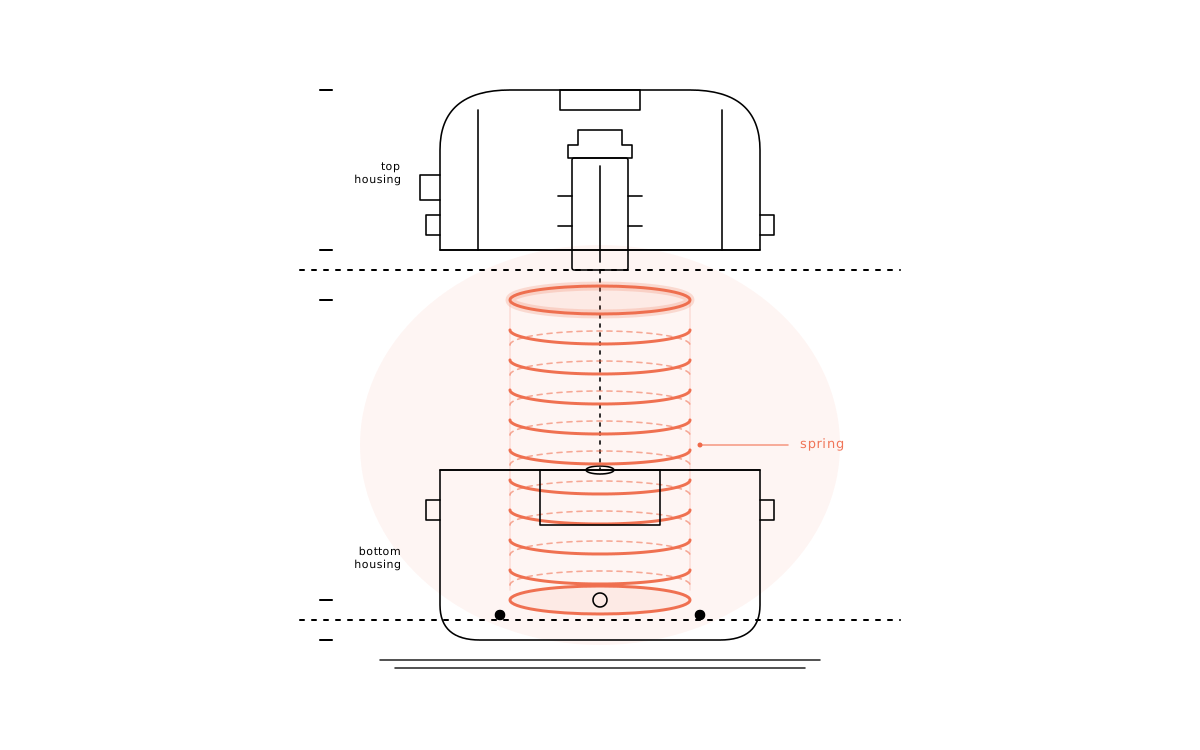
A spring swap is the modding hobby's most enthusiastic placebo and also a genuinely useful fix when the diagnosis is right. The same builder will report that a 62g progressive "completely transformed" a switch that, on careful comparison, sounds and feels almost identical to the stock 63.5g linear it replaced. They are not lying. They are also not really hearing the spring.
The reason this confusion is so durable is that to swap a spring, you have to open the switch. The act of opening a switch is itself a mod surface — the housing seats slightly differently on reclose, the stem rails get a fingerprint of fresh lube from handling, the leaf gets a millisecond of air. By the time the new spring is in, several variables have changed. The spring is the one the builder was thinking about, so the spring gets the credit.
This is fixable with discipline about what to expect. The spring does specific things. It does not do other things. Getting the categories right is the entire game.
What the spring actually controls
Three things. That is the whole list.
Initial force. The amount of resistance the spring presents at rest, before the keystroke begins. This is what the finger encounters when it first lands on a keycap and starts to press. A 50g initial spring feels lighter to begin pressing than a 65g initial spring. This is the most immediately perceptible difference between two springs in identical housings.
Bottom-out force. The total resistance at full compression, when the stem hits the bottom of its travel. This is what determines how hard the finger has to push to complete a keystroke. A 67g bottom-out feels firmer at the floor than a 55g bottom-out. Builders who type-and-bottom on every keystroke feel this constantly; builders who float their keystrokes and rarely bottom out feel it less.
Force curve shape. The relationship between travel distance and required force. A linear-wound spring climbs roughly linearly from initial to bottom-out. A progressive spring climbs slowly at first and then steeply at the end of travel, which produces a light top and a firm floor. A slow spring is wound to compress more gradually and is most often paired with silent switches where the goal is a softer overall keystroke profile.
That is what the spring is doing. Initial, bottom-out, curve shape. Everything else attributed to the spring is being done by another component.
What the spring does not control
The list of things builders think the spring changes, but does not, is longer.
Smoothness. A switch's smoothness is a function of stem rail finish, housing fit, and lubrication. A scratchy switch with a fresh 62g progressive in it is a scratchy switch with a 62g progressive in it. The spring weight has no bearing on whether the stem glides cleanly down the housing rails or catches on a tooling artifact halfway through travel.
Sound profile signature. The character of a switch's sound — clacky, thocky, creamy, poppy — is overwhelmingly determined by the housing material, the stem material, the stem-to-housing contact at bottom-out, and what is sitting under the switch in the rest of the acoustic stack (plate, PCB, foam, case). The spring contributes a tiny amount of high-frequency content if it pings, but that is failure-mode noise, not signature. Two switches with identical housings and different springs sound nearly identical at typing-volume listening distance.
Scratch. Same as smoothness, with the additional note that some builders confuse "the new spring feels rougher" with scratchiness when the actual issue is that a heavier spring is presenting more resistance against the existing rail texture, which makes that texture more perceptible. The scratch was always there. The heavier spring is just letting the finger feel it more clearly.
Spring ping. This one is worth separating because builders sometimes swap springs hoping to fix ping, and a swap can accidentally do it — by replacing a poorly-tempered spring with a better one, or by getting fresh lube on the spring during reassembly. But ping is fundamentally a function of spring metallurgy and lubrication, not weight. Going from 55g to 62g does not fix ping. Going from a cheap unlubed spring to a well-tempered lubed spring does fix ping, regardless of weight.
The options people actually swap to
Most spring swaps in 2026 are landing in one of four buckets.
Lighter linear weights. 55g to 50g, or 63.5g down to 58g. This is the swap for builders whose fingers fatigue at the stock weight, especially typists who do long sessions on heavy switches like stock Cherry MX Black or some of the heavier Akko options. The fatigue change is real because the per-keystroke work over an eight-hour day adds up to a measurable difference.
Heavier linear weights. 62g to 67g, or 67g to 78g. The swap for builders who keep accidentally bottoming out at lower weights, or who want a firmer landing. This is also the swap most often done for sound reasons, which is the one that mostly does not work — heavier springs do bottom out harder, which produces a slightly more present bottom-out transient, but the change is small and the housing is doing most of the acoustic work either way.
Progressives. A spring wound with variable pitch so the back end compresses more steeply than the front. The marketed feel is "light to press, firm at the floor." Builders who like a light keystroke but bottom out often gravitate to these because they get a forgiving top with a defined floor. The feel is real and pleasant on the right switch.
Slows. Slow springs are wound for silent and dampened switches where the goal is a gentler force curve overall. They are not a useful swap for a standard linear or tactile — they are an ecosystem choice that pairs with a specific category of switch.
The trade-offs across these are mostly about matching the spring to the typist, not to the switch. The same 62g progressive that feels great on one builder's hands feels too heavy at the floor for another. There is no universally good spring weight, and there is no spring weight that is wrong on the spec sheet for any healthy switch.
When the swap is the right answer
There are three diagnoses that point cleanly at a spring swap.
The first is bottom-out hardness mismatch. If a builder is consistently bottoming out hard enough to feel it in their fingertips by mid-afternoon, the bottom-out force is too low for their typing style and a heavier spring or a progressive will help. This is the most common legitimate spring-swap case.
The second is initial-force fatigue. If the first 30 keystrokes feel fine but the next 1000 feel like a workout, the initial force is too high for the typist's hand strength. A lighter spring genuinely helps here, and the help compounds across a workday.
The third is an unusual stock weight on a switch the builder otherwise loves. The C3 Equalz Tangerine R2 is a common example: it ships at 67g actuation in a housing many builders rate among the best-tuned linears in the catalog, and a significant share of Tangerine owners swap to 62g or lighter springs within the first week while keeping the housing exactly as-is. Swapping to a more conventional weight in the same housing is a clear win when the housing is the part the builder wanted. The opposite pattern: the HMX Cloud ships at 42g actuation in a housing most builders are happy with, so spring-swapping it is valid only if the stock weight is specifically the mismatch — the factory lube job that made the switch appealing will survive the swap intact.
Outside of these three, the spring is probably not the right thing to be changing.
When the swap is the wrong answer
The clearest wrong answer is "I want this switch to sound different." The spring is not the lever for that. Housing material, plate material, case stack, lube application, and keycap profile are doing the acoustic work. A spring swap will produce a tiny audible delta and a much larger placebo-driven delta, and a month later the builder will be back swapping again because the actual problem was never the spring.
The second wrong answer is "this switch feels scratchy and maybe a different spring will fix it." It will not. Lube the rails, or sell the switch. A new spring in a scratchy switch is a new spring in a scratchy switch.
The third wrong answer, and the most expensive in time, is swapping springs across a full board without testing on a few switches first. Spring preferences are individual. Buying 110 of a weight that turns out to feel wrong is several hours of work for an outcome the builder dislikes. Always sample-swap eight to ten switches in a usable typing row, type on them for a few days, and decide whether to commit to the rest of the board.
The take
Spring swaps are worth doing when the diagnosis is force, not sound or feel-quality. If the stock weight genuinely does not match the typist, the swap is one of the highest-leverage modifications in the hobby because force is not something other mods can address. PE foam, tape, films, lube — none of them change how hard the switch pushes back. Only the spring does that.
If the diagnosis is anything else, the time is better spent on lubing the switches, plate foam, the tape mod if the board sounds hollow, or a better case. The afternoon spent opening 65 switches to install a spring that does not address the actual problem is an afternoon that could have been spent on the mod that would.
The honest framing: spring swapping is a precision tool for one job. Used for that job, it is excellent. Used as a general-purpose "make this switch better" mod, it mostly makes the builder feel like they did something. Both outcomes have value, but only one of them is engineering.
Worth watching: a small but growing batch of vendors are starting to ship sample packs — eight to ten springs across a weight range, designed for exactly the test-before-commit workflow that makes spring swapping actually rational. If those become standard, the failure mode of buying 110 of the wrong weight goes away and the mod becomes meaningfully more useful to the broader hobby. That is the right direction.
Build sheet
Keep reading
- Ideas
Lubing switches: what to use, how much, and what to skip
Four lubes, four application points, and one rule that prevents most mistakes: over-lubing is irreversible, under-lubing is not. Here is the practical reference.
thock10 min read - Ideas
Switch films: do they actually do anything?
Thin POM shims between your switch housings cost five dollars and promise a tighter, better-sounding switch. The mechanism is real. Whether it matters on your specific switches is a separate question.
thock8 min read - Ideas
The Holee mod: what foam inside the switch actually buys you
Small pads of polyurethane foam cut and wedged inside the switch housing itself — not under the PCB, not behind it, not under the keycap. The Holee mod works at a smaller scale than every other foam mod in the hobby, and it costs proportionally more time.
thock8 min read - Ideas
Why typing tests lie
Monkeytype scores reward fast and forgiving. A daily driver needs comfortable and honest. Optimizing a build for the test selects for the wrong things — and the gap shows up around hour two, not in the leaderboard.
thock7 min read