Switch films: do they actually do anything?
Thin POM shims between your switch housings cost five dollars and promise a tighter, better-sounding switch. The mechanism is real. Whether it matters on your specific switches is a separate question.
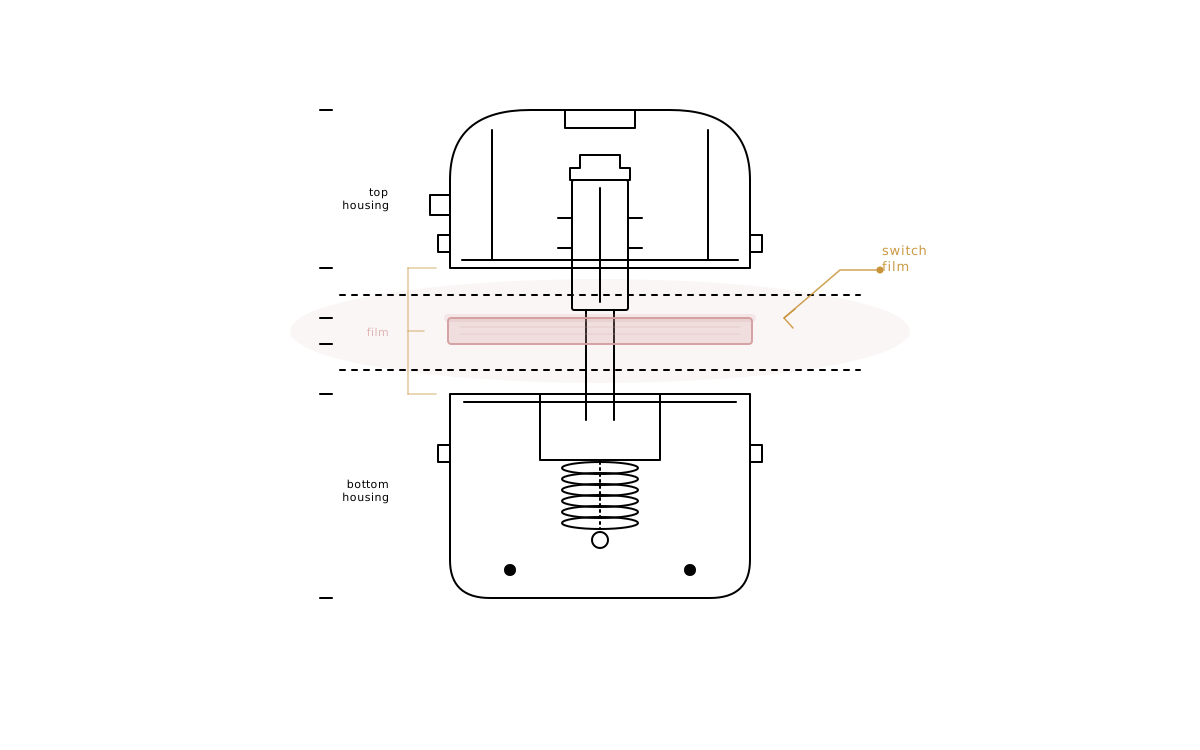
A $5 bag of translucent shims arrives, the builder places one between each switch housing, and the keyboard sounds — maybe a little different. Maybe not. The hobby has been arguing about this since switch films arrived around 2018, and the argument has not resolved cleanly because both camps are right about different things.
What switch films are and what they claim to do
Switch films are thin, flat shims — typically 0.1–0.15mm thick — that sit in the seam between the top housing and bottom housing of a MX-footprint switch. They are stamped or cut from POM (polyoxymethylene), PORON, or PE film stock, with a cutout for the stem and clearance for the LED and the leaf spring. Most packs contain 110–120 pieces, enough for a standard 65% to TKL build with some spares. NovelKeys's switch film listing is representative of what the market looks like: $5–7 per 110-pack, usually two material options (POM or PORON), occasionally a thickness choice.
The claim is straightforward: the top and bottom housing of a switch are injection-molded parts that clip together, and like any two molded parts, the gap at the seam varies. A looser fit means the top housing can rock slightly relative to the bottom — a motion called stem wobble when it originates at the stem itself, and housing wobble when it originates at the housing seam. Films close the gap at the seam, which, in theory, reduces housing wobble, tightens the sound, and changes the feel.
The theory is correct. The practical effect depends on where you start.
Where the mechanism actually matters
Housing wobble is measurable. Hold a switch between two fingers and press the top housing sideways while holding the bottom — some switches move meaningfully; others barely shift. Switches with tight-tolerance tooling, like Topre housings or the retooled Cherry MX2A Red, have enough housing precision that the seam gap is already narrow. Films on a Cherry MX2A Red do very little because Cherry's revised tooling addressed the wobble problem directly. The housing fit is already tight; a 0.13mm shim is not closing a gap that isn't there.
The switches that respond most to films are the ones with comparatively looser housing tolerances. Older-generation Gateron yellows and blacks, many Akko and Outemu-sourced switches, and particularly high-tactile switches where the stem geometry creates more lateral force on the housing — the rounded-bump geometry of the Drop Holy Panda X, for instance, exerts lateral stress on the housing seam through the bump's travel — these are the candidates. The lateral force of a pronounced tactile bump is doing mechanical work against the housing seam on every keystroke; a film that reduces housing play is actually under load in a way it is not in a light linear where the stem travels mostly vertically.
Gateron Oil King is an interesting middle case. The Gateron Oil King has reasonably consistent housing tolerances out of the factory, but the polycarbonate top housing is slightly more dimensionally variable than nylon across a 70-switch tray — PC has a wider thermal expansion coefficient than nylon, which means housing fit varies more with ambient temperature during molding. Builders running Oil Kings in humid, warm conditions sometimes report more improvement from films than builders in drier, cooler environments. The mechanism tracks.
Topre-style switches — which include the electrostatic capacitive boards from HHKB and Leopold — do not accept films at all. The housing geometry is fundamentally different; there is no seam in the same location, and attempting to install films in a Topre switch is a non-starter.
Does it actually change the sound or feel?
For spring ping: no. Spring ping originates at the spring itself — the coil resonating inside the housing — and the seam between top and bottom housing is not in the acoustic path of that resonance. Films do not affect spring ping. If that is the primary issue, stem-side lubing or spring swapping is the fix.
For bottom-out sound: a small but real difference on high-wobble switches. When the housing rocks during keystroke travel and snaps back on bottom-out, the seam contact produces a subtle secondary transient — a faint rattle or looseness layered under the switch's primary bottom-out. On switches where this is happening, films remove it and the bottom-out becomes more singular. The change is most audible on low-profile builds or builds with hard plates where other acoustic sources are already suppressed and the switch noise is unmasked.
For feel: marginal but detectable on very wobbly switches. The feel change is about consistency more than it is about force or character. A switch that wobbles produces a keystroke that feels slightly different depending on the angle of finger contact; a filmed switch that no longer wobbles produces a more repeatable keystroke regardless of typing angle. For builders with a heavy lateral keystroke habit, the feel difference is real. For builders who hit keys straight down, the improvement is minimal.
How to install them
The installation process is simple but repetitive. Open each switch (a switch opener tool makes this a minute-per-switch operation rather than a three-minute one), set the bottom housing aside, place the film over the bottom housing so the cutouts align with the stem hole and the leaf spring channel, then clip the top housing back down. The film should be fully seated in the seam groove; if it is folding or bunching, it is either too thick for the switch or misaligned. Close the switch and confirm it actuates freely before moving on.
For a 65-key build, plan for about two hours including desoldering if the board is not hot-swap. On a hot-swap board where the switches pull out easily, the same job runs faster — sixty to ninety minutes for a practiced builder.
| Switch type | Film benefit | Recommended? |
|---|---|---|
| High-wobble linears (older Gateron, Akko, Outemu) | Audible seam rattle reduction, more consistent feel | Yes |
| High-tactile switches (Holy Panda X, Boba U4T) | Reduced housing movement under lateral tactile force | Worth trying |
| Gateron Oil King | Modest, depends on tray tolerances | Optional |
| HMX Cloud | Minimal — factory tolerance is already tight | Optional |
| Cherry MX2A (either weight) | Minimal — tight tolerances already | Skip |
| Topre / HHKB | Incompatible housing geometry | Not applicable |
The verdict
Switch films do something real in the right context. The mechanism — closing housing seam gaps to reduce wobble — is physically valid, and on switches where that wobble is present and audible, the result is a more consistent, slightly cleaner bottom-out. At $5–7 per pack with material left over for the next build, the cost-to-try ratio is favorable.
What they do not do is transform a mediocre switch into a premium one, address spring ping, or compensate for anything else in the acoustic stack. A scratchy switch is still scratchy after filming. A pinging spring still pings. The mod is narrow and honest about its scope in a way that many modifications are not. Builders looking to address case resonance — the hollow, boxy quality that films cannot touch because it originates at the PCB and case walls — will find the tape mod is the cheapest intervention for exactly that problem.
The practical guidance: buy one pack of POM films, pick the five or six switches in your tray with the most housing play, film them, compare them to unfilmed switches from the same tray. If the difference is audible or the feel improvement registers, film the rest. If it does not, the remaining 100 films will wait in the bag for the next project. The worst outcome is an afternoon's worth of switch opening with no payoff — that is the entire downside.
The feel consistency that films introduce — a more stable keystroke on the two-hundredth press, not the second — is exactly what a sixty-second typing benchmark cannot measure. For the full argument, see why typing tests lie.
Watch for materials development here. The next round of interesting work is in films made from harder elastomers rather than rigid POM — materials that close the gap while adding a controlled amount of acoustic damping. A few boutique vendors are shipping small batches of these variants and the early reception is positive on very clicky, high-housing-resonance switches. Whether that translates to a general recommendation depends on how the acoustic character sits across different plate materials and case designs — monitor vendor forums and the thock guides section as the category matures.
Keep reading
- Ideas
Lubing switches: what to use, how much, and what to skip
Four lubes, four application points, and one rule that prevents most mistakes: over-lubing is irreversible, under-lubing is not. Here is the practical reference.
thock10 min read - Ideas
Spring swaps: what swapping the spring actually changes
Swapping the spring is the most-discussed mod that does the least of what builders expect. Here is what the spring actually controls, what it does not, and when the swap is worth the afternoon.
thock9 min read - Ideas
The Holee mod: what foam inside the switch actually buys you
Small pads of polyurethane foam cut and wedged inside the switch housing itself — not under the PCB, not behind it, not under the keycap. The Holee mod works at a smaller scale than every other foam mod in the hobby, and it costs proportionally more time.
thock8 min read - Ideas
Why typing tests lie
Monkeytype scores reward fast and forgiving. A daily driver needs comfortable and honest. Optimizing a build for the test selects for the wrong things — and the gap shows up around hour two, not in the leaderboard.
thock7 min read