The tape mod: what one strip of Kapton actually does
Three to five strips of painter's tape on the back of your PCB — that's the whole mod. The acoustic effect is real. Its magnitude depends almost entirely on the board underneath it.
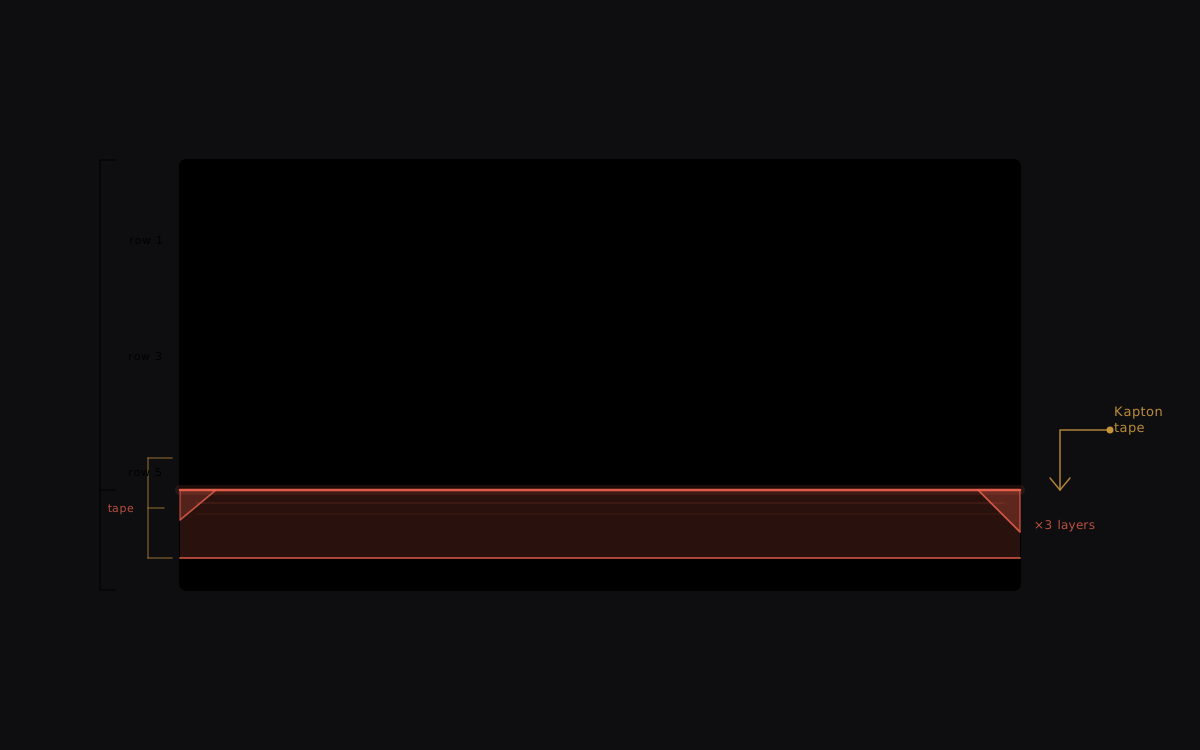
Painter's tape. Not Kapton, despite what half the build threads call it — Kapton is a polyimide film used for high-temperature electronics work and it costs significantly more. Regular painter's tape from a hardware store is what the community actually means, and it is what works. Five minutes, reversible with a fingernail, zero dollars if you own any tape at all.
The question worth asking is not whether to do it but what it actually changes, and on which boards the change is worth noticing.
What the mod is
Remove the PCB from the case. Apply three to five strips of painter's tape in an even grid across the back of the PCB — the component side, not the switch side. Reassemble. That's it.
The tape sits between the back of the PCB and whatever is above it in the stack (typically the plate, sometimes foam, sometimes air). It adds a thin layer of material — a small amount of mass and a slight acoustic barrier — across the surface that, on many budget boards, vibrates most freely during a keystroke.
No switches are removed. No soldering is involved. The modification comes off in seconds if the result is not to taste.
The acoustic effect
The audible change is a slight muffling of what hobbyists call hollow resonance — that slightly empty, boxy quality when keystrokes ring out rather than land and stop. On a board where the PCB sits tightly against a plate with minimal dampening in between, the tape introduces a small amount of damping at that interface. The case resonance drops by a noticeable step on boards where the PCB is doing a lot of acoustic work.
In practical terms: a budget 60% or 65% in a basic aluminum top-mount case, with no case foam and no dampening material anywhere in the stack, might go from a somewhat hollow, metallic-adjacent sound to something slightly warmer and more thuddy. Not dramatically — but the change is real and immediately obvious on a side-by-side typing test before and after.
The mechanism is simple. Painter's tape has some acoustic absorption. The thin adhesive layer further damps vibration at the PCB surface. The PCB is a large, thin surface that resonates when keystroke energy passes through it; covering it with a slightly absorptive material changes that resonance characteristic. The physics is not complicated.
The feel effect
Minimal. This is the part that gets overstated.
PCB flex — the springy, giving quality that some builders associate with gasket-mount boards — comes primarily from the mounting style and the plate, not from the PCB substrate itself. Applying tape to the PCB back does not meaningfully change how the PCB flexes under keystroke load. On a rigid top-mount board, the plate is doing almost all of the structural work; the tape is not in a position to alter that.
There is a very slight bottom-out softness on some boards where the PCB back contacts the plate directly and the tape is genuinely sitting in the contact zone. But this is easy to overstate. If a builder reports that the tape mod "transformed the typing feel," they are probably hearing the acoustic change and attributing it to feel — which is a normal perceptual conflation, but not accurate. The tape mod is primarily an acoustic modification with a negligible feel component. Builders who want to change the keystroke's actual force profile — lighter initial press, different bottom-out weight — are looking for spring swaps; that mod is orthogonal to this one.
Where it helps most
Budget top-mount boards. A 60% or 65% in a basic aluminum tray or top-mount case, no gasket, no significant case foam — this is the tape mod's natural habitat. The PCB is sitting against the plate with nothing between them, the case cavity is modest, and case resonance is one of the loudest problems in the acoustic stack. Three strips of tape will make a noticeable difference here.
Stock boards before a bigger mod investment. Someone who just bought a budget board and wants to extract some improvement before deciding whether to buy plate foam or case foam: the tape mod is a sensible first step. It costs nothing if you already own tape, takes five minutes, and gives a baseline for how much acoustic tuning work the board actually needs. If the tape mod already gets the board to a satisfying place, the budget for PE foam or tape foam can go elsewhere.
Linear switch builds where hollow resonance is unmasked. Linears bottom out cleanly and completely, which means the hollow quality of the case resonance is unobstructed. A tactile or clicky switch introduces more acoustic complexity that partially masks case resonance; a linear on a hollow board lets the hollow ring through on every keystroke. The tape mod addresses exactly that problem — though rail noise and spring ping from unlubed linears layer on top of the case resonance; lubing the switches first isolates the case resonance so the tape mod's contribution shows up cleanly.
Where it doesn't help much
Gasket-mount boards. A well-engineered gasket-mount design already isolates the plate from the case through compliant gasket pads. The PCB has flex separation from the case structure. Case resonance is already addressed by the mounting system. Tape on the PCB back is adding a third layer of damping to a stack that already has two working layers — the marginal return is small. If the board still sounds hollow despite gaskets, the problem is almost certainly not the PCB surface; it is something else in the stack. For a breakdown of how gasket, top-mount, and tray-mount designs differ and the acoustic isolation each provides by default, see mounting styles compared; for the three variables that determine whether a gasket-mount board actually delivers on that label, see what gasket mount actually delivers.
Boards with extensive existing foam. If the board already ships with case foam, plate foam, or a PCB foam layer, the tape mod is adding noise to a system that has already solved the resonance problem. At some point the stack has too much damping and the typing sound loses all character without gaining anything useful. Tape on top of an already-foamed board is usually unnecessary.
Fully polycarbonate or acrylic cases. The acoustic character of a PC case comes primarily from the case material itself — PC flexes and absorbs differently than aluminum, and that case flex dominates the sound profile. Tape on the PCB will not change what the case is doing. Builders who dislike the sound of a PC case will not fix it with tape. For a breakdown of how aluminum, polycarbonate, brass, and ABS each shape the acoustic baseline differently, see the case materials guide.
How to do it
The full process, including disassembly and reassembly, runs five to eight minutes on most boards.
- Remove the case screws and separate the top and bottom halves.
- Unscrew the PCB from the plate or standoffs (if it is not already free).
- Cut three to five strips of painter's tape roughly as wide as your finger and long enough to span the PCB in parallel runs.
- Apply the strips in an even grid across the back of the PCB, avoiding the areas directly over hot-swap sockets if clearance is a concern.
- Reassemble in reverse order.
That is the entire process. No special tools. No consumables beyond the tape. Reversible by peeling the strips off.
| What you need | Where to get it | Cost |
|---|---|---|
| Painter's tape, 1-inch width | Any hardware store | Already owned, or ~$5 for a roll |
| Screwdriver for case screws | Already owned | — |
| Five minutes | — | — |
The honest verdict
Subtle. The tape mod is worth doing if you have tape and a board with hollow resonance. It is not worth buying tape specifically for. The acoustic change is real on budget top-mount boards and near-zero on gasket-mount boards with existing foam — which means it matters most exactly where people are most likely to want free improvements.
Like most acoustic modifications, the change the tape mod makes does not register on a sixty-second typing benchmark — the test ends before the body notices the hollow resonance. For that argument, see why typing tests lie.
The comparison point is the PE foam mod, which addresses the same basic problem (case resonance) by targeting the cavity below the PCB rather than the surface of the PCB itself. The PE foam mod is a slightly bigger acoustic swing for effectively the same effort tier and similarly negligible cost. If you are deciding between the two, do PE foam first. If you have already done PE foam, the tape mod is a marginal addition. If you have neither, doing both together is sensible — the mods target different parts of the acoustic path and are complementary.
For a broader look at where tape mod and PE foam sit across the full acoustic stack — alongside case foam and plate foam — see the sound dampening guide. Stabilizer rattle is a louder, more immediate problem than case resonance and the tape mod cannot address it; servicing the stabilizers first ensures the board's most obvious acoustic failure is solved before tape mod and PE foam show what they contribute.
Switch films target housing seam wobble on linears with loose tolerances — a different acoustic layer than case resonance — and are complementary when both the PCB and the switch housings are contributing hollow sound. Neither tape mod nor PE foam is a substitute for a better board. A $45 board with PE foam and tape is still a $45 board. What these mods do is help a board reach the ceiling of what its design allows — and on some budget designs, that ceiling is genuinely not bad.
Watch for this mod in pre-built form: some vendors are beginning to ship boards with tape already applied at the factory, usually called something like "PCB dampening layer" in the spec sheet. It costs them almost nothing to add, it moves the out-of-box sound in the right direction, and it lets them claim acoustic tuning without meaningful added cost. That is not cynicism — it is the mod working as intended, just done before you open the box.
Keep reading
- Ideas
The PE foam mod: the two-dollar upgrade that actually works
PE foam is one of the most accessible mods in the hobby — a $2 sheet between your PCB and case can noticeably reduce hollow resonance. Here is what it actually does, when to use it, and when to skip it.
thock10 min read - Ideas
Stabilizer servicing: the one step most builders skip
Most builders lube their switches meticulously and treat stabilizers as an afterthought. The rattle that survives a full stab lube job almost always traces back to one overlooked contact point.
thock11 min read - Ideas
Hot-swap sockets: what you actually give up for the convenience
Tool-free switch swapping turned hot-swap PCBs into the default spec across the hobby, and the default is earned. Here is the honest, specific list of what a socket costs against a soldered joint — and the two cases where soldering is still the right call.
thock8 min read - Ideas
The Holee mod: what foam inside the switch actually buys you
Small pads of polyurethane foam cut and wedged inside the switch housing itself — not under the PCB, not behind it, not under the keycap. The Holee mod works at a smaller scale than every other foam mod in the hobby, and it costs proportionally more time.
thock8 min read