What a silent switch actually silences — and what it can't
Every keystroke lands twice — once on the floor, once on the ceiling. Cherry molds an elastomer pad onto the stem to catch both; Gazzew fits a silicone one. The undamped Boba U4T shows what either approach is buying — about 14 dB on one tester's meter — and what it costs in travel, rebound, and a bump with nowhere left to go.
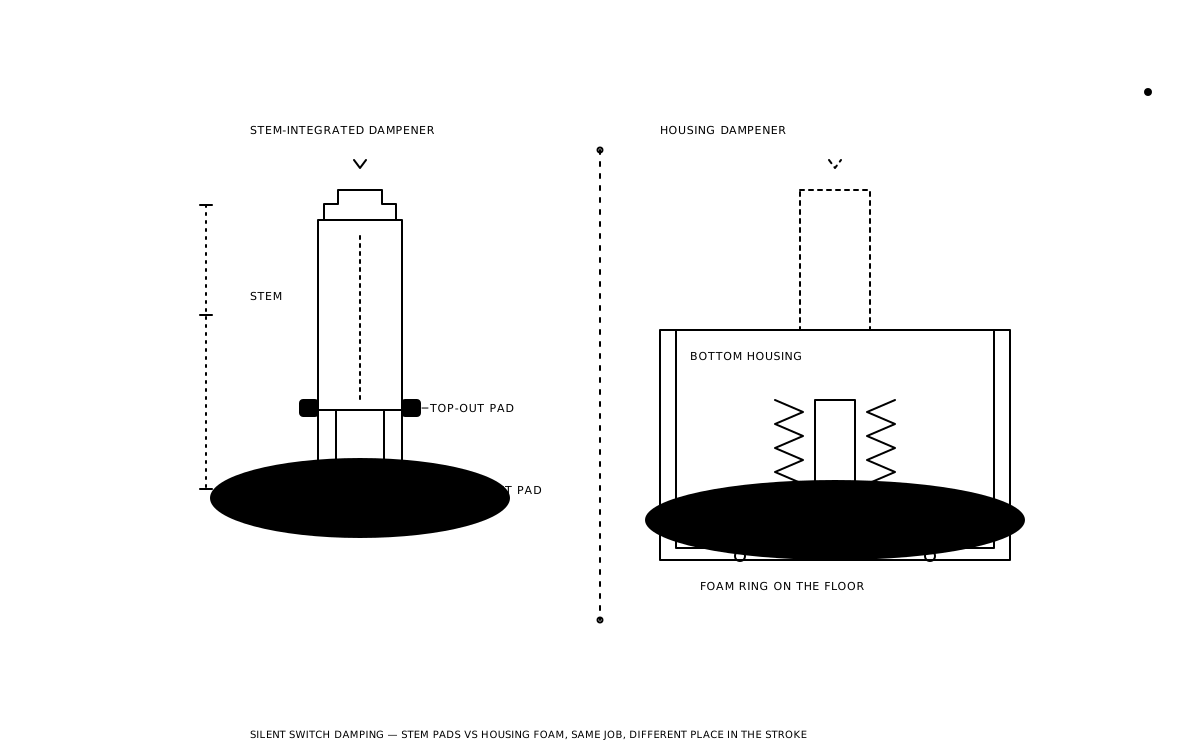
A silent switch is not a quieter switch. It is a switch in which two specific collisions have been intercepted — the stem's legs arriving at the floor of the bottom housing, and the stem's rails arriving at the ceiling of the top housing on the return — while everything else inside is left exactly as loud as it was. The Cherry MX2A Silent Black and the Gazzew Boba U4 both intercept those collisions with an elastomer pad mounted on the stem. Where they differ is how the pad gets there. Cherry molds it on. Gazzew fits it. The Gazzew Boba U4T — the U4's housing with the pads left off — is the control that makes the difference measurable.
Two impacts, one moving part
A keystroke produces two hard-plastic-on-hard-plastic collisions. On the downstroke, the feet of the stem's legs reach the floor of the bottom housing; on the upstroke, the spring drives the stem back until the shoulders of its rails strike the underside of the top housing. Each is a short, sharp impulse, and the housing rings with it. The acoustics deep-dive follows that energy out into the plate, the case, and the desk. This piece stays inside the housing, because that is where a silent switch does its work.
A dampener inserts a compressible layer at the instant of each collision. The elastomer deforms on impact, stretches the collision over a longer span of time, and converts a share of the energy to heat instead of passing it into the housing as vibration. The housing receives a push rather than a strike, and a push does not ring.
The pad goes on the stem because the stem is the one body that touches both impact surfaces: one moving part, two pads, both collisions covered. A housing-side design would need a pad at the floor and a second in the top housing exactly where the stem rails run — two parts, two moldings — which is why mainstream MX-compatible silent switches put the elastomer on the stem.
Molded versus fitted
Cherry's approach is the integrated one. Cherry's MX2A Silent Black product page describes a stem "made of two components" carrying "integrated, patented noise reduction technology"; vendor listings name the second component as TPE, a thermoplastic elastomer co-molded onto the POM slider at the foot of the legs and the top of the rails — one piece of the redesigned stem geometry the MX2A revision shipped across the whole line, not just the silenced variant. The pad cannot shift, cannot be lost, and cannot be removed. The cost shows up on the spec sheet: Cherry's MX Silent line lists 1.9mm pre-travel and 3.7mm total travel against the 4.0mm of a standard MX2A such as the Cherry MX2A Red. That 0.3mm is pad thickness plus compression allowance — the dampener's footprint written into the travel number.
Gazzew's approach is modular. The U4's dampeners are discrete silicone pads seated on the stem at the same two surfaces, and they come off. Switch and Click notes that removing them "adds a bit of pretravel before the bump," which is more revealing than it sounds: the top-out pad also sets the stem's rest position. With the pad in, the stem sits a pad-thickness lower and the legs engage the leaf almost immediately; take it out and a sliver of free travel appears before the bump. ThereminGoat's U4 review places the bump "at the very start of the downstroke" for the same reason.
The modular design's dividend is the U4T: the housing tooling carries over unchanged, and only the stem (a longer pole, in place of the pads' seats) and the pads themselves differ. Cherry cannot do even that much with a two-component stem — the MX2A Red and the Silent Black are different parts from the mold outward, no shared tooling at all.
What the pads buy: the U4T control
Because the U4 and U4T share everything but the pads, one tester's readings of both are the closest thing the hobby has to a controlled measurement of stem-pad damping. Click and Thock's Boba U4 review logs the switch at 67.7 dBA; the same site's U4T review logs 81.5 dBA on a full keyboard under SA, MT3, and GMK keycaps. That is a 13.8 dB gap. Meter distance and room are not published, so treat the absolute figures loosely — but the delta between two switches on one rig holds wherever the meter stood. By the rule of thumb that a 10 dB step reads as roughly half the perceived loudness, the U4T lands at well over twice the perceived volume of its silenced twin. The U4T's reputation is a subtraction, not an addition.
Cherry's side of the ledger is thinner. No like-for-like dBA reading of an MX2A Silent Black against an MX2A Red from one tester surfaced in research for this piece. What exists is qualitative: Protesilaos Stavrou's notes on the MX2A Silent Black report that "the fan of the computer and the birds outside are louder than my typing" — consistent with the physics, but not a measurement.
What the pads cost: feel
Three costs, in rising order of how much builders argue about them. The first is travel, already counted: 0.3mm on Cherry's spec sheet, and an unspecified but real fraction on the U4.
The second is the floor. An undamped switch bottoms out against a wall; a damped switch bottoms out against a ramp. The elastomer is a short, stiff spring in series with the housing floor, so the last fraction of travel carries a rising force instead of an abrupt stop. Whether that reads as "cushioned" or "mushy" depends on pad durometer, pad thickness, and how much spring force arrives at the pad. Protesilaos describes the Silent Black's landing as "comfortable rather than being an abrupt crash," and Cherry's 60cN operating force is part of why: a heavier spring masks the cushion because the finger is already working against resistance when it meets the pad. The Gazzew Boba U4 arrives at its floor with less spring behind it — 62g actuation, 68g bottom-out, well under Cherry's 100cN — yet Switch and Click still credits it with avoiding "pronounced mushiness," which says as much about pad durometer and thickness as it does about spring weight.
The third is the return. A top-out pad does not just absorb the upstroke; it stores a fraction of the energy and gives it back. The stroke ends in a soft rebound rather than a tick, and that rebound — the "rubbery" return in every silent-switch complaint thread — is the elastomer's elasticity, not a defect. Cherry attacks the other half of the upstroke with what its product page calls a "noise-reducing barrel spring design," aimed at the spring rather than the pad.
Why silent tactiles are harder
A silent linear has two collisions to manage. A silent tactile has the same two, plus a leaf.
The bump is a leaf event: the stem's legs ride up and over the contact leaf, which flexes and snaps back. That snap is a third transient inside the housing, and neither pad can reach it — it occurs in the metal, between the two surfaces the pads cover. Clicky switches turn a version of that same leaf snap into the entire point of the switch instead of a transient to muffle. On the upstroke it repeats in reverse, which is the return bump a silent tactile still produces audibly when both ends of the stroke are muted.
The second problem is momentum. Once the stem crests the bump, the leaf releases it into the rest of the stroke under full spring load plus whatever the finger was putting in to clear the peak. A tactile arrives at the floor harder than a linear of the same weight, so the bottom-out pad has more impulse to absorb. A wide spread makes it worse: the Durock T1 climbs a full 12g after its bump, as the U4T deep-dive laid out, so its spring pushes that much harder into the floor. The U4's 6g spread, 62g to 68g, is the narrow end of the range — and narrow is what a silent tactile wants.
The third problem is geometry. The bottom-out pad sits on the feet of the legs, millimetres from the surfaces that generate the bump, and its thickness eats post-bump travel; a bump placed low in the stroke runs straight into the cushion. Gazzew's answer is to put the bump at the very start of the downstroke, giving it the longest possible run-out before the pad. That is why the U4 reads as a distinct bump followed by a quiet glide — and why the Boba LT, with no leaf event to protect, needs none of this care.
Lube and the pads
Damping changes what lube is for. On an undamped switch the bottom-out is the loudest event and rail scratch is a texture underneath it. On a damped switch the bottom-out is gone, so whatever the pads do not touch — rail scratch, spring noise — becomes the loudest thing left.
Both makers lube from the factory, with different footprints. Cherry's MX2A grease ring covers the rails on every MX2A, Silent Black included. Gazzew lubes the U4's leaf and spring bottom and leaves the rails dry — hence the "leathery scratch" ThereminGoat reports a light rail lube cleaning up, and the standard builder move of a thin oil on any Boba spring. Contrast the Gateron Oil King, whose factory lube extends past the rails onto the stem legs: on a silent stem the legs carry the pads, so that footprint has to stop short. Thick lube on an elastomer pad does not help it damp — the pad works by deforming — and a film of Krytox 205g0 on silicone or TPE makes the landing stickier, not quieter. Lube the rails; oil the spring; leave the pads dry.
Verdict and what to watch
Molded versus fitted is a manufacturing decision, not an acoustic one. Cherry's two-component stem wins on consistency: the pad cannot migrate and the travel spec is fixed. Gazzew's fitted pad wins on flexibility: a builder with tweezers can pull a U4's pads and pick up a slice of the U4T's pretravel character, short of the longer pole underneath. The U4T's 13.8 dB gap over the U4 is the number either approach is buying, and the feel costs are the same on both sides — a shorter stroke, a ramped floor, a springy ceiling.
What neither approach touches is the leaf. The next silent tactile that matters will be the one that damps the return bump rather than the two ends of the stroke, and that is a leaf problem, not a pad problem. The other thing to watch is the spec sheet. Gasket durometer became a published number on boards, as the acoustic spec piece tracked; pad durometer is the equivalent for a silent switch, and neither Cherry nor Gazzew prints one. The first maker to put a Shore rating next to the spring weight will have said more about how its silent switch feels than any sound test can.
Keep reading
- Deep Dives
The Boba Family: One Housing Blend, Five Switches, and the Sound thock Is Named For
Gazzew designs, Outemu molds, and a plastic softer than nylon does the rest. Every Boba is the same chamber with something deliberately left out — and the pattern of subtractions is the whole family tree.
thock10 min read - Deep Dives
What Cherry's MX2A revision actually changed
Cherry's MX2A landed in 2023 with a real engineering update — factory lube, tighter tolerances, the same 100M-press lifespan. The reason the discourse cooled isn't that the switch failed; it's that the enthusiast slot it aimed at was already claimed by the time it arrived.
thock8 min read - Deep Dives
Why the Gazzew Boba U4T Rings Where the Boba U4 Stays Quiet
Same housing, same bump position — the U4T's whole personality comes down to what Gazzew left out. Pull the dampening pads from a Boba U4 and the bottom-out stops being polite.
thock11 min read - Deep Dives
Why clicky switches still have a constituency
Linears and tactiles dominate the modern build conversation, and clickies barely appear in it. The reason is not that clicky switches have aged out — it is that the people who want them really want them, and the manufacturers know it.
thock10 min read