PCB flex cuts, explained: a flex budget milled straight into the board
No plate change, no gasket, no case redesign — just a slot routed through the fiberglass near a switch hole. Flex cuts are the cheapest lever a designer has for adding give to a board that otherwise has none, and the cheapness is exactly why they show up where they do.
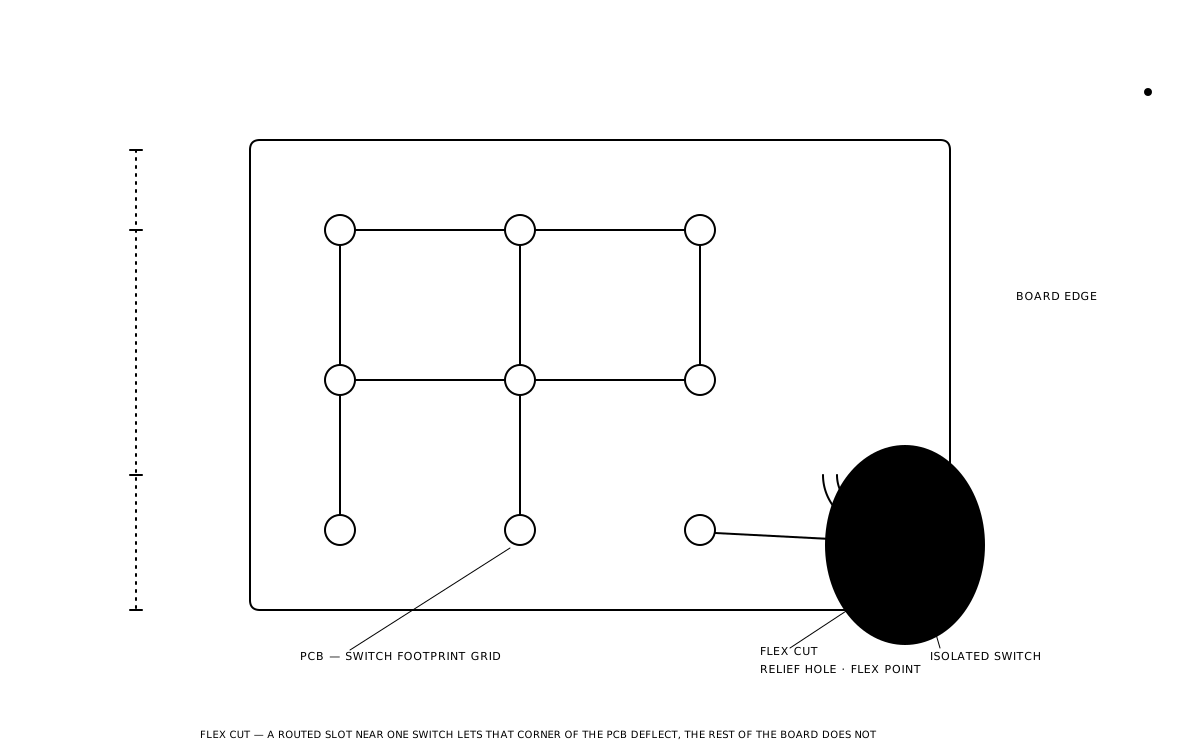
Open the design files for almost any board that advertises "flex cut PCB" and the feature is easy to miss: a pair of thin slots, usually shaped like a stretched C or a bracket, routed through the copper-clad fiberglass a few millimeters from a switch's mounting holes. No moving parts, no added material, no interface with the case. Just fiberglass with less of itself left near the switch than the rest of the board has. That absence is the entire mechanism.
What is actually being cut
A mechanical keyboard's PCB is a rigid, layered composite, almost always FR4 — woven fiberglass cloth bonded with epoxy resin, copper-clad and etched into traces. The same laminate shows up a second time in most builds as a plate material choice, where it behaves very differently once it's the layer switches snap into rather than the layer that routes signal — see plate materials, explained for how FR4's stiffness reads on that side of the stack. FR4 is stiff by design; the same rigidity that keeps traces from cracking under thermal cycling also makes the board resist bending under a keystroke. A flex cut interrupts that rigidity locally. The manufacturer routes two slots that nearly meet around a switch's mounting holes, leaving a narrow bridge of PCB material connecting the switch position to the rest of the board. Press the key, and that bridge — not the whole board — is what flexes.
This is a PCB-level intervention, not a plate or case one, and that distinction is worth holding onto because the vocabulary around keyboard "flex" gets sloppy fast. A gasket mount floats the plate-and-PCB assembly on compressible pads inside the case, so the whole deck moves as one body relative to the shell. A leaf-spring mount puts a bending cantilever tab at the case-to-plate boundary, so the deck moves on matched springs at its edges. A flex cut does neither. It doesn't touch the case, it doesn't touch the plate, and it doesn't move the assembly as a unit. It carves a deliberately weak path into the PCB itself, right where a single switch or a small cluster of switches sits, so that one part of the board can deflect independently of the rest.
Why bother, when the case already has a mount style
Every keyboard has some amount of "flex budget" — the total give available to a keystroke before it bottoms out against something unyielding. On a gasket-mount board, most of that budget lives in the gasket material and the case-to-plate interface, and the PCB itself barely needs to contribute. On a board with no gasket and no leaf spring, the budget has to come from somewhere else, or it doesn't exist at all.
That is the situation on a PCB-mount or top-mount board: the PCB is screwed rigidly to the plate, and the plate is screwed rigidly to the case, with no compressible layer anywhere in the stack. Every joint in that chain is a hard joint. Absent a flex cut, the only give available to the keystroke is whatever the switch itself provides internally, plus whatever the PCB's own bulk stiffness allows across its full unsupported span — which, screwed down every few centimeters, is close to none.
QK75 is a clean example of a board sitting in exactly that gap. Qwertykeys' 75% ships in a PCB-mount configuration: the PCB sits on standoffs in the bottom case, and depending on the build, the plate is either fastened rigidly alongside it or omitted in favor of a plateless build. There's no gasket ring, no foam strip, no leaf-spring tab anywhere in the stack. Whatever give a typist feels on that board either comes from the switch itself or from flex engineered into the PCB — there's no third place for it to come from. A flex-cut revision of a board in that mounting family is doing real, load-bearing work, because it is the only source of "give" the design has budgeted for anywhere in the stack.
Compare that to a board that already has a compliant mount elsewhere. The Bakeneko65 clamshells its case around a single perimeter o-ring, giving the whole plate-and-PCB assembly a few tenths of a millimeter of travel before anything gets stiff. The KBD75 v3 uses a conventional gasket-mount arrangement with foam strips top and bottom. On either board, a flex cut at the PCB level would be additive rather than foundational — a small, local softening layered on top of a mount that was already going to feel soft. It's the difference between a flex cut being the only lever in the design and a flex cut being one more turn of a knob that was already partway open.
The economics explain why this shows up where it does. Adding a full gasket system to a case means retooling the case halves, sourcing a gasket material, and validating the compression behavior — the kind of investment that shows up in a board's price tier. Adding a flex cut means changing the PCB's routing file. It's a design decision that costs a manufacturer almost nothing beyond the CAD time, which is exactly why it turns up on budget and mid-tier PCB-mount and top-mount boards that were never going to get a gasket redesign in the first place. A flex cut is what a designer reaches for when the case tooling is fixed and the PCB is the only part of the bill of materials still open for revision. That same asymmetry — a case-tooling decision costs real money, a PCB-routing decision costs almost none — is the economic logic that fixed the 60% footprint as the custom scene's shared case-and-plate grid in the first place; see how the 60% became the default custom-keyboard layout for the fuller history of what gets tooled once and reused rather than revised on every board.
What the cut trades away
None of this is free, and the tradeoffs are specific enough to name individually.
The slot ends are stress concentrators. Wherever a routed cut terminates, the material around that point sees load funneled into a smaller cross-section than the surrounding board, and that geometry is the textbook setup for fatigue cracking under cyclic loading — which is precisely what a keystroke is, repeated tens of thousands of times over a board's life. A flex cut that works exactly as intended on day one can, after years of typing, develop a hairline crack at a slot's rounded end and change how that key feels, or worse, damage a trace running near the cut.
Flex cuts also don't fix what's upstream of the PCB. If the case is a thick, unyielding aluminum shell and the plate is a rigid, fully-screwed sheet of steel, a slot cut into the PCB softens only the PCB's own contribution to the stack — it cannot make the plate bend or the case give. A flex cut on a board with a genuinely stiff plate and case produces a smaller improvement than the same cut on a board with a thinner plate, because the PCB's flex has to work against whatever resistance the layers above it still provide.
And compared to the mounts that inspired the feature in the first place, the effect is subtle. A well-executed gasket mount gives a typist something in the range of half a millimeter to over a millimeter of perceptible plate travel. A leaf-spring mount, tuned by the cube law that governs cantilever stiffness, can offer a similarly springy deck. A flex cut, working on a single small bridge of FR4 a few millimeters wide, gives back a fraction of that. It changes a PCB-mount board from feeling like typing on a countertop to feeling like typing on a countertop with a slightly softer corner — noticeable in a side-by-side, not transformative on its own.
A tuning knob, not a mount style
That's the honest way to place flex cuts in the broader mounting-feel conversation: they're a feature of the PCB, not a competitor to gasket-mount or leaf-spring mount as a category. A board doesn't choose between "gasket-mount" and "flex-cut PCB" the way it chooses between mount styles in the mounting styles comparison — a flex cut can sit inside a tray-mount board, a PCB-mount board, or, additively, inside a gasket board that already has plenty of give elsewhere. It's a local modifier to one layer of the stack, sized to matter most exactly where every other layer in that stack is locked rigid. The acoustic side of that same stack — how flex and mount choices upstream of the PCB change what a keystroke sounds like, not just how it feels — is covered separately in the physics of thock.
That's also why flex cuts are most interesting as a design signal rather than a spec-sheet selling point. A vendor putting flex cuts into a PCB-mount or top-mount board is acknowledging, implicitly, that the mount style they chose has no flex budget anywhere else — and is spending the cheapest possible fix on the problem rather than the most effective one. Watch for two things going forward: whether more PCB-mount boards in QK75's price tier start publishing where their cuts sit relative to hotswap sockets, and whether any manufacturer starts specifying flex-cut geometry — bridge width, slot radius, material thickness at the cut — with the same rigor Geonworks and other leaf-spring plate makers have started applying to tab thickness. Right now, "flex cut PCB" is a label with almost no published geometry behind it, on a feature whose entire effect is determined by that geometry. The parallel to where gasket-mount specs stood a few years ago is not a coincidence.
Keep reading
- Deep Dives
Why stabilizers rattle: the engineering behind a smooth stab
A stabilizer has to be loose enough to slide and tight enough to stay quiet, and those two requirements contradict each other at three separate interfaces. Every rattle, tick, and clunk on a spacebar is one of those interfaces losing the argument.
thock10 min read - Deep Dives
How the 60% became the default custom-keyboard layout
Every custom-keyboard buyer's guide since the mid-2010s opens with the same four-term vocabulary — 60%, 65%, 75%, TKL — as though it always existed. It didn't. One open-source PCB out of a geekhack thread is most of the reason that taxonomy exists at all.
thock11 min read - Deep Dives
The physics of thock: how every layer shapes your keyboard's sound
Every component between your fingertip and the desk makes a decision about your keyboard's sound — the switch, the plate, the case, the surface it sits on. Understanding what each layer adds or subtracts is the difference between chasing a sound blindly and engineering it deliberately.
thock16 min read - Deep Dives
Why the Drop Holy Panda X feels the way it does
The Holy Panda was a six-month frankenswitch project for most of its life. The Drop Holy Panda X is the first version where the geometry, the spring tune, the housing pairing, and the factory lube were the spec — not the mod.
thock13 min read