Why stabilizers rattle: the engineering behind a smooth stab
A stabilizer has to be loose enough to slide and tight enough to stay quiet, and those two requirements contradict each other at three separate interfaces. Every rattle, tick, and clunk on a spacebar is one of those interfaces losing the argument.
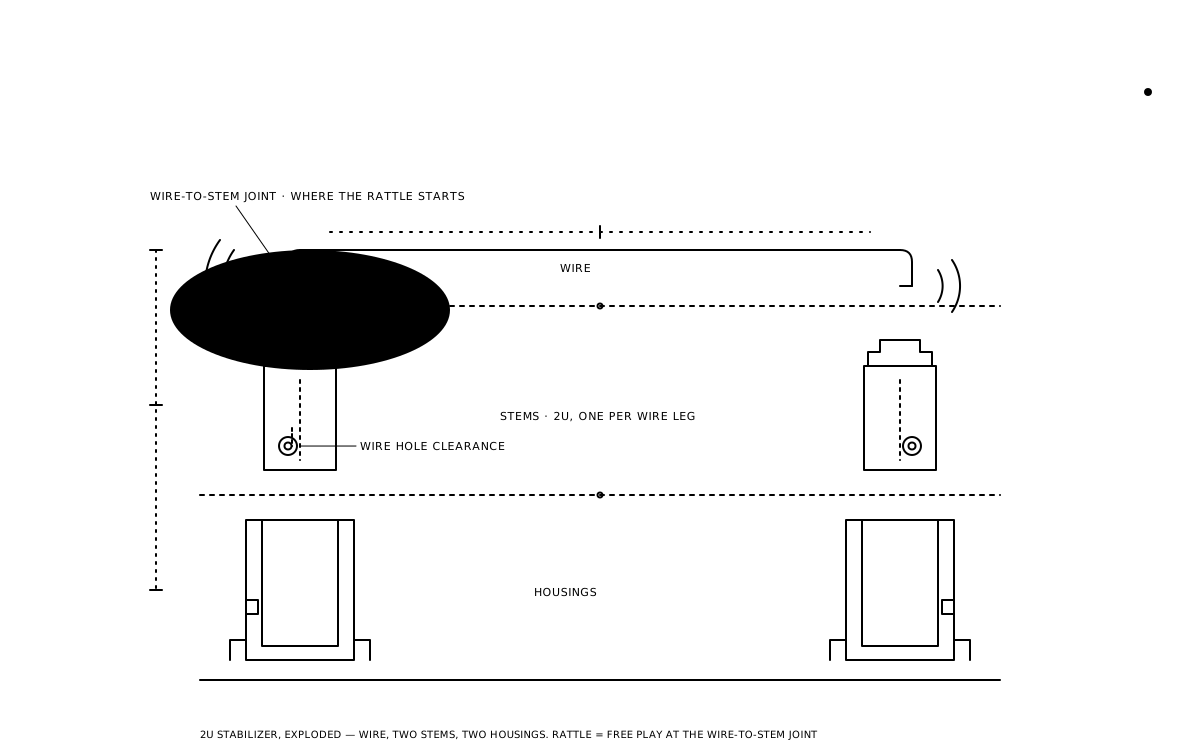
Pull the spacebar off any board and press the bare switch under it. It sounds fine. Put the cap back on and the same key is louder, brighter, and more metallic — and the switch did not change. The keycap is now driving two stabilizers, and a stabilizer is a small machine with more moving interfaces than the switch it flanks. A spacebar over a factory-lubed Gateron Oil King still sounds like its stabilizers. This piece is not a servicing walkthrough — the servicing guide and the explainer cover the how. This is the why. For how stabilizers fit into the keyboard's full acoustic stack — switch, plate, case, desk — see the keyboard acoustics deep dive.
The wire is a torsion bar
A Cherry-style stabilizer keeps a wide keycap level by linking its two ends through a bent steel wire. The Deskthority wiki puts the mechanism precisely: the wire "pivots against both the keyboard and keycap; pressing one end of the key rotates the wire, and the other end of the wire pulls its end of the keycap down accordingly." The rotation has to travel along the span from one leg to the other, which makes the span a torsion bar, and torsion bars care about diameter and straightness. Cherry-pattern wire is 14 AWG stainless — 1.63mm — per the Geekhack thread that reverse-engineered it. Torsional stiffness scales with the fourth power of diameter, so a slightly undersized wire reads as a soft far end of the key. Straightness matters differently: the two legs are supposed to rotate about one shared axis. Put a bow in the span and one leg seats deeper than the other, the wire binds at one end of travel, and the far end of the keycap arrives late. That lag is the rocking a bent wire produces, and no lube fixes it, because it is geometry, not friction.
Tolerance stacking: three gaps that have to exist
Ryan Norbauer, who designed a stabilizer from a blank sheet, framed the problem in one line in his 2024 write-up: "we need the mechanism to be at once loose and tight." A stabilizer is a linear slider driven by a rotating wire, and every sliding or rotating pair in it needs clearance: stem in housing bore, wire leg in the slot at the base of the stem, housing in its plate cutout or on the PCB. Norbauer's first workable design needed "0.3mm clearance between wire and housing to prevent binding" — one gap of three.
Those gaps stack into a keycap corner that moves a visible fraction of a millimetre before the mechanism takes up the slack, and every take-up is a collision. Norbauer's diagnosis is that the Cherry-type design is kinematically over-constrained: too many surfaces guiding the same motion, each needing its own slop so they do not fight. Every mod either shrinks a gap slightly or softens what happens when it closes.
Three sources, three sounds
Wire-in-stem slop is rattle proper. Norbauer's definition: "the sound of the hard wire linkage striking against the hard plastic surfaces in the interior of the slider." On a fast press the stem outruns the wire; inertia carries the wire across the slot clearance into the ceiling, and on release the reverse happens. Steel on plastic: bright, metallic, and present at both reversals.
Stem-in-housing play produces a scrape or a tick. Dry, the stem's outer walls scratch faintly against the bore across the travel. Loaded off-centre, as every stabilized key is, the stem cocks in the bore, catches, then snaps square. That snap is a tick: discrete, plastic-on-plastic, at one point in the stroke.
Housing-to-plate or PCB movement is a clunk. If the housing can shift — a clip-in lifting fractionally on the upstroke, a plate-mount rocking in an oversized cutout — the whole assembly lands on the PCB at bottom-out. A low, hollow sound under the keystroke that survives any amount of wire and stem lube, because neither touches it.
Tick is not rattle
Norbauer's split is the useful one: rattle is the wire striking inside the slider; ticking is "the sound of either the slider or wire moving against the housing." Rattle is distributed — the wire has free play and exercises it throughout the stroke — so the fix is to take up the play with something viscous or compliant. Tick is positional — something catches at a specific point, usually where the wire leg swings through the housing channel at the travel extremes or where the stem's feet meet their limit — so the fix is to change the path: grease the channel, clip the feet, straighten the wire. Greasing wire ends to chase a cocked-stem tick goes nowhere; so does clipping stems to chase wire-slot slop.
Why 2u and 6.25u are different keys
A 2u shift and a 6.25u spacebar share wire gauge, stems, and housings, and do not behave the same. The difference is span. Stem spacing on a Cherry-pattern PCB is 23.8mm for 2u keys, 100mm for a 6.25u spacebar, and 114.3mm for a 7u, per HilPCB's footprint guide.
Torsional compliance grows with length, so the 6.25u wire twists a little over four times as far as the 2u wire under the same torque before the far stem follows — the far corner of a spacebar arrives a beat late in a way a 2u never shows. The moment arm compounds it. On a 2u the stems sit 11.9mm from the switch centre, so the switch carries most of an off-centre press. On a 6.25u the corner is 50mm out and the stabilizer carries the whole press — harder strikes across every gap, from a heavier wire. The 7u is the same story with 14.3mm more span. A bow that is invisible across 23.8mm is a visible rock across 100mm, which is why wire balancing matters on a spacebar and rarely on a shift. Layout choice decides how many of these long spans a board carries in the first place — a 60% keyboard carries exactly one 6.25u spacebar and no 7u key at all; see the 60% layout history piece for how that footprint became the default.
What each mod actually changes
Each common mod acts on one of the three gaps. Knowing which is the difference between a fix and a ritual.
Grease at the wire ends and hook does not close the wire-in-stem gap. It fills it with a viscous film the wire has to push aside before it can strike plastic. Viscosity is the whole point — thin oil drains out of the clearance and leaves the strike intact — which is why the joint gets dielectric grease, not the stem-bore lube.
The holee mod changes the gap itself. A strip of fabric bandage pressed into the stem slot adds a compliant, lossy lining: the wire lands on fabric, and the clearance is partly consumed by material that yields instead of binding. It is the only hobbyist mod that attacks source one structurally rather than chemically.
Clipping is a stem mod — despite the "wire clipping" name that circulates, nobody cuts the wire. The two nubs under the stem are removed so it bottoms on its flat base, turning a bottom-out tick into a broader landing. It does nothing for wire rattle or housing movement.
The band-aid mod is bandage strips on the PCB under the housing feet — a lossy layer for source three, and nothing else. Grease the wire, clip the stems, forget the feet: that is the stabilizer that "still clunks" after servicing.
Screw-in, clip-in, plate-mount
Mount geometry decides how big source three is allowed to be. A screw-in housing is clamped to the PCB through a threaded boss; it cannot lift, so the only remaining path is the plastic foot on the board surface. A clip-in is retained by two barbs — retention, not clamping — so the housing can lift a fraction on the upstroke and land again at bottom-out. A plate-mount housing hangs in a cutout whose fit is in the plate maker's hands, in a plate that flexes under the press — the geometry where source three is largest and the stabilizer maker can do the least about it. How much that same plate flexes — brass, aluminium, FR4, POM — is its own argument; see the plate materials deep dive for what each material actually changes.
Why the good ones rattle less out of the box
Each well-regarded aftermarket set went after a specific gap, and the product copy says which.
TX's AP Rev 4 uses a doubleshot stem — "POM Outside" with "TPU & POM Inside," per Divinikey's listing. Softer TPU where the wire leg contacts the stem is a factory holee mod, moulded in, and Rev 4's housing and stem changes are pitched as "better fitting of the wire, reduced wobble, and reduced noise."
Owlab's Owlstab V3 shrank the gaps directly — "reducing wire entry hole size, and decreasing the width of the outer housing," per Chosfox's listing. The wire is a shape-memory alloy "allowing for a slight bending of the wire to return to the original, straight shape" — an answer to the torsion-bar problem, not the slop problem.
C3 Equalz V3 shipped "new molds for improved tolerance on stems" and "razor straight, balanced wires" from a new wire manufacturer, according to Divinikey. It also ships a tuning kit in the box — housing mats, stem landing mats, a wire dampening mat, holee-mod material — which is the vendor acknowledging the gaps survive tighter moulds and selling a compliant layer for each one.
Durock V2 is the baseline the others are measured against: pre-clipped stems, gold-plated wires, and "patent designed V2 wire hooks to prevent wire popping," per Omnitype — the set that made pre-clipped the default rather than a mod.
None of them removed the clearances; they shrank some and softened others. Removing them is what Norbauer's design does — hinge leaves on "precision metal pins" with "zero clearance at all interfaces," in 21 parts per tower — and the part count is why nobody else has. Switches went through the same shift from hobbyist mod to factory spec — the Holy Panda X deep dive covers a tactile switch that spent six years as a frankenswitch before Drop moulded the mod in.
Verdict
Stabilizer rattle is a tolerance problem wearing an acoustics costume. Three gaps have to exist for the mechanism to move; three sounds are those gaps closing. Wire straightness decides whether the two ends agree on where the keycap is; span decides how much the spacebar amplifies all of it. Mods work when matched to the gap they act on, and the premium stabilizers work because they moulded the mods in.
Two things to watch. Compliant contact at source one has become a manufactured feature rather than a hobbyist fix — TPU inserts, mats in the box — and the next revision cycle will show whether the rest of the field follows TX into doubleshot stems. And shape-memory wire attacks the one failure no tolerance improvement touches: a bent span. If it holds up over years of spacebar cycles, wire balancing becomes something builders used to do.
Build sheet
Keep reading
- Deep Dives
The physics of thock: how every layer shapes your keyboard's sound
Every component between your fingertip and the desk makes a decision about your keyboard's sound — the switch, the plate, the case, the surface it sits on. Understanding what each layer adds or subtracts is the difference between chasing a sound blindly and engineering it deliberately.
thock16 min read - Deep Dives
Plate materials, explained: what brass, FR4, POM, and aluminium actually change
The plate is the cheapest variable in the build and the one builders argue about hardest. Most of the heat is misdirected — but a usable fraction of it is real, and the difference is worth pinning down.
thock13 min read - Guides
Stabilizers explained: from stock rattle to silent smoothness
Stabilizers are the most acoustically influential component most builders treat as an afterthought. Understanding what they are and why they fail changes every build that follows.
thock12 min read - Deep Dives
PCB flex cuts, explained: a flex budget milled straight into the board
No plate change, no gasket, no case redesign — just a slot routed through the fiberglass near a switch hole. Flex cuts are the cheapest lever a designer has for adding give to a board that otherwise has none, and the cheapness is exactly why they show up where they do.
thock10 min read