What gasket mount actually delivers (and what it doesn't)
The label appears on keyboards at every price point, from $90 prebuilts to $350 group-buy customs, but two boards with identical spec-sheet language can sound nothing alike. Here is what the term actually tells you, and what it doesn't.
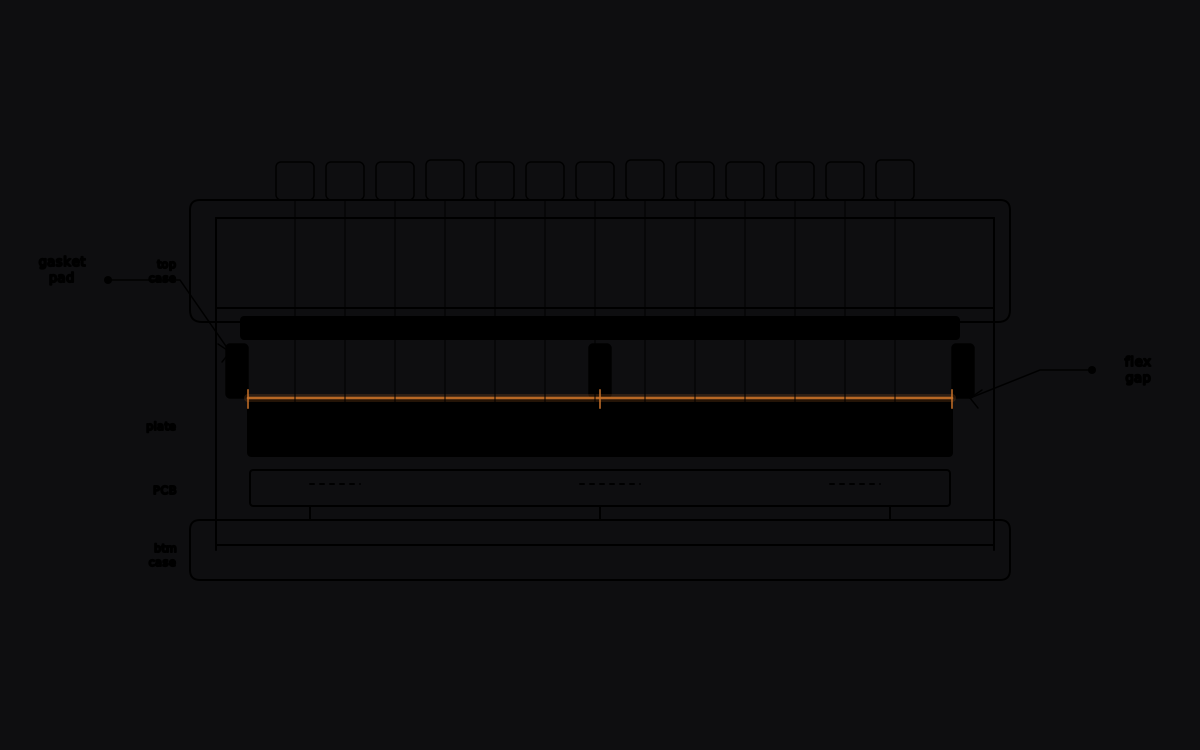
Two keyboards both say "gasket mount." One costs $90, one costs $350. They sound nothing alike. The spec sheet gives no way to predict which is which.
That gap is not a quality-control failure. It is the predictable result of a term that describes a structural category without specifying any of the three variables that determine how the structure actually behaves. Gasket mount tells a builder that the plate does not contact the case directly — and stops there. Everything that matters acoustically and in terms of typing feel is downstream of what the spec sheet does not say.
What the term actually means
In a gasket-mount keyboard, the plate — the piece of aluminum, polycarbonate, FR4, or POM that holds the switches — floats. Instead of sitting on pillars bolted to the case or screwed directly to standoffs, the plate is sandwiched or cradled by a compressible material, usually silicone, that bridges the gap between plate and case. The plate can deflect slightly under typing force. The gasket material absorbs some of the impact before it reaches the case walls.
That description is accurate for every keyboard that legitimately uses the term. It is also almost entirely uninformative about the result, because the behavior of that floating plate depends entirely on what the gasket material is, how much of it there is, and how many points of contact it makes with the plate.
The alternative mount types — top mount, tray mount, bottom mount, each covered in the mounting styles guide — have more predictable outcomes because the stiffness of a screw-to-standoff joint varies less across manufacturers than the stiffness of a piece of silicone. Gasket mount introduced a variable that the industry has not yet standardized, and the marketing adopted the term before the engineering settled.
The three variables that determine the result
Plate material. The plate is where most of the acoustic character originates, and the mount style interacts with it directly. A PC plate on a gasket mount produces the sound most people are reaching for when they buy into the category: a deep, slightly muted thock that stays warm across long typing sessions. The polycarbonate flexes independently of the gasket, so the plate is doing some of the acoustic damping work alongside the silicone. A brass plate on the same mount produces a completely different result — tighter, more articulate, heavier at the fingertip, with less give. The gasket softens the bottom-out but cannot override the density of the plate itself. FR4 and POM sit between those poles in different ways: FR4 is stiffer than PC and slightly crisper in sound; POM is similarly flexible to PC but with a slightly softer high-frequency edge.
Boards that offer a plate material choice — the Mode Sonnet configurator, for instance, describes its POM, aluminum, carbon fiber, and copper options by sound character rather than hiding them as a secondary spec — are giving the buyer the actual lever. Boards that don't mention plate material but advertise gasket mount are advertising the category without the substance. For a deeper look at how PC, brass, FR4, and POM compare across different build contexts and mount styles, see plate materials explained.
Gasket hardness and thickness. Silicone gaskets have a Shore A durometer rating. A 40A gasket gives substantially more than a 70A gasket under the same load. Gasket thickness compounds this: a thicker pad at 50A deflects more than a thin pad at the same durometer. These numbers rarely appear on product pages. They have to be extracted from build logs, teardown reviews, or asking the vendor directly — and many vendors don't publish them.
The practical effect: a softer, thicker gasket produces a floatier typing feel with more noticeable plate travel. A stiffer, thinner gasket makes the board feel closer to a top-mount with added acoustic damping. Both get to call themselves gasket-mount on the storefront. The $90 board with a molded TPE gasket running the full perimeter of the plate is not using the same engineering as a board with individually tuned silicone O-rings at eight discrete contact points. Neither is misrepresenting itself with the term; the term is simply too coarse to distinguish them.
Attachment point count. The number of locations where the gasket contacts the plate changes both the consistency of the deflection and the sound character. A board with four gasket pads — one on each corner-ish region — deflects relatively freely and tends to produce a more pronounced plate-flex feel. A board with eight or ten contact points limits lateral movement, stiffens the effective deflection, and tends toward a more even response across the key map. The center keys and the edges feel closer to the same.
Attachment count also affects something subtle: how the board responds to heavy-handed typing. A four-point gasket that feels pleasantly springy at light typing force can feel loose and slightly inconsistent for someone who bottoms out hard. A tighter attachment count holds up better across typing styles. This is the variable that low-cost gasket-mount designs compress on first, because tooling for more contact points costs more. The board with two molded gasket pads per side and a thin silicone sheet between plate and PCB is technically within the gasket-mount definition and acoustically nothing like a board that put engineering effort into the contact geometry.
Where the label is doing marketing work
A gasket mount listing on a $90 keyboard is almost always describing a structural category while implicitly invoking the reputation of more expensive implementations. The term arrived in the hobbyist vocabulary alongside boards like the Geon Frog, the Bakeneko65, and Mode's own lineup — boards that were designed around the mount type and whose feel and sound became the reference against which the category is measured. Attaching that label to a keyboard whose gaskets are a continuous strip of 80A silicone foam running a groove in the bottom case is accurate in the loosest structural sense and misleading in every practical one.
That is not an argument against the budget category. Some of those boards sound fine. The argument is against using the label as a shortcut to an expected outcome. A builder who buys a gasket-mount board expecting the Frog or the Sonnet result because the product page says gasket mount is going to be surprised by the actual board, and the surprise will correctly feel like a category failure even though the manufacturer said nothing technically false.
The label is doing engineering work when the vendor can answer two questions: what is the gasket durometer, and how many attachment points does it use? Any vendor with an actual gasket-mount design has those numbers. A vendor that can't or won't provide them is selling the category rather than the implementation.
How to evaluate a board before you build it
Skip the mount label. Start with the plate material and whether it can be swapped. A PC plate on a gasket design is a reasonable prior for softness and warmth; everything else is a modifier. A brass plate with the same gasket label is going to sound and feel nothing like the PC version, and no amount of foaming or switch selection will close that gap entirely.
Find a teardown or a build log. The keyboard hobby has good documentation culture — a board with meaningful build activity will have at least one video where someone compresses the plate by hand and comments on how far it gives. That one-second moment tells more than three paragraphs of product copy. If the plate barely moves and the reviewer has to look carefully to confirm it's moving at all, the gasket is stiff or the contact count is high. If the corner of the plate visibly deflects before returning, the gasket is doing real work. Theremin Goat and several of the longer-form comparison channels do disassemblies that show contact geometry explicitly — worth searching by board name before purchasing.
Ask whether the gaskets are replaceable. A board that ships with replaceable gaskets in multiple durometers is acknowledging that the right answer depends on the builder and the switch choice. That design philosophy is a reliable signal that the manufacturer understands the variable, even if they're not publishing the Shore A number in the storefront copy.
Finally, pair expectations to the rest of the build. A gasket mount with a brass plate and stiff gaskets running Gateron Oil King linears is going to sound fundamentally different from the same mount with a PC plate and softer gaskets. The switches and the plate interact before the gasket sees any of the energy. No mount design can override what the plate material and switch characteristics are already doing. The gasket shapes the tail of the acoustic envelope — the sustain and the decay — not the fundamental character of the keystroke. A builder who understands that will not be surprised by any gasket-mount board, regardless of what the label costs. Stabilizers operate in that same post-impact acoustic window; for how stab rattle and chassis resonance interact, see stabilizers explained.
What to look for
A gasket-mount board worth the name has a PC or POM plate option, a gasket durometer the vendor will tell you, and at least six contact points. Below that threshold the term is shorthand for "softer than a tray mount," which is useful information — just not the information the marketing implies. For builders who own a board in that range and want reliable acoustic improvement without waiting for better specs, the tape mod is the cheapest intervention that specifically targets the PCB resonance that budget top-mount and tray-mount builds leave unaddressed. Layering in PE foam addresses the low-mid resonance the tape mod leaves; the sound-dampening guide covers how both stack with the chassis design. A board at $90 that says "soft typing feel, compliant mount" is describing itself accurately and asking for appropriate expectations. A board at $90 that says "gasket mount" and provides no further detail is asking to be benchmarked against boards that cost four times as much. The distinction is worth holding.
The interesting development to watch over the next two quarters is whether the more detailed acoustic specifications — gasket durometer, contact count, plate-swap compatibility — migrate down to the $150 tier as competition for that bracket intensifies. The boards arriving in 2026 at the mid range are already speccing more carefully than 2023 equivalents. The spec sheet is catching up to the label. When a $120 board publishes its gasket Shore A alongside its plate material options, the term will have earned its marketing weight. It hasn't yet, but the direction is right.
Keep reading
- Ideas
The brass weight mod: what added mass actually buys you
Bolting a half-pound of brass into the bottom of a case is one of the more expensive mods in the hobby for how little it visibly does. It changes how a board sounds and sits on a desk — just not in the ways the marketing copy implies.
thock8 min read - Ideas
The Holee mod: what foam inside the switch actually buys you
Small pads of polyurethane foam cut and wedged inside the switch housing itself — not under the PCB, not behind it, not under the keycap. The Holee mod works at a smaller scale than every other foam mod in the hobby, and it costs proportionally more time.
thock8 min read - Ideas
The o-ring mod: soft landings for tray-mount and top-mount boards
A $2 bag of silicone O-rings is enough to give a tray-mount board meaningfully more flex and a cleaner sound. Here is the full procedure and what to realistically expect.
thock8 min read - Ideas
Pairing Oil Kings with the Mode Sonnet
This pairing has been on the bench for months, and a free Sunday finally made it happen. The Sonnet is a soft 75 with a block mount, and Oil Kings are a heavy factory-lubed linear — together they hit a register worth coming back to.
thock5 min read