Mounting styles, compared: gasket, top-mount, tray, and integrated plate
A builder who has lubed switches and tuned stabilizers and chosen a keycap profile and still cannot place why their next board feels different from their last one is usually meeting the mount style. The plate's relationship to the case is the half of the typing feel that nobody discusses on a sound test.
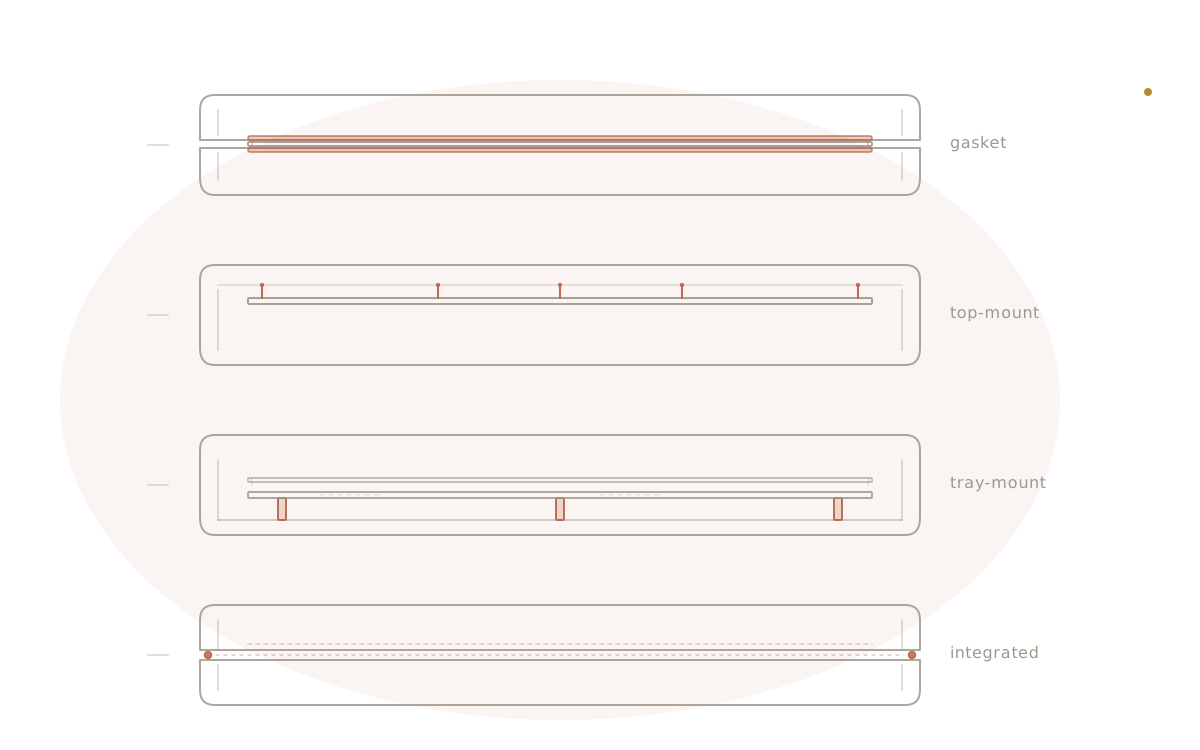
A builder finishes their second custom and notices, without quite being able to say why, that it feels different from the first. The switches are the same batch. The stabilizers are tuned. The keycaps moved over from the old board. The case material is the same aluminum the last one was. But the new board lands softer at the bottom of every press, the sound is rounder, the typing surface gives a millimeter under a heavy stroke. The thing that changed is the mount style — the mechanical relationship between the plate, the PCB, and the case shell — and it is the half of the typing feel that almost no review covers directly.
Mount style is structural, not cosmetic. It decides how vibration from a keypress travels into the case, how much give the plate has under the finger, and whether the case acts as a rigid sounding board or a dampened one. The market has converged on four canonical styles, plus enough hybrids to keep the taxonomy honest. This guide walks each in turn, then closes on which to actually pick.
Gasket-mount
Gasket-mount sandwiches strips of foam — usually Poron, sometimes silicone — between the plate and the case shell on both top and bottom. The plate does not touch the case directly. It rests on the foam strips, which compress slightly under every keypress and absorb the resulting energy before it reaches the aluminum or polycarbonate around them.
The sound is the easiest signature to identify in a side-by-side. Gasket boards read as deeper, rounder, and more uniform across the board than any of the other three styles. Because the plate is decoupled from the case, the case stops contributing high-frequency ring to the signal — what comes out is mostly the switch and the keycap, dampened by the foam, with a low-end character the gasket strips themselves help shape.
The feel is the more subtle change. A well-built gasket board gives perceptibly under a heavy keypress — not a lot, somewhere between half a millimeter and a millimeter and a half depending on the foam density and the strip placement — and a typist who comes off a top-mount or integrated board onto a gasket notices the give within a few keystrokes. Light typists may not notice at all. The "soft" reputation gasket boards have earned in the modern era is mostly accurate and mostly a function of the gasket compression rather than any quality of the plate material itself.
Mode Sonnet is a canonical modern example: a 75% aluminum case with the plate gasket-mounted top and bottom, shipping with hotswap PCBs and a brass weight option. The typing feel is the standard reference point for what gasket means in the current market — soft, uniform, low-pitched. Most enthusiast boards announced for group buy since 2023 are gasket-mounted, and the format has effectively become the default for new custom designs. The KBD75 v3 is a 75% counterpart in the same tier — gasket-mounted, hotswap PCB, QMK/VIA — and a common first recommendation for builders who want a function row without moving to a full TKL. The MM Studio Class80 from MM Studio takes the same approach in a TKL chassis — CNC aluminum with both top-mount and gasket-mount configurations available from a single board — and is one of the more studied examples of how a multi-mode mount system changes the shape of the builder's decision.
The honest caveat with gasket is that execution matters more than the label. A board that calls itself gasket-mount but uses thin strips with poor compression behaves more like a top-mount with extra steps. The foam density, strip length, and the snugness of the case fit all have to land for the mount to deliver its advertised character. Builders evaluating a new design should look for actual compression specs in the announcement, not just the word "gasket" in the marketing copy.
A distinctive gasket variant worth naming on its own is the burger mount — a name that comes from the original Bakeneko65 design, where the case clamshells around a single o-ring that runs the perimeter of the plate-PCB assembly instead of foam strips top and bottom. The o-ring still isolates the assembly from the case shell and still compresses under a keypress, just less than a well-built foam gasket does — the feel and sound land closer to gasket than to integrated, tighter and more uniform than a foam-strip build but with real give, not zero. Bakeneko-style boards remain the standard reference for what a well-executed budget gasket implementation sounds like, at a price point full custom gasket boards cannot reach.
Top-mount
Top-mount screws the plate directly to standoffs on the inside of the top case half. The plate is bolted to the case; the PCB hangs off the plate through the switches; the bottom case half is structural but not mechanically connected to the typing surface. It is the classic high-end mount style, dominant in the customs of the late 2010s and early 2020s — the Tofu redux, the Bauer, the Mr. Suit, most of the early TGR boards.
The sound is tighter, more focused, and slightly higher-pitched than a gasket equivalent. Because the plate is hard-coupled to the case, vibration travels into the shell and contributes to the signature. The result is a board that sounds more "alive" — more case character in the signal — which is exactly the quality some builders chase and exactly the quality others have moved away from in the gasket era. Top-mount boards are also the most prone to plate ping among the four styles, because the metal-to-metal contact between plate and standoff gives high-frequency vibration a clean path into the case.
The feel is firmer and more direct. There is essentially no give. The plate flexes only as much as the plate material itself permits, and on a stiff aluminum or steel plate that is almost none. Heavy typists who like the sensation of "hitting something" often prefer top-mount over gasket for exactly this reason; light typists who type from the wrist often find top-mount fatiguing over a long session.
Top-mount is the reference style most gasket boards are positioned against. A reader who has only typed on modern gasket customs and finds them too soft is usually looking for a top-mount, even if they would not phrase it that way. The classic feel is not gone from the market — designers like Cipulot and the smaller Korean custom houses still ship top-mount boards regularly — but the volume has shifted, and a builder shopping for top-mount in 2026 is shopping a thinner catalog than they would have been in 2020.
Tray-mount and the "no plate fixing" family
Tray-mount is the budget default. The PCB screws directly to standoffs on the bottom case shell, and the plate — if there is one — clips into the switches with no mechanical link to either case half. There are no gaskets, no plate screws, no acoustic engineering at the case-to-plate seam. It is the cheapest mount style to manufacture, which is why it dominates the prebuilt end of the market: most Royal Kludge, GMMK, and entry-level Keychron boards ship tray-mounted whether or not the spec sheet says so.
The sound is the most variable of the four styles. Because the only structural contact between the PCB and the case is at the standoff points, vibration travels into the case unevenly — keys above a standoff sound tighter and brighter, keys between standoffs sound looser and more hollow. The board's acoustic signature depends on where the keys are relative to the screws, which means a typist who lives mostly in the home row may hear something very different from a typist who lives in the modifier cluster.
The feel inherits the same problem. The PCB and plate are stiffest at the standoff points and softer between them, so the give under a keypress is non-uniform. A typist who consistently presses a single key near a screw may not notice; a typist who roams across the board will feel keys "soften" as they move away from the screws. Tray-mount boards typically benefit the most from PE foam, plate foam, and the other acoustic mods covered in the sound-dampening guide — there is more raw hollowness in the case for those layers to absorb.
A close cousin worth naming is PCB-mount, where the PCB sits on standoffs in the same tray-mount configuration but without a plate fastened to either the PCB or the case. QK75 is a representative example: a CNC aluminum 75% from Qwertykeys with the PCB mounted to the bottom case and the plate either floating in the switches or omitted entirely (the board ships with a "plateless" option). The result is a looser, bouncier feel than tray-mount with a fixed plate — switches have nothing rigid behind them and rely on the PCB itself for backing. Builders who like the sensation describe it as "marshmallow"; builders who do not describe the same configuration as imprecise.
Either way — tray-mount or PCB-mount — the family character is the same: cheap to build, sound varies across the layout, feel varies across the layout, responds well to the acoustic mod stack. The unmodded version is the prebuilt baseline. The modded version can sound and feel surprisingly good, but it takes more work than gasket or top-mount to reach the same finished state.
Integrated plate
Integrated plate machines the plate as part of the case rather than as a separate piece. There is no plate-to-case seam to engineer because there is no separate plate. The switches snap into a milled cutout in the case top, the PCB sits below, and the whole assembly is mechanically continuous from switch to case shell.
The sound is the most consistent of the four styles. There are no foam strips to compress unevenly, no standoffs creating zones of stiffness, no plate-screw torque variation across the board — every key sits in the same rigid environment. The character is also the highest-pitched and most case-dominant of the four. Because the plate is the case, the case material defines the acoustic signature directly: an aluminum integrated board reads as bright and tight, a polycarbonate integrated board reads as softer and a step deeper but still firmer than a polycarbonate gasket.
The feel is the firmest of the four. Zero give, zero flex, zero margin — the typing surface is a solid block of metal or plastic. Heavy bottom-out typists tend to either love this or bounce off it within a week. There is no in-between.
Modern budget boards in the KBDfans QK series and similar unibody designs lean on this approach to deliver a tight, consistent sound at a price point top-mount customs cannot reach — no separate plate to manufacture or tune, just a milled case doing double duty.
How real boards blend these
The four styles above are the canonical taxonomy. Real-world boards routinely blend them. Gasket-burger boards combine gasket strips with perimeter o-ring isolation. PCB-mount-with-case-foam boards effectively port the tray-mount geometry into a gasket-adjacent feel by foaming the cavity the standoffs leave. Some top-mount designs ship with optional gasket-mount adapter kits. The label on a vendor page is a useful starting hint, not a guarantee of feel.
The practical move when evaluating a new board is to read past the one-word mount-style tag in the spec sheet. Look for the foam density on a gasket. Look for the standoff count on a tray-mount. Look for the o-ring durometer on a burger. The execution variables decide where on the spectrum a board actually lands, and two boards both calling themselves "gasket-mount" can sit a noticeable distance apart on every axis that matters.
What to actually pick
If a builder wants the softest, deepest, most uniform sound and feel — and they are buying in the modern enthusiast custom market — they want gasket. The mode-sonnet and most of its contemporaries cover that space well, and the catalog is large enough that the only real question is which case material and which layout, not which mount. Builders who want that same gasket character at a fraction of the price should look at burger-mount boards like the Bakeneko instead — the earlier section covers the trade-off.
If a builder wants the firmer, more direct, more case-resonant feel that defined the late-2010s custom era, they want top-mount. The catalog is smaller and the prices are usually higher, but the boards exist and the character is real and distinct.
If a builder is shopping at the prebuilt end of the market and willing to mod, tray-mount is what they are getting whether the listing says so or not. The PE foam mod and tape mod stack can take a tray-mount board most of the way to a satisfying sound; the o-ring mod handles the standoff contact points that foam cannot reach; and properly serviced stabilizers address the rattle that neither foam nor o-ring touches. The floor is lower than gasket and the ceiling is lower too.
If a builder wants the tightest possible sound at the lowest possible price — and is willing to accept zero give in the typing surface — integrated plate is the answer. The QK-series delivers a sound character at $200 that most top-mount customs struggle to match at twice the price, with the trade-off paid entirely in firmness of feel.
The honest closing note is that mount style interacts with everything else the builder has chosen. A linear switch on a gasket board with PE foam and a thick MT3 set produces one kind of sound; the same switch on a top-mount board with bare PCB and a Cherry-profile ABS set produces a different one. The mount is a layer, not a verdict. For the plate variable that pairs with each of these mount styles — how aluminium, brass, FR4, POM, and polycarbonate each interact with tray, gasket, and top-mount geometries — see plate materials, explained. The thock house take: pick the mount that matches the typing feel wanted, not the sound — the sound can be tuned around the mount, but the feel under the finger cannot.
Keep reading
- Guides
Keyboard case materials, compared: aluminium, polycarbonate, and ABS
The case is the largest resonant body in a keyboard. Aluminium, polycarbonate, and ABS each change the sound, feel, and weight profile in fundamentally different ways — here is what each material actually does.
thock11 min read - Guides
Stabilizers explained: from stock rattle to silent smoothness
Stabilizers are the most acoustically influential component most builders treat as an afterthought. Understanding what they are and why they fail changes every build that follows.
thock12 min read - Guides
Sound dampening, compared: case foam, plate foam, PE foam, and the tape mod
Four layers, four very different jobs. Here is what each sound mod actually changes, where it sits in the build stack, and the order to stack them in if you only have time for one or two.
thock9 min read - Guides
How to clean and maintain a mechanical keyboard
Dust, oil, and crumbs collect on every keyboard whether anyone notices or not. A light routine on a fixed cadence keeps a board feeling and sounding like day one — no teardown required.
thock8 min read