The brass weight mod: what added mass actually buys you
Bolting a half-pound of brass into the bottom of a case is one of the more expensive mods in the hobby for how little it visibly does. It changes how a board sounds and sits on a desk — just not in the ways the marketing copy implies.
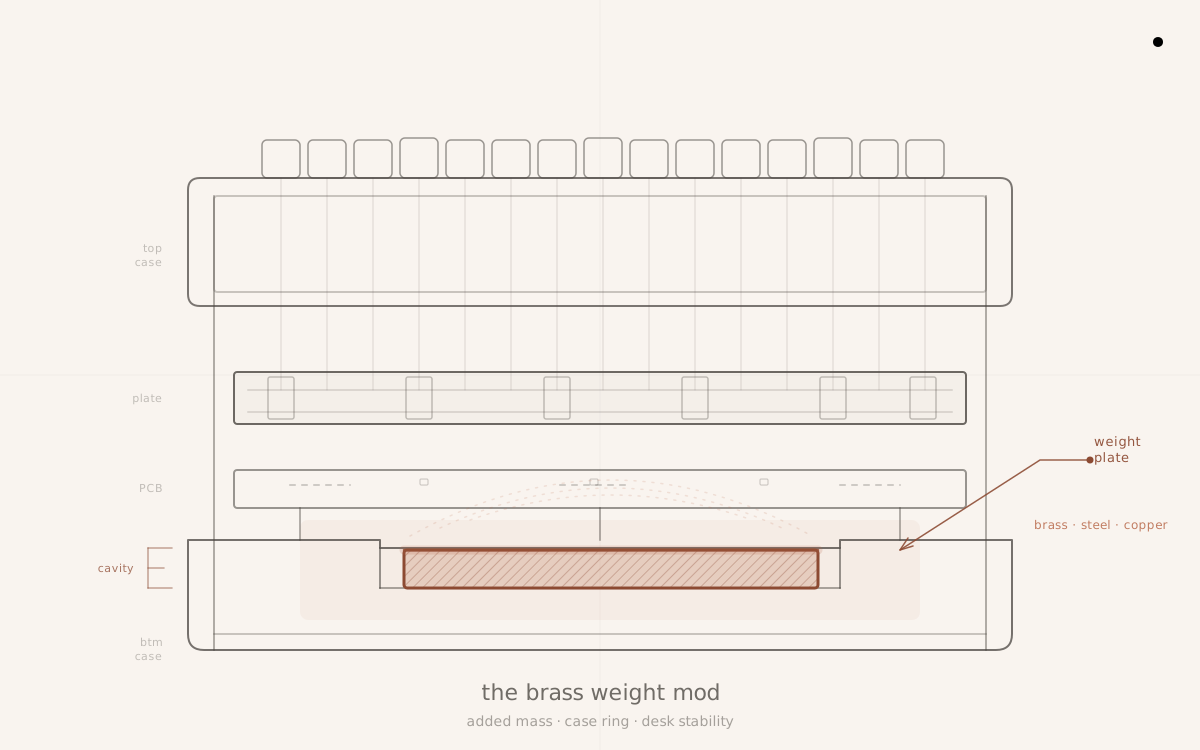
A brass weight kit costs more than most switch sets and does not touch a single switch. It does not lube anything, tension anything, or fill a single air gap with foam. It just sits in the bottom of the case being heavy. That it remains one of the most-discussed mods in the boutique-custom tier says something about what builders are actually optimizing for once the acoustic basics — foam, films, lube, stabilizers — are already handled.
What the mod actually is
Most implementations are one of three things: a milled brass (occasionally steel or copper) plate that bolts into the case bottom in place of a stock plastic or thin-aluminum bottom, a set of brass weights that drop into cavities molded for exactly that purpose, or brass feet that replace the stock rubber ones. Vendors like Mode Designs and Meletrix sell brass weight options as an add-on SKU alongside their standard case; the Mode Sonnet is a documented example, offered from the factory with an optional brass bottom weight that regularly sells out ahead of the standard aluminum one, as covered in the case materials guide. DIY versions exist too — bar stock cut to fit, or a cavity filled with epoxy and steel shot — but the fitted, vendor-milled option is far more common because tolerance matters: a weight that rattles inside its cavity defeats the purpose.
The mechanism is straightforward physics, not chemistry. Adding mass to the case bottom increases the total moving mass the keystroke's impact energy has to accelerate. For the same force from a bottom-out, a heavier assembly moves less and vibrates less — the classic F = ma relationship, just applied to a keyboard chassis instead of a physics problem set. It also raises the energy required to excite the case's own resonant modes, which is the mechanism behind the "less case ping" builders report on lightweight aluminum or steel-bottom boards that ring audibly when struck or flicked with a fingernail.
The sound change is real and modest
The audible result is a bottom-out that reads as denser and a shade lower in pitch, with less of the thin metallic ring that some lightweight cases carry underneath the switch sound. This is a genuinely different mechanism from foam or tape mods — those add damping material that absorbs vibration; a brass weight adds inertia that resists being set into motion in the first place. They are solving adjacent problems from opposite directions, and on a case that both rings and resonates hollow, doing both is not redundant.
It is worth being precise about the size of the effect, because the mod gets sold with heavier claims than the physics supports. The density numbers explain why brass, steel, and copper are the materials of choice and aluminum is not: brass runs roughly 8.4–8.7 g/cm³, copper close to 8.9 g/cm³, and steel around 7.85 g/cm³ — all three to four times denser than the 2.7 g/cm³ of the aluminum case around them. That density is what lets a weight kit add real mass — typical kits run somewhere in the 150–400 gram range — without taking up much more room than the empty cavity it replaces.
The feel change is mostly psychoacoustic, and that is fine
Builders describe a heavier board as feeling more "planted" or more "premium" under the hands. Some of that is real: a heavier keyboard resists lateral displacement more effectively than a lighter one, so an aggressive typist who normally walks a light board an inch across the desk over a long session will notice the heavier build staying put. That part is basic physics — the same reason a loaded weight plate does not slide across a gym floor the way an empty one does — and it is the most concrete, least arguable benefit of the mod.
The rest of the "feel" claim is softer than the sound claim. Added mass in the case bottom does not change plate flex, gasket compression, or how the switch itself feels underneath the finger — those are functions of mounting design and switch internals, entirely separate from how much the case weighs. So "planted" is doing real perceptual work that is only loosely connected to what actually changed mechanically. Weight reads as quality partly because heavy objects in consumer goods generally are built to tighter tolerances, and the brain imports that association whether or not it applies here. That does not make the feeling fake. It means a builder should be honest about which part of the improvement is mechanical and which part is the same bias that makes a heavier phone feel more expensive than a lighter one with identical specs.
What it does not fix
This is the section that separates the mod from the marketing around it. A brass weight will not fix a scratchy switch, will not quiet down untuned stabilizers, will not add flex to a board that types rigid because the plate is screwed straight to the case, and will not turn a hollow-sounding budget board into a dense-sounding one — that is a damping problem, and damping is what foam and gaskets are for, not mass. Nor will it compensate for a genuinely bad mounting design: a board with an unstable typing feel because the gasket geometry is wrong stays exactly as unstable with forty extra dollars of brass screwed into the bottom of it. Weight changes how much energy the case absorbs and how far a board slides; it does not change the mechanical relationship between plate, switch, and finger.
The cost-to-effect ratio is also worth stating plainly. A vendor weight kit typically runs $40 to $150 depending on material and finish, for an effect that is real but subtle enough that a blind A/B test on a well-built board will produce a meaningfully smaller consensus than a sighted one. Compare that to the O-ring mod at two to five dollars or PE foam at two dollars, both of which produce more immediately obvious acoustic deltas for a fraction of the cost. The brass weight mod is not a value play. It is a finishing move for builders who have already done the cheap, high-leverage mods and are looking for the next small increment on a board that is otherwise already tuned well.
Where it earns its keep
The mod makes the most sense on lightweight, thin-walled metal cases — extruded aluminum shells in particular, since these are the designs most prone to an audible ring when the case itself is struck or when a hard bottom-out excites the shell directly. It also makes sense for typists who bottom out hard and consistently shift a light board across the desk during aggressive sessions; the added mass genuinely solves that specific, physical complaint. It makes the least sense as a first mod, as a fix for a board that sounds hollow rather than ringing, or as a substitute for servicing stabilizers and lubing switches — both of which address louder, more common acoustic problems for a fraction of the price and belong earlier in any build's tuning order.
What to watch
More vendors are starting to offer brass, steel, or tungsten weight options as a checkout-time SKU rather than an aftermarket purchase — the same shift already underway with configurable case material, tracked in the case materials guide. That trend makes sense: it is a low-engineering-risk upsell with a real, if modest, effect, and it lets a boutique vendor sell the same shell twice at two price points. For a builder deciding whether to pay for it, the honest framing holds regardless of who is selling it: the brass weight mod changes a board's resonant behavior and its resistance to sliding across a desk. It does not change what the switch feels like under a finger, and no amount of added mass makes a poorly tuned board sound like a well-tuned one.
Build sheet
Keep reading
- Ideas
What gasket mount actually delivers (and what it doesn't)
The label appears on keyboards at every price point, from $90 prebuilts to $350 group-buy customs, but two boards with identical spec-sheet language can sound nothing alike. Here is what the term actually tells you, and what it doesn't.
thock9 min read - Ideas
The Holee mod: what foam inside the switch actually buys you
Small pads of polyurethane foam cut and wedged inside the switch housing itself — not under the PCB, not behind it, not under the keycap. The Holee mod works at a smaller scale than every other foam mod in the hobby, and it costs proportionally more time.
thock8 min read - Ideas
The o-ring mod: soft landings for tray-mount and top-mount boards
A $2 bag of silicone O-rings is enough to give a tray-mount board meaningfully more flex and a cleaner sound. Here is the full procedure and what to realistically expect.
thock8 min read - Ideas
The tape mod: what one strip of Kapton actually does
Three to five strips of painter's tape on the back of your PCB — that's the whole mod. The acoustic effect is real. Its magnitude depends almost entirely on the board underneath it.
thock10 min read