Switch housings, compared: nylon, polycarbonate, POM, and the rest
The housing line on a switch spec sheet is the second-most-important thing about a switch, after the type, and most buyers skim past it. Material decides how the switch rings, how the stem rails feel under a finger, and how much grace it gives a bad lube job. A 'PC top, nylon bottom' tag is doing more work than its three words suggest.
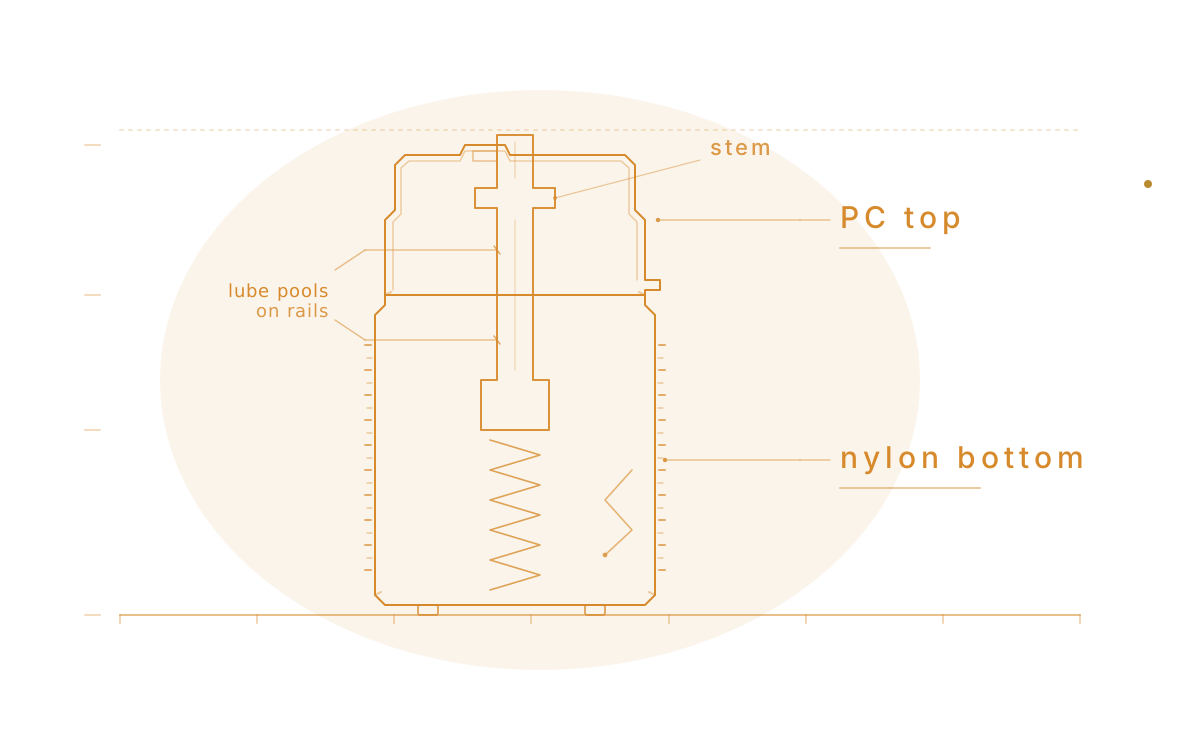
A first-time buyer opens a switch product page, reads "PC top, nylon bottom" near the bottom of the spec block, and has no idea what to do with the information. The brand line, the spring weight, the actuation distance are explained somewhere on the page. The housing material is named and dropped, as if the reader already knows what it changes. Most do not, and the gap shows up later, when the same buyer wonders why two switches with identical weights and similar travel sound and feel nothing alike.
Housing material is the quiet decision in every switch. It sets the acoustic ceiling and floor, changes how forgiving the stem rails are to lube, and shifts the wobble character of the stem under a fingertip. Five or six materials show up on real product pages, and one combination has effectively become the default. This guide walks each in turn, then closes on a decision tree for buyers facing a top or bottom housing swap.
Why housing material matters
Three axes move with housing material: sound, feel, and lube behavior. Everything else (RGB shine-through, color options, mold tolerance) is downstream.
Sound is the loudest difference. The housing is the resonant chamber a switch makes its noise inside. A harder plastic lets the chamber ring at a higher pitch and for longer; a softer plastic absorbs more of the ring and damps the high end of the spectrum. Builders chasing a "thocky" signature are mostly chasing soft, dense bottom housings; builders chasing brighter and more articulate signatures are mostly chasing harder top housings.
Feel is the more subtle change. Stem wobble (the small N/S and E/W play under a keycap before the press starts) depends partly on how snugly the housing walls grip the stem, and that grip is set by surface friction and dimensional stability out of the mold. Some plastics flow into the mold more crisply than others; some grip the stem with a little more friction. The result is a perceptible difference in how planted a switch feels before it has moved at all.
Lube behavior is the practical axis most builders learn about by ruining a set. Some plastics are self-lubricating to a useful degree, which means the same drop of Krytox 205g0 goes further. Others are friction-hungry and reward careful application. Others punish heavy application with a sluggish, slow-motion press. The housing decides the budget and the margin for error.
Nylon
Nylon (almost always PA66 in keyboard switches) is the classic housing material. It is warm, muted, sound-dampening, and forgiving. The vast majority of stock Cherry-style switches use nylon bottoms, and a large share also use nylon tops. The polymer is slightly soft, slightly grippy at the surface, and absorbs high-frequency ring efficiently. The result is the sound profile a generation of typists grew up calling "the Cherry sound."
Cherry MX2A Red is the canonical reference: an all-nylon switch in the modern Cherry catalog, with the warm, muted, slightly hollow character that defines the family. A typist who has touched a stock Cherry switch in the last thirty years has touched nylon. The sound is low and round, the ring is short, the high-frequency content is essentially absent. On a bare PCB with no foam, all-nylon switches still produce a coherent sound because the housing itself does most of the dampening.
Under the finger, nylon's surface is faintly grippy. The same property that absorbs ring also raises sliding friction at the stem rails, which is why nylon switches reward lube more than any other housing material: the difference between a stock and a hand-lubed all-nylon switch is one of the largest deltas in the hobby. Nylon also grips the stem firmly at the rails, which reduces wobble compared to a harder housing of equal mold quality. Cheaper nylon switches can have looser stem fits than premium ones, which costs them some of that advantage.
Polycarbonate
Polycarbonate (PC) is the harder, clearer, brighter alternative. The plastic is denser at the molecular level, less compliant under impact, and significantly more transparent. PC tops ring more, dampen less, and let the upper chamber of the switch contribute high-frequency content to the sound. PC bottoms, which are rarer, push the same character into the bottom-out itself.
The trend over the last several years has been clear: PC top, nylon bottom. The combination keeps the bright, articulate, slightly clacky top-out and adds a warm, muted, well-dampened bottom-out. Gateron Oil King is the most-cited example, a switch whose sound signature is essentially a textbook of what the combination delivers. Most enthusiast switches released since 2022 use either this combination or a near variant of it.
All-PC switches sit at the brighter end of the spectrum. Tecsee Sapphire V2 is a useful reference: an all-polycarbonate housing that produces a notably brighter signature than either an all-nylon switch or a PC-top-nylon-bottom hybrid. Some builders love the character; others find it fatiguing on long sessions. On clicky switches, PC tops cause the click itself to ring more, which is why most clicky enthusiast designs (especially in the Kailh Box family) use PC tops on purpose.
PC is also the housing material most sensitive to lube application. The polymer is not self-lubricating, the surface friction is lower than nylon out of the box, and a heavy hand with 205g0 can drop the switch into a slow-motion press the lube tools call "molasses." The fix is a thinner application, often a thinner oil like 105 on the rails. PC rewards builders who already calibrate to a light coat and punishes the ones still learning.
POM
POM (polyoxymethylene, also sold as Delrin or acetal) is the slick, dense, low-friction option. Most switch stems are POM already; the polymer's self-lubricating character is exactly why it dominates the stem axis of the market. POM housings are a different animal: rare-ish, distinctive, and acoustically muted in a way neither nylon nor PC quite match.
POM housings reduce sliding friction at the stem rails to the point that they barely need lube. A stock POM-housed linear is closer to a hand-lubed nylon switch than a stock nylon switch is. The sound is muted, slightly hollow at the top of travel (POM does not absorb high-frequency ring as well as nylon does), and distinctively dense at the bottom-out. Some typists call it the most "thocky" plastic on the market; others describe it as plasticky or muffled.
The Gateron Box CJ is the most visible all-POM enthusiast switch in the current catalog, and a handful of group-buy designs ship POM in either housing. POM also shows up in some silent-linear lines, because the low-friction property pairs naturally with the dampening goal. The caveat is dimensional: POM is harder to mold to tight tolerances than nylon, so cheaper POM housings can have looser stem fits than a well-made nylon equivalent. A tester press before committing to a full set is the cheap safeguard.
The rest, briefly
UHMWPE (ultra-high molecular weight polyethylene, often just called UPE in marketing copy) is the niche favorite of the last two years. It is extremely smooth, deeply muted, and slightly waxy under the finger. TX Boutique and several Tecsee LY lines use UPE in one or both housings. The sound is the deepest and most damped of any current housing material, and the feel is correspondingly soft.
LY nylon (long-glass-fiber-reinforced nylon, sometimes labelled PA12 in adjacent variants) is stiffer than regular nylon, with a brighter top-end than PA66 but still warmer than PC. Several recent Gateron and HMX switches use it on the top housing to split the difference between nylon's warmth and PC's articulation.
ABS housings exist almost entirely in budget switches and should be avoided. They sound hollow and high-pitched, the molding tolerances are usually loose, and the polymer's surface is unfriendly to lube. If a switch's spec page lists ABS for either housing, the price has already told the same story.
How housings interact with lube
The single most useful piece of housing knowledge for a modder is which plastics forgive which mistakes. Nylon is forgiving. It hides over-lubing well because its surface friction is high enough that even a generous coat of 205g0 does not drop the switch into molasses territory. Beginners learning to brush lube should start on nylon switches for exactly this reason: the margin for error is the widest, and the same lube job that looks fine on nylon will look much worse on PC.
PC punishes over-lubing. The lower baseline friction means even a moderately heavy coat slows the switch noticeably. The rails go to slow-motion, the return becomes sluggish, and the typist's first instinct (apply more) makes it worse. The fix is a lighter touch, often with a thinner oil on the rails.
POM barely needs lube on the rails. The housing's self-lubricating character means a stock POM switch behaves closer to a lubed nylon one. Most POM modders lube only the stem legs and bottom housing slider points; heavy rail lube on POM is wasted material and a risk of dragging the switch.
For the full technique — which products to use for each housing type, how to apply them, and how much is too much — lubing switches is the practical reference.
How to choose
A buyer who wants a warm, quiet typing sound should choose all-nylon or PC top with nylon bottom. The latter is the modern default for a reason: brightness on top, warmth at the bottom, and a wide catalog built to the recipe. The cherry-mx2a-red end is the conservative all-nylon answer; the gateron-oil-king end is the modern hybrid.
A buyer who wants a brighter, more articulate sound with more chamber ring should choose PC tops with nylon bottoms, or all-PC if they want the sharper end outright. The tecsee-sapphire-v2 end is where this lives. The trade-off is fatigue on long sessions for some typists; the reward is a more "alive" board.
A modder building a quieter board with minimal lube fuss should choose POM-housed switches. The low-friction housing reduces the lube budget, the muted character pairs well with foam and dampening mods, and the bottom-out has a dense quality builders chasing thock appreciate.
A new builder who wants one switch that works on the first try should pick PC top with nylon bottom. The combination is the modern consensus, the price band is well populated, and the result is the closest thing to a default the hobby currently has.
Closing
The housing line on a switch spec sheet is a compact summary of how the switch will sound, feel, and respond to a modder's tools. Two letters and a word do most of the work: PC top means brighter, nylon bottom means warmer, all-POM means slicker and denser, UPE means deepest and most damped. The buyer who learns the shorthand ends up with the board they meant to build; the buyer who skips it ends up swapping switches twice before realizing the housings were doing all the talking. For the acoustic layer between the switch and the case — how plate material shapes the resonance path once the keystroke leaves the housing, and how mounting style determines where that vibration goes from there — those guides complete the stack.
Keep reading
- Guides
Keyboard case materials, compared: aluminium, polycarbonate, and ABS
The case is the largest resonant body in a keyboard. Aluminium, polycarbonate, and ABS each change the sound, feel, and weight profile in fundamentally different ways — here is what each material actually does.
thock11 min read - Guides
Lubing 101: what matters, what doesn't, and where to stop
Lube moves the sound and feel of a switch in ways nothing else in the build can. It also chews up a Saturday and ruins switches when applied with the enthusiasm the rabbit-hole crowd recommends. Here is the version that earns its keep.
thock9 min read - Guides
Mounting styles, compared: gasket, top-mount, tray, and integrated plate
A builder who has lubed switches and tuned stabilizers and chosen a keycap profile and still cannot place why their next board feels different from their last one is usually meeting the mount style. The plate's relationship to the case is the half of the typing feel that nobody discusses on a sound test.
thock13 min read - Guides
Artisan keycaps: a practical buying guide
A single sculpted cap on the Escape key can cost more than the switches underneath it, and the buying process looks nothing like ordering a keycap set. Here is what an artisan actually is, how the raffles work, and the one check that keeps a buyer from winning a cap their board can't use.
thock9 min read