Gaming Boards Are Winning the Spec War, and Enthusiasts Are Paying Attention
Hall-effect sensors and Rapid Trigger have done what RGB lighting and polling-rate marketing never could: closed the spec gap between gaming keyboards and enthusiast builds at the hardware layer. The divide persists in culture and community, but at the switch and firmware level, the lines are dissolving.
For most of the last decade, the enthusiast mechanical keyboard community and the gaming keyboard market operated on separate spec ladders. The enthusiast side competed on switch feel, layout configurability, acoustic character, and mount compliance — things you measure with your fingertips and ears. The gaming side competed on RGB saturation, polling rate, and brand recognition — things you measure on a spec sheet and in milliseconds. The two communities shared a form factor and not much else. That partition is breaking down, and it's breaking down specifically at one feature cluster: hall-effect sensors, Rapid Trigger, and the firmware that ties them together.
What Rapid Trigger actually changes
The mechanism is worth understanding precisely because the marketing around it is easy to dismiss. Traditional mechanical switches — contact-based, whether linear, tactile, or clicky — operate on a binary: the switch is either open or closed. The actuation point is fixed at the factory, typically between 1.8mm and 2.2mm of travel. Once the key crosses that threshold, it fires. To fire again, it has to return above a reset point, also fixed. The physical constants are built into the spring rate and the contact geometry, and no firmware in the world changes them.
Hall-effect switches replace the contact mechanism with a magnet in the stem and a Hall sensor on the PCB (full sensing architecture in the magnetic switch deep-dive). The sensor reads the magnet's field continuously as an analog value across the full range of travel. Nothing snaps. Nothing contacts. The firmware receives a stream of position data and can define actuation and reset points wherever it chooses — including in real time, key by key, with sub-millimeter precision. Rapid Trigger is the firmware feature that exploits this: instead of fixed actuation and reset thresholds, the switch fires whenever the key moves downward past a configurable distance from its last peak, and resets whenever it moves upward past that same distance. The result is an actuation point that tracks with the key rather than staying pinned to a position in space.
For gaming, the implications are well-understood: counter-strafing, re-tapping, wasd spam all become cleaner when the reset happens at the physical top of the keystroke rather than at an arbitrary threshold. For typists, the case is subtler but real — a 0.2mm Rapid Trigger window means the switch effectively actuates on any intentional press and ignores partial presses that don't commit, which cleans up misfires on bottom-out keys without demanding a heavier spring.
Two Computex narratives, converging
The interesting development in the first half of 2026 is not that one category picked up Rapid Trigger. It's that both categories did, simultaneously, at Computex, and arrived at nearly identical hardware specs from completely different starting points.
The gaming-mainstream side: Corsair CLIPPER PRO Mini 60. IP57 water resistance, 8000Hz polling, Rapid Trigger configurable down to sub-0.1mm resolution, 60% layout, full RGB. A gaming peripheral from a company whose marketing vocabulary runs on esports partnerships and pro-player testimonials. The board targets the buyer who reads "polling rate" as the headline number and trusts the brand's ecosystem — iCUE configurator, wireless dongle, the usual peripheral stack.
The enthusiast side: IQUNIX EC75, debuted at Computex 2026. An Alice-adjacent layout with a gasket mount, 8000Hz polling, hall-effect sensors, and Rapid Trigger at the same sub-0.1mm floor. Targeted at the reader who reads "gasket mount" and "Alice" as the headline features and treats the polling rate as confirmation rather than pitch. Different audience, different framing, effectively identical sensor and firmware spec.
The score signal
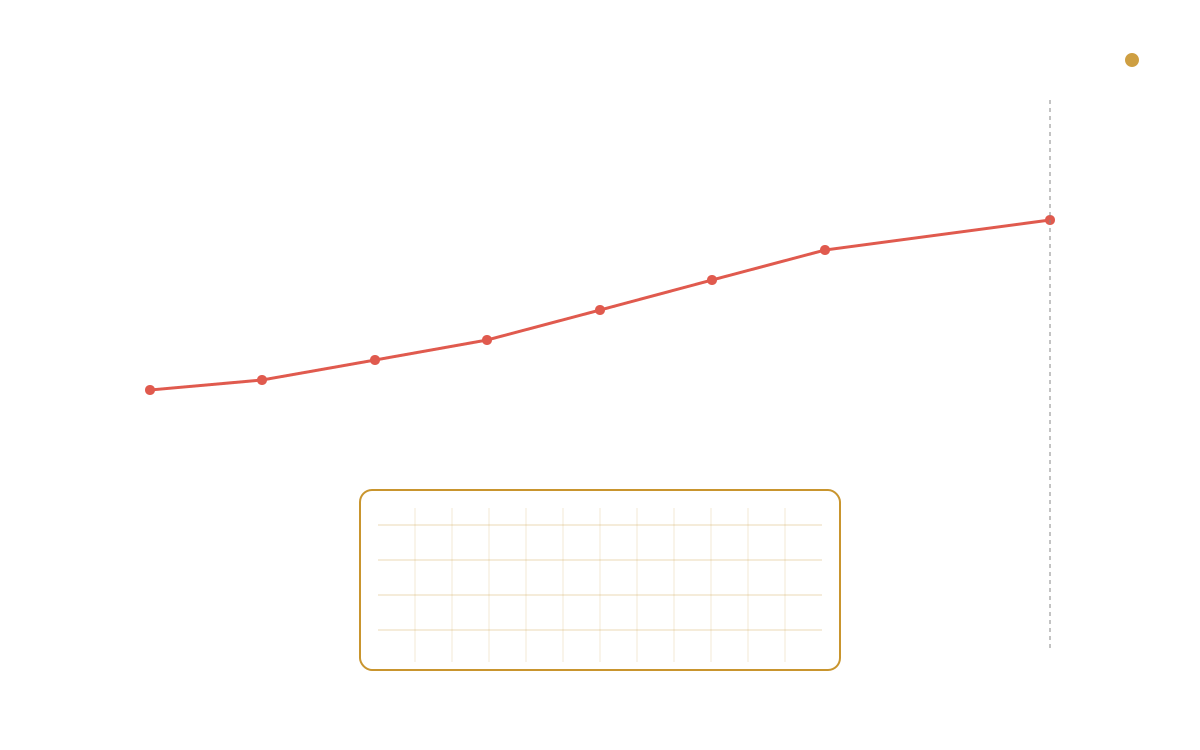
The Trends Tracker has been logging this convergence. Hall Effect / Rapid Trigger has posted a score of 76 in W25 — up from 60 in W22 — the highest in the switch category for three consecutive weeks and treated as baseline expectation for new gaming boards across multiple W25 roundups — a trajectory covered in depth in the hall-effect mainstream piece.
The shape of that climb is not a spike. A spike would suggest a single product launch or a review that happened to catch attention. A brief W21 dip aside, eight weeks of upward movement is the shape of a category whose floor is rising — more products arriving, more roundup coverage including HE/RT as a comparison dimension, more readers encountering the spec and flagging it as relevant to their next purchase. The W22-to-W25 acceleration — from 60 to 76 in three weeks — coincides with Computex, which is the expected supply-side injection. But the earlier W18-to-W20 climb was already happening before the show. The product announcements found demand that was already building.
The spec comparison the gap-closing argument rests on
Three boards render the argument clearly. The Corsair CLIPPER PRO Mini 60 brings hall-effect switches, 8000Hz polling, and sub-0.1mm Rapid Trigger to the gaming-mainstream tier at a price point that reflects peripheral-market pricing — retail, readily available, no group buy, no waitlist. The IQUNIX EC75 brings the identical switch type, the identical polling rate, and the identical RT floor to an Alice-adjacent gasket-mount enthusiast chassis. A reader comparing both boards on hardware specs alone cannot identify which belongs to which category. The Mode Sonnet R2 — the boutique gasket mount thock has covered at length — ships with contact-based mechanical switches, no Rapid Trigger, and polling at 1000Hz. It competes on feel, mount compliance, and build quality. Its spec card looks categorically different on every HE/RT dimension.
That contrast is the argument. The Mode Sonnet R2 is a better board to many readers — the gasket compliance, the mount options, the weight selection, the group-buy community ritual. None of that is challenged here. But its spec card on the HE/RT dimensions looks like the budget gaming tier of two years ago, while a mainstream Corsair gaming peripheral and an Alice-layout enthusiast board from a boutique brand are now indistinguishable on those same specs.
Where the divide still holds
The convergence is real and it is specifically at the switch and sensor layer. The rest of the divide is intact.
Software is the clearest partition. Corsair's Rapid Trigger lives inside iCUE, which is a closed ecosystem. IQUNIX's configurator is proprietary. Wooting's stack — still the reference for Rapid Trigger tuning depth and analog input features — has no open-source equivalent. The QMK and ZMK communities have watched hall-effect firmware mature from the outside for three years and the question of whether either project will add first-class HE support is genuinely open. There is interest in both communities but no shipped implementation. If QMK adds Rapid Trigger support for HE switches, the appeal to the open-firmware enthusiast cohort changes substantially; if it doesn't, HE remains a parallel ecosystem that shares form factors and switch slots with the open-firmware world but not the configurator culture.
Community is the other partition. The reader who sources switches from NovelKeys, follows group buys on Discord, and argues about gasket compression in forum threads is not the same reader who follows pro-player endorsement streams and buys through retail. The spec sheets have converged; the social layers haven't. The Discord servers are different. The review vocabulary is different — "switch feel" and "thock" versus "deadzones" and "input latency." The audiences overlap at the margins and that margin is growing, but a Corsair buyer and a group-buy customs buyer are still different buyers with different upgrade paths.
What to watch
The firmware question is the one that could accelerate or stall the full convergence. If an open-source project ships a credible QMK or ZMK Rapid Trigger implementation for hall-effect PCBs, the cohort that was watching from outside the HE ecosystem has a way in that doesn't require adopting a proprietary configurator. That's the path by which the enthusiast community — the one that cares about keymap layers, open firmware, and long-term reprogrammability — could absorb the HE spec without the ecosystem tradeoff.
The alternative is a stable split: hall-effect firmware remains proprietary, the gaming and enthusiast communities continue to share switch hardware but not software culture, and the spec convergence visible on the Computex floor remains a surface-level convergence rather than a community-level one. The W25 tracker score at 76 captures the hardware momentum. The firmware question is where the next phase of that score gets written.
For the practical purchase question — who gains from HE and when to stay on MX — see the Hall-effect buyer's guide. The Trends Tracker continues logging both signals weekly.
Build sheet
Keep reading
- Trends
How Hall-effect quietly became the new mid-premium default
The polling-rate hype is loud and easy to wave off — 8K, 32K, numbers chasing each other up the spec sheet. The quieter story is that the magnetic-switch tier has stopped being a Wooting-shaped niche and has settled into the $100–$230 prebuilt slot the scene actually buys from. The volume has moved, not just the marketing.
thock7 min read - Trends
Hall-effect stopped climbing. That's not the same as cooling off.
The Hall Effect/Rapid Trigger category has held flat at 97 on thock's trends tracker for two straight weeks, after climbing from 82 in late June. A flat line at the top of the chart looks like fading interest if you're reading it as a stock ticker. Read as a market snapshot, it says something closer to the opposite.
thock6 min read - Guides
Hall-effect keyboards: a practical buyer's guide
Rapid trigger, per-key actuation depth, analog axis output — Hall-effect keyboards deliver all three, but only if the firmware matches the hardware. Here is what to look for, what to pay, and who should skip the category entirely.
thock10 min read - News
Computex 2026: hall-effect keyboards enter the enthusiast conversation
Computex 2026 (May 20–24) was the week hall-effect stopped being a gaming-peripheral curiosity and walked into the same room as enthusiast-grade chassis. Two boards made that argument concrete.
thock8 min read