Build of the week: the Bakeneko65 stops being a budget board under GMK Bentō R2 and Tecsee Sapphire V2
A $150 evergreen hotswap board, a sold-out doubleshot ABS set, and a sparkly polycarbonate tactile aren't a mismatch — the cheap part of this build is the entry price, not the result.
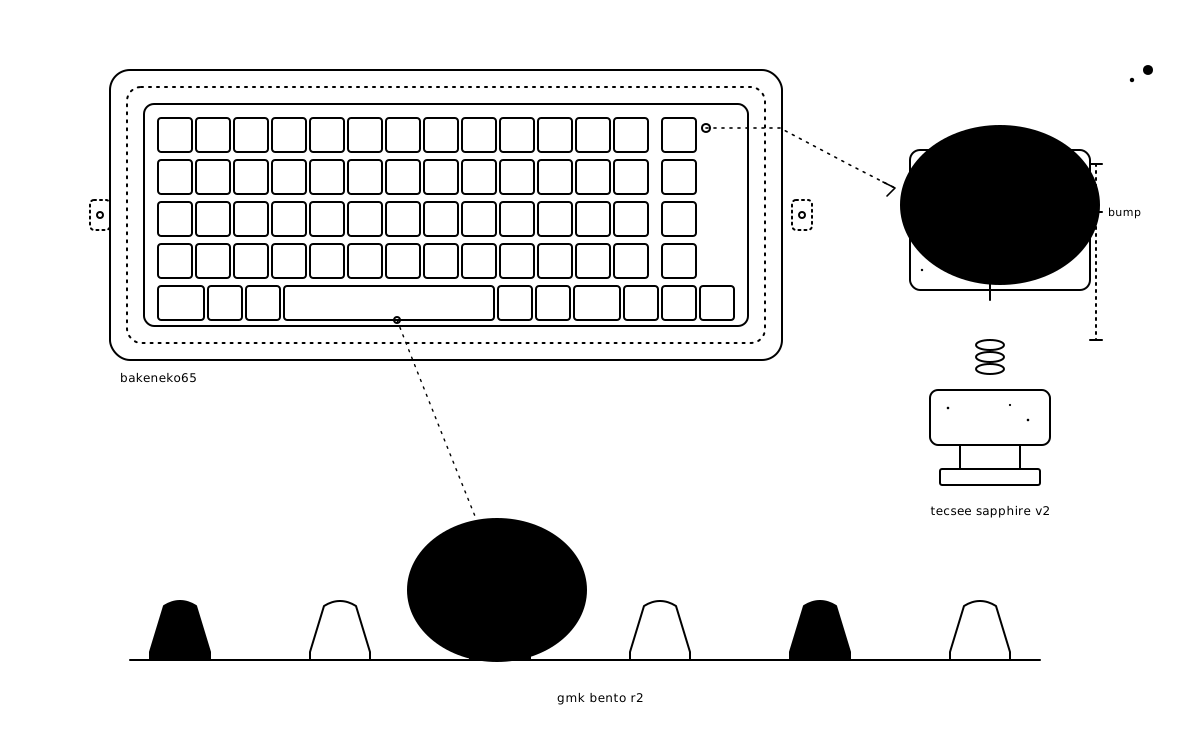
"First custom board" gets treated as a budget category, and the parts that usually get recommended for it reinforce that: the cheapest hotswap PCB, whatever switches are on sale, keycaps picked for coverage rather than character. That's a reasonable way to keep the entry price low. It's also not a rule. This build keeps the actual entry point cheap — the board is still $150 — and spends the rest of the decision on parts that would hold up in a build with no budget ceiling at all.
The parts
| Role | Part | Why it's here |
|---|---|---|
| Board | Bakeneko65 | Cast-aluminum 65%, o-ring gasket mount, FR4 plate, hotswap QMK/VIA PCB, $150 |
| Keycaps | GMK Bentō R2 | Cherry-profile doubleshot ABS, white/dark-blue/pink, designed by biip |
| Switch | Tecsee Sapphire V2 | Mid-tactile, UHMWPE stem, sparkly PC-on-PC housings, factory-lubed |
The Bakeneko65 is the part doing the least talking here, which is the point. It's CannonKeys' evergreen 65%, in stock, gasket-mounted, and it's earned its reputation as "the board most often recommended as a first custom" by being unglamorous and reliable rather than distinctive. That reputation is also why it's easy to underrate what it can carry.
Gasket isolation is why a bright switch housing doesn't sound cheap here
Sapphire V2 runs polycarbonate-on-polycarbonate housings, and PC housings have a known acoustic tendency: they read brighter and more resonant than nylon or POM housings on a rigid mounting platform, because a harder, more resonant plastic transmits more of its own ring into whatever it's bolted to. Tecsee has tuned around that at the switch level — the listed sound profile for the Sapphire V2 is "muted and creamy rather than poppy" — but a switch's own tuning only survives contact with a case that isn't fighting it.
That's where the Bakeneko65's gasket mount earns its keep. An o-ring gasket mount decouples the plate-and-PCB assembly from the case wall instead of screwing it down directly, which means high-frequency resonance generated at the switch has to cross a compliant boundary before it reaches the aluminum shell. A rigid tray-mount board skips that boundary — plate bolted straight to the case — and a bright PC housing on a board like that can read thinner and more hollow than the switch was tuned to sound. On the gasket-mounted Bakeneko65, the case isn't adding its own ring on top of the switch's; the FR4 plate underneath contributes a moderate amount of flex of its own, firmer than a polycarbonate plate but with more give than a steel or aluminum one, and that combination lets the switch's factory tuning come through mostly intact instead of getting brightened by the platform underneath it.
Cherry profile and a top-of-stroke bump are both forgiving choices, for different reasons
GMK Bentō R2 is Cherry profile, and on a build that's meant to be someone's first custom rather than a themed showpiece, that's a quietly practical choice rather than a safe one. Cherry's row sculpt is moderate compared to a tall profile like SA — there's no clearance engineering required, no case headroom to plan around, no risk that the cap height will crowd the board's proportions. It's the profile equivalent of the Bakeneko65 itself: unglamorous, and correct on almost anything. A first build has enough new variables in play — hotswap sockets, plate fit, lubing questions — without also making keycap-to-case clearance one of them.
The switch pairs the same forgiving logic against a different problem: reading the actuation point. Sapphire V2 is a mid-tactile with the bump positioned near the top of its 3.8mm travel, rounding off into a softened bottom-out rather than a sharp wall. For someone new to hotswap who hasn't built the muscle memory to feel a subtler bump lower in the stroke, a bump that shows up early and rounds off gently gives clear, low-effort feedback about where actuation happens — more forgiving than a linear, where there's no bump at all to read, and less demanding than a heavy clicky, where the click bar's snap and a higher operating force both have to be managed at once. The switch also ships factory-lubed, which removes an entire optional step — hand-lubing forty-some switches — from a first build's task list without removing the option to do it later.
Build notes: sockets, stems, and a plate that isn't polycarbonate
Three fit checks are worth doing before this build gets buttoned up.
First, the hotswap sockets. The Bakeneko65's PCB is QMK/VIA hotswap, and any hotswap socket rewards a quick pin check before switches go in at volume — a bent or recessed socket leg is easier to fix on switch one than switch sixty-eight. Sapphire V2 uses a mixed-material stem rather than a single uniform plastic, and while that doesn't change the pin spec, it's still worth seating a handful of switches first and checking for even resistance before committing the full set.
Second, the plate. FR4 is stiffer and snappier underfoot than the polycarbonate plates that have become common on other 65% boards, with less of the softened, slightly muted platform feel a PC plate contributes. That's not a defect — it's simply a different starting point than a builder coming from a PC-plate board might expect, and it's part of why the gasket mount is doing real acoustic work here rather than incidental work.
Third, the caps. Doubleshot ABS sets fit MX stems reliably, but any secondhand or reprint doubleshot run can have minor stem-tolerance variation cap to cap. Since Bentō R2 is sold out and not in active production, a builder sourcing a set secondhand should check a sample of caps directly on switches for wobble before assuming the full set is uniform.
Who should skip this build
This isn't a build for someone chasing the lightest possible sound signature — a gasket-mounted aluminum shell with an FR4 plate is a firmer, denser platform than the ultra-light polycarbonate builds tuned specifically for the quietest possible profile. It's also not for someone who wants SA-scale visual drama; Cherry profile is the deliberately unremarkable choice here, and a builder who wants a keycap set that dominates the desk should look elsewhere. And it's not for someone who wants a keycap set they can reorder without friction: Bentō R2 is sold out, and buying in means buying on the secondhand market on whatever timeline that market offers, not a configurator's timeline.
Verdict
The Bakeneko65's reputation as the safe first board is deserved, but it's a reputation about accessibility, not about ceiling. Paired with a switch whose acoustic tuning depends on a case that won't fight it, and a keycap profile whose whole value is not creating new problems, the same evergreen $150 board reads as a deliberate choice rather than a default one. Nothing about this pairing requires stepping up in price to get a distinctive build — it requires spending the same budget on a keycap set and a switch that were doing careful work already, and trusting a gasket mount to let that work show. For a first build that doesn't want to look or sound like a first build, that's the whole case.
Keep reading
- Ideas
Build of the week: the Drop CTRL goes synthwave under GMK Laser and Ink V2 Yellow
A board tuned for directness, a switch tuned for speed, and a keycap set tuned for attention — the gap between the first two and the third is the entire reason this build works.
thock7 min read - Ideas
Build of the week: the mission control desk, in Class80, Godspeed, and Box White
A retro TKL, a steel-blue-and-cream SA set, and a clicky box-stem switch aren't three separate purchases here — they're one decision, made three times, that only works because each part solves a problem the other two create.
thock7 min read - Ideas
Mixing keycap profiles on one board: what actually works
Mixing profiles reads as a deliberate design choice or a rookie mistake depending entirely on where the swap lands. A handful of zones tolerate it well. The alpha block almost never does.
thock6 min read - Ideas
Lubing switches: what to use, how much, and what to skip
Four lubes, four application points, and one rule that prevents most mistakes: over-lubing is irreversible, under-lubing is not. Here is the practical reference.
thock10 min read