Mixing keycap profiles on one board: what actually works
Mixing profiles reads as a deliberate design choice or a rookie mistake depending entirely on where the swap lands. A handful of zones tolerate it well. The alpha block almost never does.
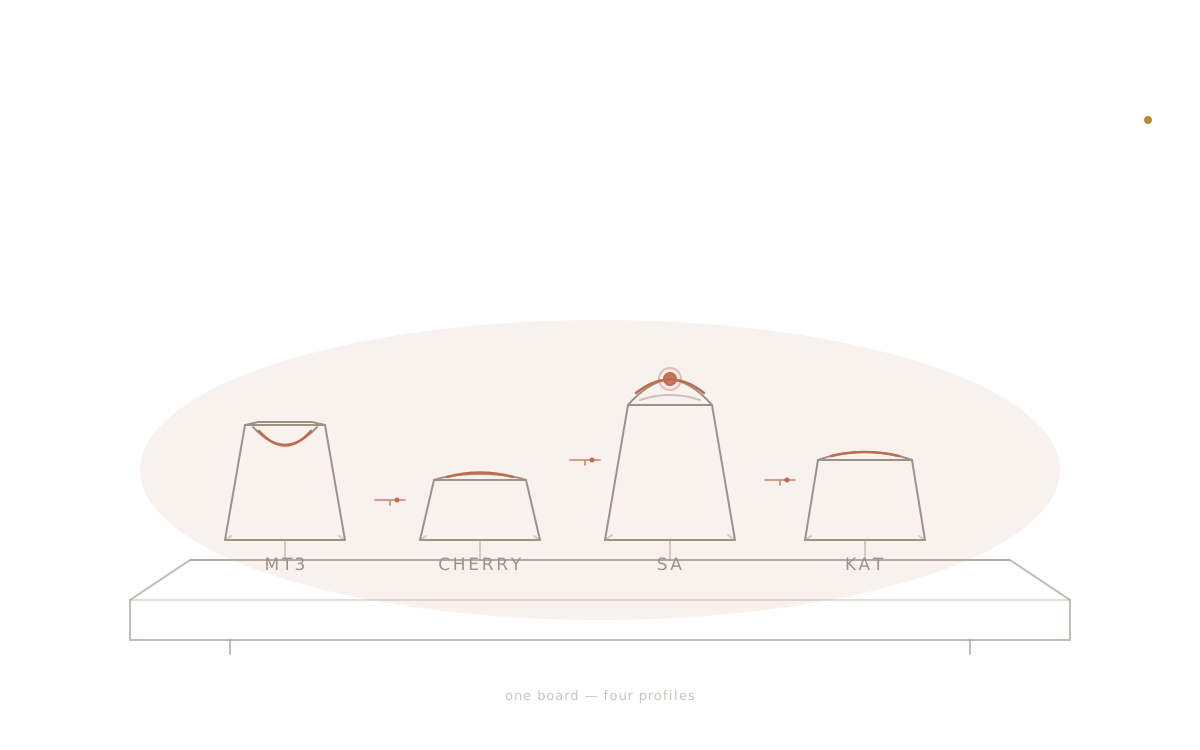
Every keycap forum has a thread titled some version of "is this too much?" attached to a photo of a Cherry-profile board with a single towering SA cap sitting on Escape. Half the replies say it looks intentional. Half say it looks like the wrong cap got left in the box. Both readings are correct, and the difference between them has almost nothing to do with taste and everything to do with where on the board the mix happens.
Mixing profiles is not a reckless move by default. It is a targeted one, and the targets are narrower than most first attempts assume.
Where the swap actually lands
Builders who mix profiles successfully are not reshuffling the whole layout. They are working three zones: a single accent key (usually Esc or the arrow cluster), the modifier row, and the spacebar. Everywhere else — the alpha block, the number row — stays in the base profile, because that's where sculpted profiles do the most row-to-row work and where a mismatch is most visible to the eye and most disruptive to touch-typing.
The reason the alpha block is off-limits is the same reason sculpted profiles exist in the first place: each row is a different shape so the fingers land on the same plane reaching from the number row down to the bottom row. Swap three keys' worth of a different profile into the middle of that curve and the plane breaks — not just visually, but under the fingers, mid-reach.
The three ways a mix falls apart
The height clash is the most common failure. SA Godspeed and the rest of the SA family sit roughly twice as tall as Cherry profile at the top row and only step down toward the spacebar. Drop the SA row-1 cap onto a Cherry-profile Esc key and the neighboring number-row caps suddenly look stunted next to it — a visible step where there shouldn't be one. That same SA cap on the bottom row, next to the spacebar, reads completely differently: SA's own sculpt tapers down toward its bottom rows, so the height gap against Cherry neighbors there is much smaller. The lesson generalizes: the safest place to mix a tall profile in is the row where that profile is already at its shortest.
The second failure is stabilizer clearance, and it only shows up on the spacebar. Tall sculpted spacebars like SA and MT3 have more internal shell height above the stabilizer wire than a low Cherry-profile spacebar does. A stabilizer that's been clipped, lubed, and band-aid modded for a tall cap has more vertical room to work with. Drop a shorter Cherry spacebar onto that same stabilizer and the wire ends can sit close enough to the cap's inner ceiling to introduce a new tick that wasn't there before the swap. Any time the spacebar's profile changes, the stabilizer needs a listen-and-adjust pass — it isn't a one-time setup.
The third failure is slower to show up: material mismatch. Domikey WOB is a PBT set specifically because PBT resists the glossy shine that ABS develops with hand oils and UV exposure. Pair a PBT base with an ABS accent set and the two will look color-matched on install day and visibly mismatched a few months later, as the ABS piece picks up sheen the PBT base never will. That sheen is a separate problem from the yellowing that shows up on much older ABS — the kind of discoloration retrobrighting is built to reverse — but both trace back to the same ABS-versus-PBT aging gap this mix is exposed to. The stem itself is not the issue — MX stems are compatible across ABS and PBT and across every profile discussed here — but the finish drifts apart over time in a way that reads as neglect rather than intent.
Combinations that hold up
KAT Drifter is the lowest-risk entry point precisely because KAT is a uniform profile — every row is the same shape, so there's no per-row sculpt to break by relocating a cap. A KAT accent dropped onto a Cherry-profile board doesn't fight the alpha block's curve the way a sculpted profile would, and it can sit on almost any non-alpha key without the backwards-slant problem that a misplaced sculpted cap produces.
Same-profile, different-set swaps are shape-safe but not automatically risk-free. Drop MT3 Dasher and Drop + Matt3o MT3 /dev/tty share a profile, so pairing a Dasher base with a /dev/tty spacebar changes the palette without changing a single height or sculpt line. What it doesn't share is material — Dasher is doubleshot ABS, while the original /dev/tty run is dye-sub PBT — so this pair inherits the same finish-drift exposure as any other ABS-versus-PBT mix, even with the profile risk fully solved.
| Base set | Accent piece | Zone | Risk |
|---|---|---|---|
| Domikey WOB (Cherry, PBT) | KAT Drifter (KAT, PBT) | Esc or arrow cluster | Low — uniform profile, matched material |
| MT3 Dasher (MT3, ABS) | MT3 /dev/tty spacebar (MT3, PBT) | Spacebar | Medium — same profile, but material differs; shape risk is zero, finish will still drift apart over time |
| Domikey WOB (Cherry, PBT) | SA Godspeed bottom-row mods (SA, ABS) | Modifier row | Medium — height gap is smallest here, but material will drift over time |
| Domikey WOB (Cherry, PBT) | SA Godspeed row-1 Esc (SA, ABS) | Single top-row key | High — largest height gap on the board, easiest one to get wrong |
Reading intentional versus sloppy
The tell isn't how bold the mix is — it's whether the swap respects the placement and material rules above. A board that pulls its accent from the shortest-height row of the taller profile, keeps materials matched or accepts the divergence on purpose, and stops at one or two zones reads as considered. A board where the accent is whatever cap happened to be loose in a parts bin, dropped onto whichever key had a gap, reads as an afterthought — regardless of how striking the colorway is. The other tell is restraint: one accent key plus a modifier row is a statement. Four different profiles across one board is noise.
Where this goes next
The clearest sign that cross-profile accenting has become a real category rather than a forum curiosity is how vendors have started packaging for it — smaller accent kits sized for a single row or a novelty run, rather than full 100-plus-key sets, sold specifically to pair against an existing base. That packaging shift makes the low-risk version of this mod — one row, matched material, shortest-height placement — easier to execute correctly on the first try, which is exactly the version of this mod worth doing.
Keep reading
- Guides
Keycap profiles, compared: Cherry, OEM, SA, and MT3
Most beginners agonize over switches for weeks, then drop any keycap set on top and discover the keycap was doing half the work all along. Profile shapes the sound, the typing angle, and the way a board reads on a desk — and the four profiles below cover almost every set on the market.
thock11 min read - Ideas
Retrobrighting: what UV and peroxide actually reverse in yellowed ABS
Vintage ABS keycaps go the color of weak tea, and the hobby's fix is a jar of hair developer and a sunny windowsill. The chemistry behind that fix is real — but it reverses one specific kind of damage, and builders regularly aim it at problems it cannot touch.
thock7 min read - Ideas
Hot-swap sockets: what you actually give up for the convenience
Tool-free switch swapping turned hot-swap PCBs into the default spec across the hobby, and the default is earned. Here is the honest, specific list of what a socket costs against a soldered joint — and the two cases where soldering is still the right call.
thock8 min read - Ideas
The Holee mod: what foam inside the switch actually buys you
Small pads of polyurethane foam cut and wedged inside the switch housing itself — not under the PCB, not behind it, not under the keycap. The Holee mod works at a smaller scale than every other foam mod in the hobby, and it costs proportionally more time.
thock8 min read