Build of the week: the Drop CTRL goes synthwave under GMK Laser and Ink V2 Yellow
A board tuned for directness, a switch tuned for speed, and a keycap set tuned for attention — the gap between the first two and the third is the entire reason this build works.
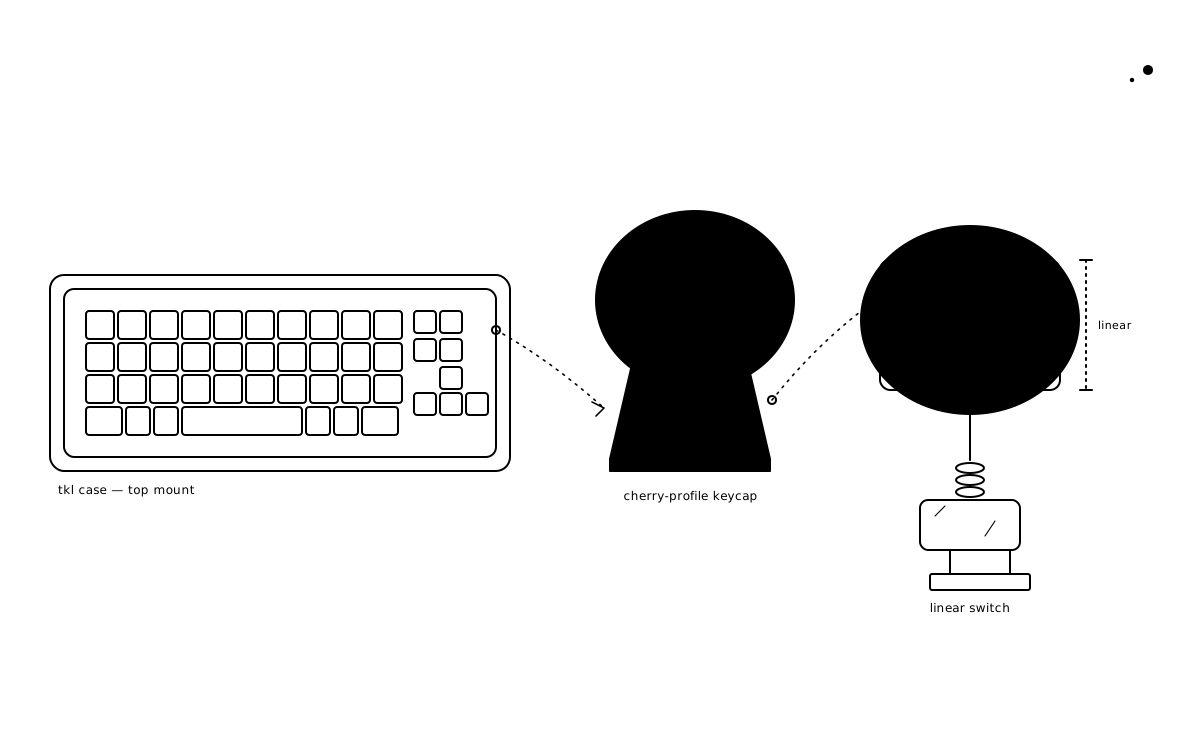
A synthwave keycap set photographs well and says nothing about how a board types. That gap is usually where theme builds go wrong — the caps deliver the look, and whatever's underneath gets forgiven for not living up to it. This build doesn't ask for forgiveness. The board and the switch underneath GMK Laser aren't inspired by the look at all; they're inspired by speed, and the result types faster than it has any business looking like it should.
The parts
| Role | Part | Why it's here |
|---|---|---|
| Board | Drop CTRL | TKL, aircraft-grade aluminum case, top-mount PCB, hotswap QMK/VIA, per-key RGB |
| Keycaps | GMK Laser | Cherry-profile doubleshot ABS, deep-purple base with pink and teal legends, discontinued |
| Switch | Gateron Ink V2 Yellow | Light linear, translucent plum PC housing, POM stem, 35g actuation / 45g bottom-out, factory-lubed |
GMK Laser is the reason this build exists and the reason it takes longer to assemble than a configurator order. Drop produced the set once, through GMK, starting in November 2018; it hasn't run again since, and its listed status is discontinued. The Drop CTRL and the Gateron Ink V2 Yellow both ship in stock. The keycaps are the one part of this build a buyer has to go find.
A board built to disappear, not to glow
Gateron Ink V2 Yellow is a light, fast, factory-lubed linear — the kind of switch recommended to gaming builds and fast typists specifically because it gets out of the way. There's no bump to read, no click bar to time, just a 35g actuation spring and a POM stem moving through 4.0mm of travel with as little friction as a stock linear offers at its price point. Nothing about that switch is asking to be looked at.
The Drop CTRL matches that intent at the board level, and it does it with a construction choice that's unusual among the boards this site covers most often. It's top-mounted, not gasket-mounted: the plate bolts straight to the case rather than floating on a compliant gasket boundary. Drop's own description of the board calls out the consequence directly — the top-mount gives "a firmer, more direct typing feel than the gasket boards in the same price range." There's no softening layer between a keystroke and the aluminum underneath it. On a build whose whole visual program is maximalist 1980s neon, the thing a typist's fingers actually feel is minimal: direct, firm, fast, with nothing added for comfort and nothing subtracted for speed.
That's the actual tension in this build, and it's worth naming plainly: a loud, nostalgic, look-at-this keycap set sitting on top of a board and switch that are both about directness and speed, not spectacle. A TKL that looks like it's about to play Tron and types like a word-count sprint.
The glow comes from the switch, not the cap
The CTRL's per-key RGB is the other half of the synthwave fantasy, and it's worth being precise about where that light actually shows up, because the obvious assumption is wrong. GMK Laser is doubleshot ABS with opaque legends — it's not a shine-through set. The pink and teal lettering on each cap is molded plastic, not a window for backlighting. Per-key RGB under a cap like that doesn't illuminate the legend; it leaks out around the stem well and through whatever light the switch housing itself lets pass.
That's where Gateron Ink V2 Yellow earns a second look.
It's a genuine point of synergy, but it's a narrower one than it first looks: the RGB reads as ambient glow around each key, not as lit-up lettering. Anyone picturing a shine-through-style build should recalibrate that expectation before ordering anything.
Build notes: sourcing a set that isn't for sale anymore
Cherry profile is a safe starting point for the clearance question that taller profiles raise on other builds — there's no special-case plate standoff or case-headroom planning required, because Cherry's moderate sculpt was the industry default the CTRL's plate and case were designed around in the first place. That part of this build is genuinely low-friction.
Sourcing GMK Laser itself is not. With the set discontinued since its original run, every unit in circulation is secondhand, and secondhand ABS doubleshot comes with real caveats worth naming honestly rather than glossing over. ABS legends can pick up a shine or a faint grease sheen on heavily used keys faster than PBT does — that's a known tradeoff of the material, not a flaw specific to this set, but it means a six-year-old set has had more time to show it. Listing photos also don't reliably convey legend wear or base-shell condition at the resolution a buyer needs; a set that looks crisp in a seller's photo can read differently once it's under direct light on a desk.
Who should skip this build
This isn't a build for a typist who wants a softened, cushioned keystroke — the CTRL's top-mount construction is deliberately firmer and more direct than the gasket-mounted boards this column has otherwise favored, and there's no compliance layer to dial that back. It's also not for anyone expecting the RGB to light up the legends themselves; the glow comes from the switch housing, and a buyer picturing a shine-through-style effect will be disappointed by an opaque doubleshot set. And it's not for someone who wants to order a finished parts list in one sitting: GMK Laser exists only on the secondhand market, at aftermarket prices, on whatever timeline that market sets.
Verdict
The strength of this build is that nothing underneath the keycaps is trying to compete with them. A gasket-mounted board would blunt the firm, direct feel the CTRL's top-mount construction is actually known for; a heavier or tactile switch would slow down a set that's paired here specifically with a switch built for speed; a shine-through keycap set would have made a different, flashier promise about the RGB than this one is set up to keep. What's left is an honest split: a maximalist, nostalgic look riding on top of a minimalist, fast platform, with the board and switch never pretending to be anything louder than they are. For a builder willing to hunt a discontinued set on the aftermarket and type on a firmer board than a gasket-mount crowd is used to, that split is the whole point — not a compromise between two aesthetics, but two different jobs, done well, stacked on top of each other.
Keep reading
- Ideas
Build of the week: the Bakeneko65 stops being a budget board under GMK Bentō R2 and Tecsee Sapphire V2
A $150 evergreen hotswap board, a sold-out doubleshot ABS set, and a sparkly polycarbonate tactile aren't a mismatch — the cheap part of this build is the entry price, not the result.
thock7 min read - Ideas
Build of the week: the mission control desk, in Class80, Godspeed, and Box White
A retro TKL, a steel-blue-and-cream SA set, and a clicky box-stem switch aren't three separate purchases here — they're one decision, made three times, that only works because each part solves a problem the other two create.
thock7 min read - Ideas
Pairing Oil Kings with the Mode Sonnet
This pairing has been on the bench for months, and a free Sunday finally made it happen. The Sonnet is a soft 75 with a block mount, and Oil Kings are a heavy factory-lubed linear — together they hit a register worth coming back to.
thock5 min read - Ideas
Mixing keycap profiles on one board: what actually works
Mixing profiles reads as a deliberate design choice or a rookie mistake depending entirely on where the swap lands. A handful of zones tolerate it well. The alpha block almost never does.
thock6 min read