DCS Olivetti and the quiet rebellion against Cherry orthodoxy
A March group buy closed strong, and eight weeks of steady tracker movement later, DCS Olivetti is the clearest sign that experienced builders are ready to argue about profile again.
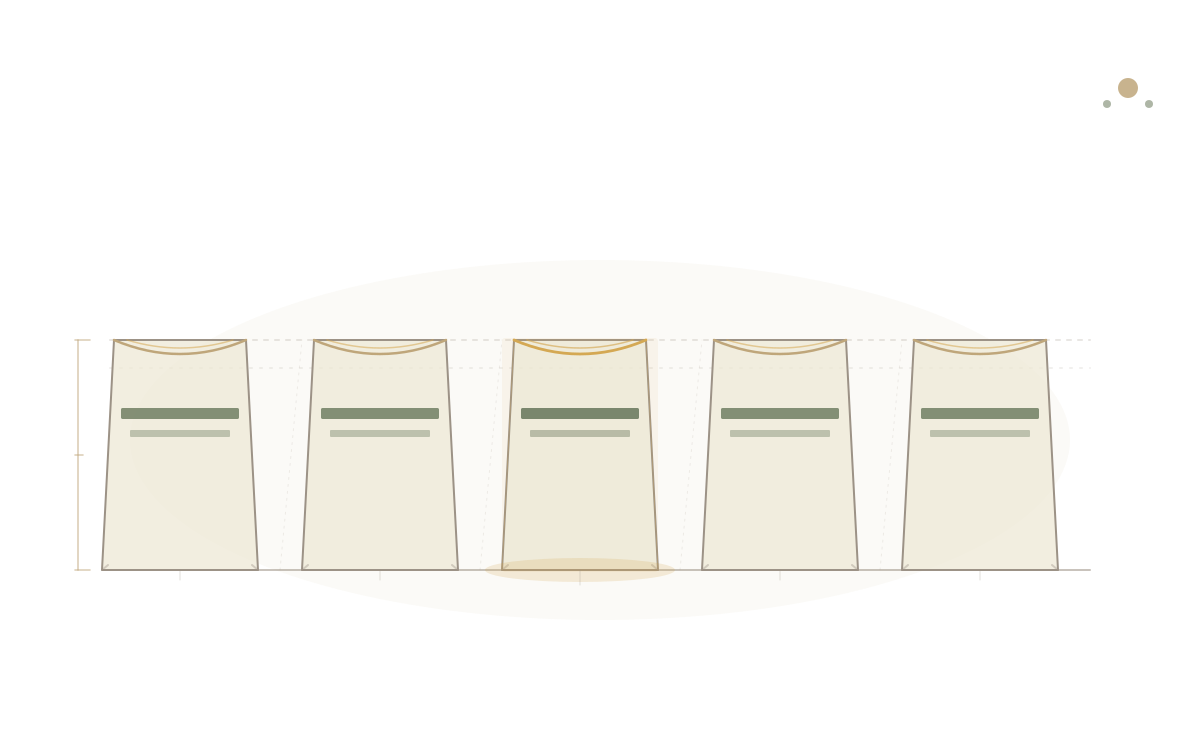
The group buy closed April 13. Interest kept climbing anyway.
That is the signal. When a keycap run's tracker trajectory bends upward after the order window shuts — not flat, not a slow decay — it means something other than FOMO is driving the attention. For DCS Olivetti, the post-close climb is a conversation: about profile, about color, about how much of the last decade's Cherry-profile consensus was default rather than preference.
Eight weeks on the tracker
The Trends Tracker registered DCS Olivetti at +18 direction up in W19 (May 4–10, 2026). The eight-week spark — 4, 6, 9, 12, 14, 16, 17, 18 — is not a spike. Spikes come from a Reddit post that surfaces at the top of r/MechanicalKeyboards for a day and then drops off. This shape is a slow, accumulating conversation: forum threads, aftermarket watch-posts on GeekHack and Keebtalk, builders pulling out their old DCS boards to photograph against newer Cherry-profile sets. The buy closed strong, and the interest did not dissipate.
The tracker note from that week reads: "March 27–April 13 GB closed strong; DCS coming back into rotation alongside Cherry signals a small rebellion against the Cherry-only orthodoxy." That word — rebellion — is doing editorial work. It is not a collapse of Cherry. It is not a paradigm shift. It is a faction of experienced builders, the kind who have owned four or five boards and know exactly what they are trading away, choosing to trade it on purpose.
What DCS is and why it disappeared
DCS is a cylindrical, sculpted profile manufactured by Signature Plastics and sold through Pimp My Keyboard. Height-wise it sits between Cherry and OEM — taller than Cherry's approximately 8mm, with steeper sidewalls and a more pronounced cylindrical scoop that seats the finger differently. The row differentiation is real: Row 3 (home row) is flatter, Row 1 (number row) leans noticeably forward. A typist who learned on a typewriter, or on a Das Keyboard from 2012, has muscle memory calibrated to something closer to DCS than to the flat, low Cherry landscape most of the current hobby occupies. For a side-by-side comparison of how Cherry, OEM, SA, and MT3 differ in height, sculpt, and sound — the profiles DCS is most often measured against — see keycap profiles, compared.
Das Keyboard used DCS keycaps through much of its early line, which is how DCS became the de facto profile for a generation of users who entered the hobby before the group-buy economy matured. Pimp My Keyboard ran DCS sets regularly through the early-to-mid 2010s. Then the GMK era arrived.
GMK manufactures in Cherry profile, and GMK became the gold standard for thick doubleshot ABS quality and collaborative group-buy production. As GMK captured the high end of the market, Cherry profile captured the community's calibration. The clone market — primarily ePBT and other PBT producers — followed suit because compatibility with the dominant profile meant a larger total addressable market. By 2020, a beginner entering the hobby would buy in Cherry profile, build in Cherry profile, and write reviews benchmarked against Cherry profile. The other profiles did not vanish; they became specialty choices you had to argue for.
The Olivetti colorway and why it lands now
DCS Olivetti specifically draws on the color story of Olivetti typewriters: cream alphas against olive-toned modifiers, the combination that characterized the Olivetti M10, the Valentine, and the Lettera 32 in their production decades. Pantone 727C-adjacent cream against a muted sage or khaki is a palette that reads as deliberately analog — not retrocomputer-bright, not candy-colored, not the high-saturation novelty story that dominates the current GMK CYL catalog.
The timing connects to a broader aesthetic thread. The GMK CYL Prussian Alert that opened in May 2026 — covered in the adjacent piece here — runs a Bauhaus red-on-cream story that has the same restrained, specific palette discipline. GMK CYL Selene extends the argument further: a special-effects glitter-reflect ABS over silver-grey, where the plastic material itself is the design story rather than the colorway. Enthusiast taste in keycap color has been rotating toward the narrowly-referenced end of the design vocabulary for two years. Olivetti fits that rotation so precisely that it barely needs to be explained to anyone who has been paying attention.
The combination of profile and color is harder to find than it sounds. A builder who wants the Olivetti colorway in Cherry profile is choosing from a shorter list than they might expect — most cream-and-olive sets in Cherry profile are ePBT runs with legends that do not match Signature Plastics' dyesub or doubleshot quality. DCS Olivetti offers the color story in the profile that reads most naturally against it. That is not a coincidence; it is why the set exists.
What this says about Cherry-profile fatigue
The DCS Olivetti trajectory on the tracker is not an isolated signal. It is part of a pattern: experienced builders who have cycled through multiple Cherry-profile sets reaching for something that types differently. Not necessarily better — the honest DCS versus Cherry comparison is taste-dependent, not objective — but distinctly different.
Cherry profile's dominance was built on three practical advantages. First, GMK quality: thick doubleshot ABS with consistent legends, manufactured at a volume and price point no other profile's vendor could match through most of the last decade. Second, clone market depth: ePBT, Akko PBT, and several other PBT producers standardized on Cherry, meaning a beginner building on Cherry profile had access to inexpensive alternatives during the long GB wait. Third, compatibility: because nearly every group buy shipped in Cherry profile, buying a Cherry-profile board never meant risking an incompatible set. The calculus was straightforward.
The faction choosing DCS knows exactly what it is giving up — the GMK catalog, the deep clone market, the broad compatibility — and is doing it anyway.
The faction choosing DCS knows exactly what it is giving up — the GMK catalog, the deep clone market, the broad compatibility — and is doing it anyway. That is the behavior of people who have already run through the Cherry-profile catalog and found it adequate but not sufficient. The first time through, adequate is fine. The fifth time through, adequate starts to feel like a ceiling.
There is a real typing experience difference to support the choice. DCS's higher profile and steeper walls change how the finger lands on each key — there is more wall to catch the side of the finger on a mis-reach, and the cylindrical scoop is more pronounced than Cherry's, which some typists find seats their fingertip more precisely. The typing sound profile is different too: taller keycap walls mean more internal volume, and DCS tends toward a slightly fuller, less tight bottom-out than the focused thock Cherry-profile thick ABS produces. Neither is objectively superior. They are two different instruments.
What to watch
The April 13 close is behind us. The aftermarket and interest trajectory from here will tell us whether DCS Olivetti becomes a sustained data point or a cycle-high before the line flattens.
Three things to track. First, the aftermarket pricing in the weeks following fulfillment — if DCS Olivetti commands a secondary-market premium over buy price, it signals that demand outpaced the GB allocation, and a second run or additional vendor stock becomes likely. Second, whether other DCS sets appear in vendor lineups or IC threads through mid-2026. A single strong group buy is a moment; two or three strong group buys is a rotation. Third, the behavior of the Cherry-dominant vendors: if KBDfans or NovelKeys lists a DCS colorway in their pipeline, that is the loudest possible signal that the profile has cleared the taste threshold the volume market pays attention to.
Eight weeks of steady upward movement after a closed group buy is the kind of signal that earns editorial attention — not because it predicts where the market goes, but because it describes where a specific, experienced part of the market already is.
Build sheet
Keep reading
- Trends
GMK CYL Red Devils is back after six years — and it's climbing the tracker faster than most first runs
GMK CYL Red Devils returns after six years for a second run, open Sept 14–Oct 10, 2026 via Omnitype and Keebz N Cables. The thock trends tracker has it up to a score of 68 off one of the steepest eight-week climbs of the season — and the buyer base behind that climb looks nothing like the one that bought the original.
thock7 min read - Trends
GMK CYL TA Neo's group buy is closed — here's what a November 2026 ship estimate actually means
GMK CYL TA Neo closed its group buy July 17, 2026 after a June 19 open, and the thock trends tracker has logged two straight weeks of cooling attention since. That's not a warning sign — it's what every closed keycap buy looks like while it waits on production.
thock7 min read - Trends
GMK CYL OG Extensions climbed eight interest-check weeks, then opened a group buy of its own
An interest check posted on Geekhack pulled ahead of both open GMK CYL group buys on the thock trends tracker — eight straight weekly reads without a single flat week — before opening a group buy of its own that has kept climbing since.
thock7 min read - Trends
DCS Grass Valley closes: what the profile's 2026 run tells us
Grass Valley's group buy closed 2026-06-01 and the tracker dropped -18 that same week — but DCS Dolch opened the same day at +29. The momentum didn't dissipate; it transferred.
thock9 min read