DCS Grass Valley closes: what the profile's 2026 run tells us
Grass Valley's group buy closed 2026-06-01 and the tracker dropped -18 that same week — but DCS Dolch opened the same day at +29. The momentum didn't dissipate; it transferred.
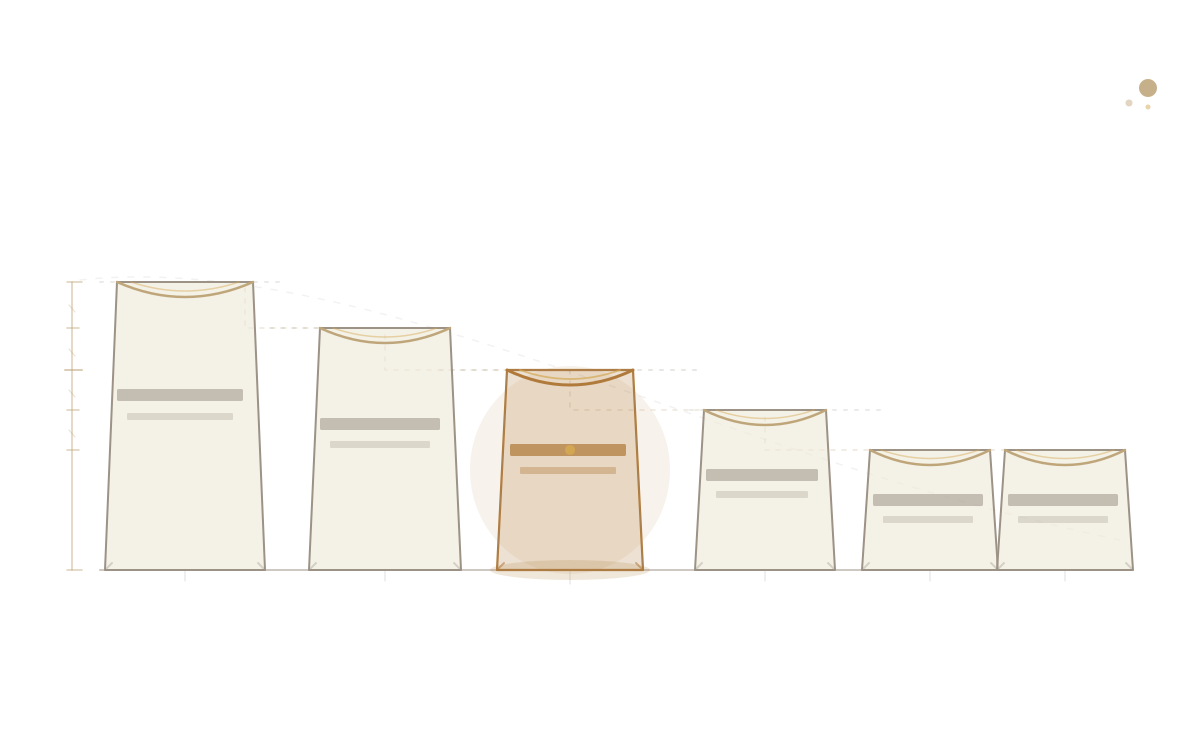
DCS Grass Valley closed its group buy on 2026-06-01. The W23 Trends Tracker snapshot registered the set down -18 that week — the standard post-close dip as community attention moves on and the set enters Signature Plastics' production queue. The same snapshot showed DCS Dolch opening at +29, direction up. Same day, same profile, two sets: one entering production, one just opening for orders. That handoff is the clearest data point yet that DCS has a real niche in 2026.
Three GBs in six months
The 2026 DCS run goes like this. DCS Olivetti ran March 27 through April 13 — a comeback group buy testing whether the profile still had a buyer base. It closed strong and the W19 tracker showed it up +18. That result was not obvious in advance; DCS had been out of regular group-buy rotation long enough that a soft close was a credible outcome.
DCS Grass Valley opened May 1 with Olivetti's close as proof of concept. It ran through 2026-06-01 via Prototypist as the primary vendor, with Geonworks and MiNoKeys providing regional support. The set tracked +22 in W21 and +23 in W22 — flat and sustained rather than a spike-and-decay — then dropped to -18 in W23 as the buy closed and cleared MOQ. Estimated ship is Q3 2026 from Signature Plastics' USA facility.
Then DCS Dolch opened at Divinikey on the day Grass Valley closed. The W23 snapshot caught that opening-week energy at +29 — the highest opening number of the three runs.
Three consecutive DCS group buys in a six-month window, each building on the prior one's result. That is not coincidence and it is not a single designer pushing their favorite profile. It is a market dynamic: vendors reading the Olivetti signal, commissioning Grass Valley as validation, and opening Dolch before Grass Valley even shipped because the pattern had become legible.
The DCS profile and why it fell out of rotation
DCS — Dolch Control Set — is a cylindrical, sculpted profile manufactured by Signature Plastics and sold through Pimp My Keyboard. The distinguishing characteristic is the steep legend height differential across rows: Row 1 (number row) leans forward noticeably relative to the home row, and the cylindrical scoop on each cap is more pronounced than Cherry's equivalent. The result is a typing surface that seats the fingertip differently — more defined, more wall-contact, a touch more lateral support on fast input — at the cost of a taller hand position over the board.
Das Keyboard shipped DCS through much of its early line. That gave DCS substantial exposure during the 2008–2015 period when the enthusiast hobby was still small enough that Das Keyboard shaped a lot of first-build calibration. When GMK arrived and built the market's quality benchmark around Cherry profile, the DCS advantage — historical resonance, specific ergonomic character — could not compete with GMK's doubleshot ABS quality and the depth of the Cherry-profile clone market behind it.
By 2020 the situation was self-reinforcing. Every major vendor ran Cherry-profile or GMK sets. Beginners bought Cherry. Review channels benchmarked against Cherry. The rare DCS run was a niche within a niche, interesting to the builders who already knew the profile but invisible to anyone buying their first or second set.
Grass Valley as a colorway signal
The Grass Valley colorway draws on broadcast-era hardware: the muted sage and olive greens of VTRs, studio consoles, and field cameras from the 1970s and 1980s. Grass Valley Group was one of the dominant manufacturers in that space — the name on a lot of the equipment whose color story this set references. The palette is desaturated and warm, closer to an institutional green-grey than to any consumer-electronics green. It does not photograph dramatically, which is arguably part of the point.
That restraint tracks with a pattern visible across the 2026 keycap market. The GMK CYL Prussian Alert that ran in parallel carries a Bauhaus red-on-cream story with the same narrowly-referenced palette discipline; GMK CYL Selene, which ran at KBDfans through 2026-06-19, takes the material-first variant of that argument — special-effects glitter-reflect ABS over a neutral grey. The appetite is for colorways with specific provenance — not nostalgia as decoration, but as a design argument that limits the palette to what the reference actually looked like. The artisan-resin segment ran a parallel instance: GSK Sweet Nightmare opened at KBDfans on 2026-05-08 with an eight-variant colorway-finish matrix and a four-day window — a different production model from DCS or GMK CYL, but the same narrow-palette discipline applied to the resin artisan format.
Grass Valley clearing MOQ under that premise is a meaningful signal. The set was not trading on broad aesthetic appeal. It was trading on the precision of its reference and the profile around which it was designed. Buyers who showed up were not buying a green keycap set; they were buying a specific colorway in a specific profile because both were correct.
The production pattern: post-close dip is expected
The -18 W23 tracker score is not a verdict on the set's quality or the run's success. Post-close tracker dips are the normal behavior for group-buy keycaps entering a production queue. The community attention that drove the open-window scores dissipates because there is nothing new to follow: the order is placed, the wait begins, and the interest migrates to whatever is currently open.
The two W21 and W22 Grass Valley scores — +22 and +23 — showed a set holding attention through a full month without decaying. That sustained flat at a positive score is a healthier open-window pattern than a sharp spike followed by decline, which tends to indicate a set got a single moment of visibility (a viral post, a featured slot in a newsletter) rather than ongoing community interest. Grass Valley's flat trajectory suggests buyers were continuing to find it and commit through the window, not just in the first week.
Estimated delivery from Signature Plastics is Q3 2026. SP runs a domestic USA manufacturing operation, which means the production queue is different from the international lead times attached to most GMK and ePBT runs. SP's queue is shorter and more predictable than the overseas alternative, but it is still a queue — buyers who committed to Grass Valley are waiting on the same production capacity as DCS Dolch, SA sets, and the rest of SP's 2026 backlog.
DCS Dolch as momentum transfer
The launch-day handoff between Grass Valley and Dolch matters to the DCS revival narrative for a specific reason: it means buyers who followed Grass Valley but did not commit had an immediate destination. That is not guaranteed. Without Dolch's same-day open, the post-close tracker dip would mark a gap in the DCS narrative — a moment where the profile had no open window and the community's attention would have migrated fully to other categories.
DCS Dolch opens that window at +29 — a stronger debut than either of the two Grass Valley open-window scores, and stronger than the Olivetti result that started the chain. Opening-week numbers for new GBs carry announcement energy that does not always sustain, so the W24 and W25 Dolch scores will tell the more informative story. But the direction of the first number is worth noting: each DCS debut in 2026 has opened higher than the prior one.
The Dolch colorway — WS1 dark charcoal alphas over WS2 medium-light grey modifiers — occupies different aesthetic territory from Grass Valley. The overlap in buyer profile is real: both sets attract the subset of the hobby that wants a non-Cherry, non-GMK option with specific historical provenance. But the two colorways do not compete on palette. A buyer who wanted the broadcast-era muted green of Grass Valley and got Dolch has not gotten what they wanted. The handoff is about profile momentum, not aesthetic substitution.
What to watch
Three consecutive SP-DCS group buys in a six-month window is notable, but it does not yet constitute a permanent niche. The test for that is whether DCS occupies a slot in major vendor lineups consistently — not as a one-off event triggered by a specific designer's pitch, but as a recurring category the way GMK CYL colorways are a recurring category at Divinikey or CannonKeys.
The variables to track through the rest of 2026 are: the Dolch close trajectory relative to Grass Valley's open-window scores; whether SP production delivers Grass Valley on the Q3 2026 estimate (a reliable delivery anchors buyer confidence in the queue); and whether any major vendor announces a fourth DCS run before the Dolch window closes. A fourth run would shift the pattern from a streak to a rotation.
If the Dolch trajectory sustains through July and the aftermarket on delivered Olivetti sets shows reasonable premium over buy price — both of which remain to be seen — the case for DCS as a permanent niche becomes structural rather than three-point evidence. Until then, the signal is strong and the interpretation should stay proportional.
Prototypist handled the Grass Valley GB for UK buyers. Divinikey's DCS Dolch product page carries the full kit and regional vendor information for the order window that ran through 2026-07-01.
Build sheet
Keep reading
- Trends
GMK CYL Red Devils is back after six years — and it's climbing the tracker faster than most first runs
GMK CYL Red Devils returns after six years for a second run, open Sept 14–Oct 10, 2026 via Omnitype and Keebz N Cables. The thock trends tracker has it up to a score of 68 off one of the steepest eight-week climbs of the season — and the buyer base behind that climb looks nothing like the one that bought the original.
thock7 min read - Trends
GMK CYL TA Neo's group buy is closed — here's what a November 2026 ship estimate actually means
GMK CYL TA Neo closed its group buy July 17, 2026 after a June 19 open, and the thock trends tracker has logged two straight weeks of cooling attention since. That's not a warning sign — it's what every closed keycap buy looks like while it waits on production.
thock7 min read - Trends
DCS Olivetti and the quiet rebellion against Cherry orthodoxy
A March group buy closed strong, and eight weeks of steady tracker movement later, DCS Olivetti is the clearest sign that experienced builders are ready to argue about profile again.
thock8 min read - Trends
Prototypist and the multi-project vendor model
Prototypist rarely carries just one thing at a time. The UK vendor's tracker signal has spent 2026 rising and falling with how many group buys it's running at once — and in July 2026 it's climbing again on the strength of its own pipeline rather than someone else's.
thock6 min read