How keycaps are actually made: double-shot, dye-sub, and the processes in between
Material and profile get the attention. The mold, the second shot, the transfer press, and the shrinkage table are what set the price, the lead time, and whether the legend is still there in ten years.
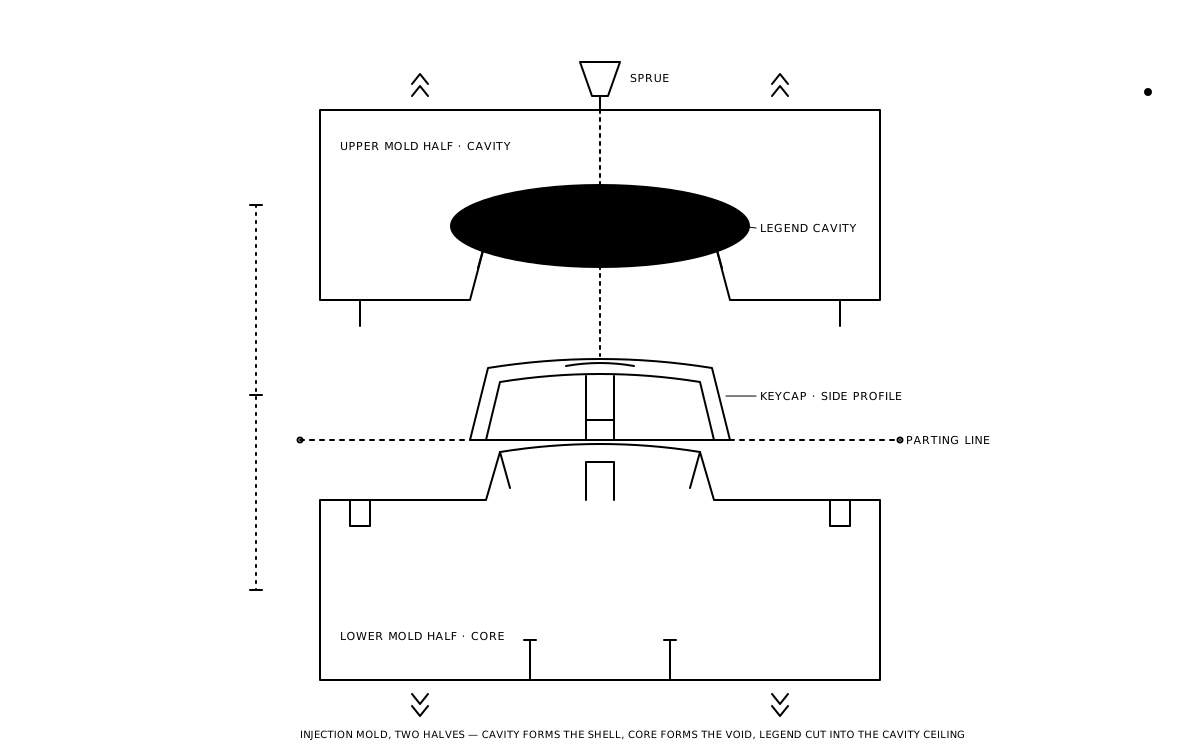
A keycap is a small part with a hard job. It has to hold a legend through a decade of fingertips, grip a stem to a tolerance measured in hundredths of a millimetre, and match the colour of a hundred siblings that came off different cavities on different days. How the factory gets there explains more about price and lead time than material or profile ever will. Material is covered in Keycap materials, compared and shape in Keycap profiles, compared. This piece is about the process.
Where the tooling came from
Every keycap process starts with an injection mold: two steel halves, a cavity shaped like the outside of the cap, a core shaped like its inside and stem, and a runner system that carries molten plastic from the machine nozzle down a sprue and through gates into each cavity. One mold holds many cavities, and the full set of molds for a profile covers every shape that profile needs. Matt3o's writeup of the MT3 launch put it plainly: the profile "so far has 31 different shapes hence 31 molds," and in keycap production "each mold goes in the range of $1000-4000." Matt3o on MT3 That is shape-only tooling, before a single legend exists.
The hobby's high-end tooling has a short family tree. Cherry stopped making its own double-shot caps in 2011; in November 2012 GMK, a family-run German firm founded in 1992, acquired Cherry's original tooling. Deskthority: GMK GMK's keycap FAQ still says it produces "with the original Cherry tools" and that "our new molds are based on the originals." GMK keycap FAQ Signature Plastics, the other legacy double-shot house, molds in Custer, Washington on its own SA and DCS tooling — SA Godspeed came out of that shop via Drop.
Double-shot: the legend is a second shot
Double-shot molding makes the legend out of plastic rather than putting it on plastic. Shot one fills a mold whose cavity is the legend: a solid plug of, say, white ABS in the shape of an "A", sitting on a thin backing plate. Shot two moves that insert into a second cavity shaped like the finished cap and floods it with the body colour. The body fuses around the legend, and the top surface becomes a single plane of two materials. The character runs the full thickness of the wall, which is why GMK states flatly on its CYL product page that "the doubleshot legends will never fade." GMK CYL
The cost lives in the tooling, and it compounds. A double-shot set needs body cavities plus a separate legend cavity for every distinct legend: every letter, modifier, and novelty, at every width where the legend position moves. Matt3o estimated that double-shotting MT3 would have needed roughly 140 additional molds on top of the 31 body molds, which is why the first Drop + Matt3o MT3 /dev/tty run in 2017 shipped as dye-sub PBT and why Drop's later double-shot ABS MT3 sets carried a price that reflected the retooling. The same arithmetic is why GMK Olivia and every other GMK set is expensive and slow: the body tooling is amortised across everything GMK makes, but the legend inserts for a colourway's specific kit are real steel. GMK quotes a minimum of 150 sets when a design uses only stock colours and 250 sets when custom colours are mixed. GMK keycap FAQ A set that cannot clear that number does not get molded. That is the entire logic of a group buy.
ABS is the natural double-shot material because it is amorphous: it shrinks a small, predictable amount as it cools, and it shrinks the same amount in every direction, so the second shot lands exactly where the mold believes the first shot is. GMK's CYL caps come out at 1.5 mm wall thickness with a choice of "over 1,000+ different colors," the top texture eroded into the steel rather than coated on. GMK CYL
Triple-shot is the same trick with a third cavity, used for sub-legends in a second colour — PBTfans lists "Hiragana/Runes/Greek (using tripleshot)" among its options. PBTfans doubleshot Every extra shot is another set of inserts and another alignment to hold.
Dye-sublimation: the legend is a stain
Dye-sub adds no material. The legend is printed on transfer paper with disperse dye, the paper is clamped onto a blank cap in a jig, and heat and pressure drive the dye into the surface of the plastic — "heated at high temperatures to allow the pigment to penetrate into the plastic," in PBTfans' description. PBTfans dye-sub The legend cannot flake, and it wears at the same rate as the cap around it.
The process sets two hard constraints. The first is material. The transfer temperature sits in a range where PBT — a semi-crystalline polyester that melts around 220 °C — holds its shape, while ABS starts to soften around 100 °C. Press an ABS cap at dye-sub temperature and the stem distorts before the dye takes. Dye-sub ABS exists and is rare; PBT dominates for a physical reason, not a marketing one.
The second constraint is colour. Sublimation adds dye to a substrate; it cannot remove pigment that is already there. A legend can only be darker than the cap beneath it. White-on-black by dye-sub is impossible, which is why Domikey WOB and every other clean WoB set is double-shot. The workaround is reverse dye-sub: mold the cap in the legend colour and sublimate the entire top and sides in the body colour, leaving the legend as the un-dyed negative. It shows as a faint halo where the dye field meets untouched plastic.
Pad printing, UV printing, laser
Everything else puts the legend on the surface. Pad printing presses a silicone pad, loaded with ink from an etched plate, onto the cap top. It is cheap, fast, and handles any colour on any base, and it wears through within months on the home row because the ink is a film sitting on the plastic, clear coat or not. UV printing is the modern version: an inkjet head lays down UV-cured ink in full colour, which is how multicolour novelties get made on top of double-shot bodies. GMK offers "premium UV-print" as an add-on for exactly this. GMK CYL The print is durable enough on a low-traffic novelty and inadequate on an alpha.
Laser comes in two flavours. Laser etching burns the legend into the surface — a pale mark on black ABS, a lighter recess on dark PBT — and laser-filled variants ablate a recess and flood it with paint. The recess is permanent; the fill wears like pad print. Shine-through caps are the common case: an opaque coat over translucent ABS, ablated so the LED shows through.
Shrinkage, warping, and the double-shot PBT problem
Plastic shrinks as it cools in the mold, and the mold is cut oversized to compensate. For ABS the figure is about 0.6 percent; for unfilled PBT it is roughly 2 percent. Injection-molding shrinkage chart The number itself is manageable. The direction is the problem. Amorphous plastics like ABS "shrink a relatively small amount and for the most part, shrink isotropically," while semi-crystalline materials "shrink much more than amorphous materials and they shrink anisotropically — more parallel to the direction of flow and less perpendicular to the direction of flow." Plastics Technology
A 1u cap can tolerate that. A 6.25u spacebar cannot. Plastic enters at a gate, flows the length of the bar, and the long axis shrinks more than the short one as the crystalline regions form; thin walls cool faster outside than inside and lock in stress. The result is the banana spacebar, and the reason good PBT spacebars are molded thicker, gated nearer the centre, or cooled on a fixture. Double-shot makes it worse: the legend insert has already shrunk once, and the second shot shrinks around it at a different rate, so legends drift, blur at the edges, or pull the top face out of flat.
That is why double-shot PBT was, for most of the hobby's history, something the Taiwanese budget houses — Vortex, Tai-Hao — did in their own lines and nobody did at GMK quality. Deskthority: double-shot moulding The fix turned out to be material, not process: stop using pure PBT. Keyreative's KAT documentation lists its double-shot compound as "85% PBT + 15% GF (Glass Fiber)" — the glass fibre pulls shrinkage down — and targets a wall of "1.65 ±0.1 mm." Keyreative on KAT PBTfans says the same thing less precisely: its caps are "mostly PBT raw materials, not pure 100% PBT." PBTfans doubleshot Wuque Studio's line took "two years of planning and over multiple mould revisions." Wuque Studio A filled blend, a thicker wall, and mold revisions per profile: that is what cracked it, and it is why every "doubleshot PBT" set on the market is technically a PBT compound.
Tolerance, cavities, and why sets come in batches
A set's consistency is decided by how many cavities its molds run and how well the factory balances them. Each cavity in a 16-cavity mold is cut and polished separately, sits a different distance from the sprue, and fills at a slightly different pressure. Unbalanced runners produce a kit where some 1u alphas sit a hair tighter on the stem than others — and stem fit is the tightest tolerance on the part, which is where GMK's claim to mold to "the original Cherry MX switches and dimensions" matters in practice.
Colour is the other batch variable. ABS is coloured in the pellet and each run is matched against a chip, which is why GMK's minimum jumps from 150 to 250 sets for custom colours. Signature Plastics tells designers that production takes "a minimum of six weeks" once a set is chosen, "longer if we don't have the keys or material on-hand." Signature Plastics designer page Every one of these numbers is a fixed cost that only makes sense spread across a guaranteed batch. That is why the hobby invented the group buy.
The verdict
Pick the process by what the legend has to survive, not by what the plastic is called. Double-shot ABS is the only process where the legend is structurally the cap, and the price is the tooling and the batch. Dye-sub PBT is the permanent legend for anyone who wants the set to look the same in five years, with the darker-than-the-cap rule as the tax. Double-shot PBT has been genuinely good since KAT reached mass production in 2019, provided the buyer reads "PBT" as "glass-filled PBT compound." Pad print, UV, and laser are for novelties, shine-through, and boards the buyer intends to recap anyway.
What to watch is the filled-PBT double-shot process reaching the legacy houses. GMK's FAQ lists its MTNU profile as PBT — a profile designed from scratch for a material the Cherry-era molds were never cut for. If GMK's tolerances and colour library hold on a PBT body at volume, the ABS-for-designer-sets, PBT-for-daily-drivers split the hobby has lived with since 2012 gets a lot less clean.
Keep reading
- News
GMK CYL Masterpiece R2 closed at KBDfans, finishing the Katakana argument R1 started
Energieschleuder's six-year-later return to Japanese craftsmanship aesthetics climbed the thock tracker all window, scoring 46 in W26 before the buy closed June 26.
thock8 min read - News
GMK CYL Pandemonium: the eclipse-themed keycap set that closed on a plateau
DeltaKeyCo's Berserk eclipse group buy climbed the tracker from its June 1 open, posting a score of 33 in W26 with a flat direction — a mid-window plateau it held through its July 1 close.
thock10 min read - News
GMK CYL Selene closed at KBDfans with the sub-line's first material-first colorway
GMK CYL Selene ran 2026-05-15 through 2026-06-19 at KBDfans with a special-effects glitter-reflect colorway in purple and teal over a silver-grey base. Designed by whysoda and inspired by the Greek Titaness of the Moon, the buy closed with Q1-Q2 2027 fulfillment ahead.
thock6 min read - Guides
Keycap materials, compared: ABS, PBT, and the rest
Most builders obsess over switches and quietly accept whatever keycaps came in the box, then wonder six months in why their board doesn't sound like the YouTube video. Half the answer is the plastic. Material decides how a cap rings, how it ages, and what it feels like under a fingertip on day one and day one thousand.
thock10 min read