Keycap materials, compared: ABS, PBT, and the rest
Most builders obsess over switches and quietly accept whatever keycaps came in the box, then wonder six months in why their board doesn't sound like the YouTube video. Half the answer is the plastic. Material decides how a cap rings, how it ages, and what it feels like under a fingertip on day one and day one thousand.
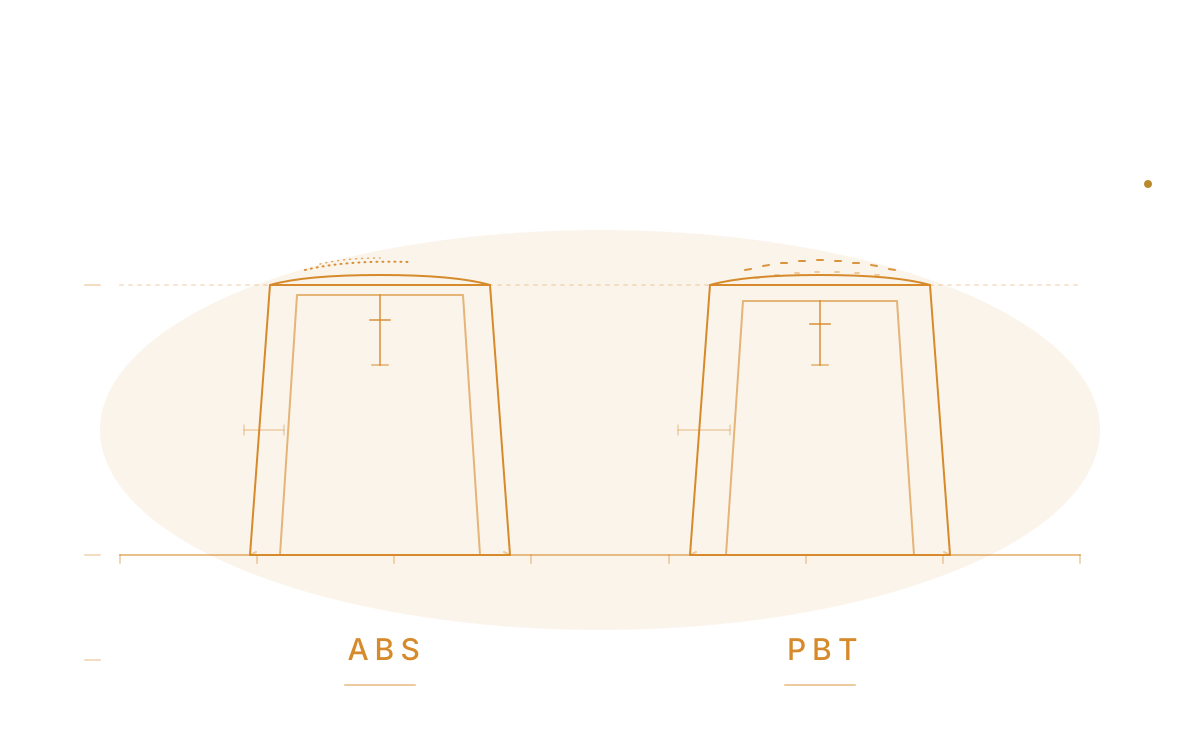
A first-time builder finishes a board, sits down to type, and notices the sound is not quite the one in their head. They blame the switches, then the case, then the foam, then maybe the desk. The thing they tend not to blame is the small piece of injection-molded plastic between their finger and the stem. That plastic is doing more work than its reputation suggests. Profile shapes the air under the cap, but material shapes the cap itself — how it rings when struck, how it wears under daily use, and how it feels when a fingertip lands on it for the ten-thousandth time. If you want to compare the sister axis — profile shape — see Keycap profiles, compared. This one is about the plastic.
Why material matters
Three things move with material: sound, feel, and durability. A fourth — look — moves with material indirectly, because legend-printing methods and surface finish are downstream of which plastic the factory is molding.
Sound is the loudest difference. Two caps cut to the exact same profile, mounted on the exact same switch, in the exact same board, will not sound the same if one is a thin shot of ABS and the other is a thick shot of PBT. The walls flex differently. The surface absorbs and reflects high frequencies differently. The hollow chamber inside rings at a slightly different pitch. None of this is subtle on a quiet board.
Feel is more subjective but real. PBT's surface is faintly textured most of the time. ABS is almost always smooth from the mold. Fingers calibrate to one or the other quickly, but a typist switching cold from a long-worn ABS set to fresh PBT will feel the difference on the first row of typing.
Durability is where the conversation gets opinionated. ABS shines. PBT mostly does not. How much that matters depends on the typist.
In practical terms, almost every set on the market is one of two plastics. ABS dominates the designer-collab and group-buy end of the catalog. PBT dominates the in-stock, longer-lived, dye-sub end. POM, polycarbonate, and ceramic exist, are interesting, and account for a tiny slice of the market. Most builders will only ever buy ABS or PBT, and most decisions live on that axis.
ABS
ABS is acrylonitrile butadiene styrene, the same family of plastic Lego bricks are made from. It melts at a relatively low temperature, flows cleanly into thin-walled molds, and takes color crisply. Those three properties are why nearly every premium designer keycap set of the last decade has been ABS. The canonical maker is GMK, the German manufacturer whose thick-walled doubleshot ABS sets define the high end of the market. GMK Bentō R2 is a representative example: Cherry profile, doubleshot construction, the kind of set buyers track on group-buy aggregators for months before committing.
The sound is what most builders are buying when they buy GMK. Thick ABS walls — GMK sets typically run 1.5mm thick — produce a low, focused sound the community calls thocky. Thin ABS, the kind that ships on cheaper sets and stock factory boards, sounds higher-pitched and a bit hollow by comparison. The wall thickness matters as much as the plastic. A thin ABS cap and a thick ABS cap from different vendors might as well be different materials acoustically.
Under the finger, ABS is smooth. Out of the mold the surface is faintly glossy and slick. Some typists love this; others find it slippery for fast typing. Tall ABS profiles like MT3 amplify both reactions because the contact patch is larger. Drop MT3 Dasher is a useful reference here: a tall, scooped, thick-walled ABS set that lives at the loudest, most resonant end of the ABS catalog.
Legends on ABS are almost always doubleshot. Doubleshot means the legend is a second piece of plastic molded through the cap, so the character is the cap — there is no surface coating to wear off, ever. ABS takes doubleshot beautifully because of the low melt temperature; two shots of ABS bond cleanly. Dye-sublimation, the other dominant printing method, doesn't work well on ABS because the surface doesn't accept the dye permanently. Buyers shopping ABS should expect doubleshot legends, and the few exceptions (pad-printed budget sets) are the kind of thing the legend rubs off in a month.
The durability story is the famous one. ABS shines. The polymer chain is soft enough that finger oils and the pressure of repeated keystrokes polish the surface to a glossy sheen, starting at the home row and spreading outward. The shine is not damage — the cap is still structurally fine — but it is visible, and it changes the look of a set. Most ABS sets show legible shine on the home row in 6 to 18 months of daily typing, depending on skin chemistry and how aggressively the typist bottoms out. Heavier typists with oilier hands can shine a set in three months. Lighter typists with drier skin can keep one matte for two years.
Whether that matters is a personal call. Some builders see the shine as the cap aging into a board the way a leather wallet ages — proof of use, a sign of love. Others find it ugly enough to refuse ABS entirely. Both camps are well represented in the hobby. The honest framing is that if a set's appearance on day one is the reason for buying it, the same set will not look identical on day five hundred, and the buyer should be at peace with that before clicking the order button.
PBT
PBT is polybutylene terephthalate, a denser, harder plastic with a higher melt temperature than ABS. The same properties that make it harder to mold cleanly also make it more durable in service. PBT walls flex less. PBT surfaces resist the polishing process that gives ABS its shine. A well-made PBT set looks effectively the same after three years that it did out of the box.
The sound is drier and lower-pitched than thin ABS, and more focused than tall ABS. The community shorthand is that PBT sounds clacky where ABS sounds thocky, but the difference is more about reverb than pitch. PBT absorbs more of the ring on bottom-out, so the sound dies faster; ABS lets the chamber sing for a few extra milliseconds. On a quiet board with good foam, the gap narrows. On a hollow board it widens.
Under the finger PBT has a faintly textured surface, almost matte, with the slight grain of the mold visible in raking light. Most typists describe it as more grippy than ABS, which can be a feature or a friction depending on typing style. Touch-typists who slide between keys sometimes prefer ABS for that reason; typists who land hard and decisively often prefer PBT.
Legend-printing on PBT is dominated by dye-sublimation, which works well because the higher melt temperature lets the dye bond into the cap surface rather than sit on top of it. Dye-sub legends are essentially permanent; they do not rub off and do not shine differently from the rest of the cap as it ages. The catch is that dye-sub only goes darker than the cap base, which is why dye-sub PBT sets in dark colorways tend to use reverse-dye-sub (the legend is the base color and the dye fills the surrounding area). Doubleshot PBT exists and is increasingly common — vendors like ePBT and the newer GMK CYL line have improved the molding tolerances over the last few years — but it remains harder to produce cleanly than doubleshot ABS, and the prices reflect that. KAT Drifter is a good example of dye-sub PBT done well: a tall-ish KAT set with sharp legends that have aged effectively unchanged since 2020.
The compatibility caveat worth flagging: PBT's higher melt temperature means thicker sets sometimes warp slightly during cooling. On cheaper PBT sets, that warp can show up as stabilizers dragging through the larger keys, or as caps that don't sit perfectly flat. Premium PBT vendors have largely solved this; budget PBT sometimes hasn't. A tester press on the spacebar before committing to a long-term set is cheap insurance.
The rest, briefly
POM is polyoxymethylene, a slick, dense plastic most commonly seen in switch housings rather than caps. POM keycap sets are rare and exotic — the surface is glassy-smooth, denser than either ABS or PBT, and produces a distinctively muted sound. The set most builders will encounter is a small-batch group buy or a single-vendor experiment. Worth trying on a friend's board before buying.
Polycarbonate is the transparent option. PC caps let RGB light through cleanly, which is the entire reason to choose them; the sound is brighter and less interesting than either ABS or PBT, and PC is more brittle than either, so corner impacts can chip caps. For a backlit showcase board, PC or shine-through ABS are the only serious choices. For anything else, PC is a niche.
Ceramic caps are the polarizing edge case. They are heavy — a ceramic cap weighs roughly 3 to 5 times what an ABS cap of the same profile weighs — expensive, cold to the touch, and produce a sharp, glassy sound that some builders adore and most find fatiguing. Ceramic sets are also a real load on the switch springs; lighter springs can struggle to return a ceramic cap consistently. Treat them as a curiosity rather than a daily-driver option.
How to choose
Strip the catalog down to the actual decision and the answer falls out of four questions.
Want a particular colorway from a designer collab. Buy ABS, almost certainly GMK or an equivalent thick-doubleshot vendor. The designer keycap market lives on ABS, and the colorway you fell for probably doesn't exist in PBT.
Want the set to look identical in three years. Buy PBT. Dye-sub PBT in particular will age effectively unchanged through several years of daily use, and the resale value holds because of that.
Care more about feel than look, and unsure which to start with. Try thick PBT first. The texture is more forgiving for most typing styles, the durability story is simpler, and the prices on premium PBT have dropped sharply over the last two years.
Building an RGB showcase board. Polycarbonate or shine-through ABS are the only two answers; pick PC if the board is the centerpiece of the desk and shine-through ABS if RGB is a nice-to-have rather than the point.
If a builder can only own one set, make it PBT in a profile they like. The durability margin is real, the price-to-quality ratio is favorable in the current market, and the set will outlast at least one and probably two switch swaps. ABS is the right answer for a second set, when the buyer knows what they want a board to look like and is willing to accept how it will look later. PBT is the safer first commitment.
Closing
Material is the half of the keycap conversation that gets skipped because shape is more visible. A buyer can see Cherry-versus-MT3 in a single side-profile photograph; they cannot see ABS-versus-PBT until they have lived with both for a year. The shortcut is to trust the consensus the hobby has converged on: ABS for the designer sets a builder cannot stop thinking about, PBT for the daily driver they want to forget about, and the rest of the catalog as occasional experiments rather than defaults. Pick the plastic on purpose, and the board will sound and age the way the buyer meant it to.
Keep reading
- Guides
Artisan keycaps: a practical buying guide
A single sculpted cap on the Escape key can cost more than the switches underneath it, and the buying process looks nothing like ordering a keycap set. Here is what an artisan actually is, how the raffles work, and the one check that keeps a buyer from winning a cap their board can't use.
thock9 min read - Guides
ANSI, ISO, or JIS: a practical layout buying guide
Two boards can look nearly identical in a listing photo and still take entirely different keycap sets. Here's how to read Enter key shape, bottom-row widths, and spec-sheet shorthand before ordering — not after a set arrives that doesn't fit.
thock9 min read - Guides
Keyboard case materials, compared: aluminium, polycarbonate, and ABS
The case is the largest resonant body in a keyboard. Aluminium, polycarbonate, and ABS each change the sound, feel, and weight profile in fundamentally different ways — here is what each material actually does.
thock11 min read - Guides
Keycap profiles, compared: Cherry, OEM, SA, and MT3
Most beginners agonize over switches for weeks, then drop any keycap set on top and discover the keycap was doing half the work all along. Profile shapes the sound, the typing angle, and the way a board reads on a desk — and the four profiles below cover almost every set on the market.
thock11 min read