Build of the week: the Ikki68 Aurora lights up under GMK CYL Ramune and Gateron Pro 3.0 Yellow
A translucent case built to diffuse glow, a switch built to carry light into the keycap, and a palette too pale to swallow either one on arrival — pull any one part and the other two stop paying off.
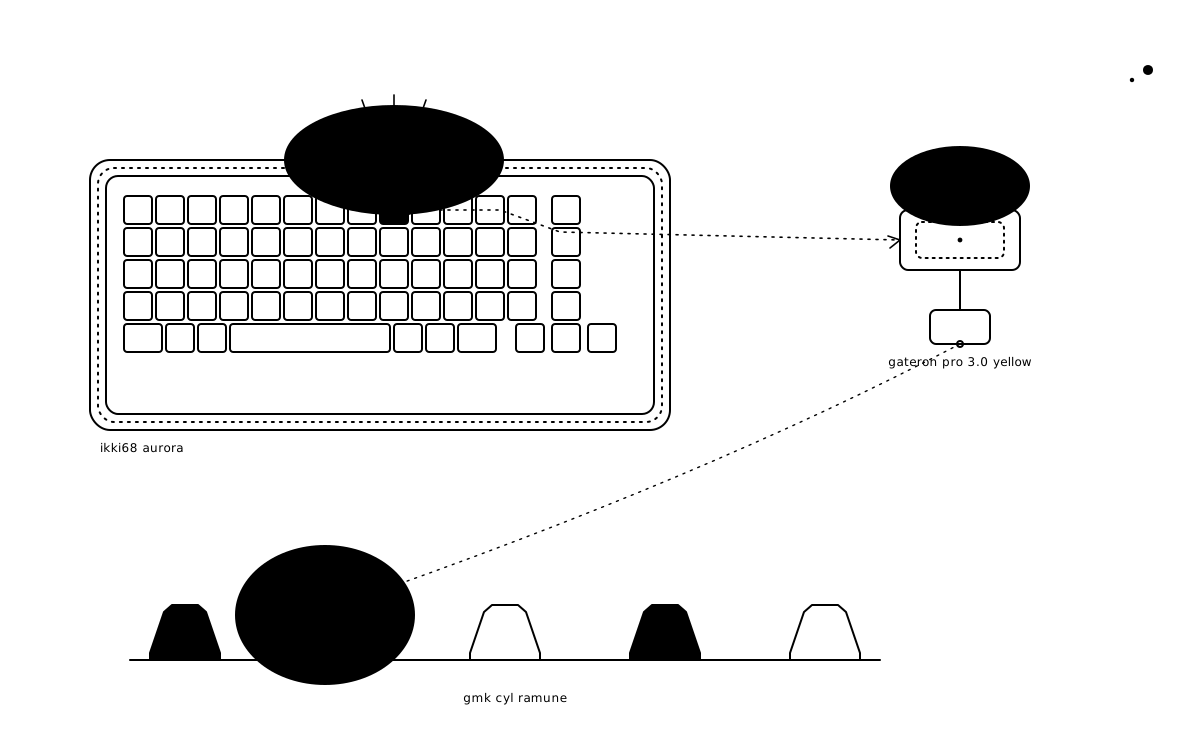
Most translucent cases make a promise they don't finish keeping: the shell is frosted and glow-ready, but the switch sitting inside it treats its own top housing as a purely structural part, opaque by default, and the light dies there instead of reaching the keycap. This build doesn't have that problem, because none of its three parts was chosen to look good alone — each one is solving a problem the other two create.
The parts
| Role | Part | Why it's here |
|---|---|---|
| Board | Ikki68 Aurora | Polycarbonate 65% gasket board, frosted translucent case, per-key RGB |
| Keycaps | GMK CYL Ramune | Pastel sky-blue, lighter blue, and blush-pink doubleshot ABS over a WS1-white base, Cherry profile |
| Switch | Gateron G Pro 3.0 Yellow | Medium linear, 50g actuation / 67g bottom-out, frosted light-guide top, factory-lubed |
GMK CYL Ramune's group buy ran 2026-05-15 through 2026-06-20 and the set is now listed sold-out, with fulfillment landing through GMK Germany later this year. Worth saying up front the way a discontinued board changes how a build should be read: the Ikki68 Aurora and the Gateron G Pro 3.0 Yellow both ship in stock today, but Ramune is a secondhand-market pickup, not an add-to-cart order.
A case built to glow, and a switch most boards waste
The Aurora's entire identity is its shell. Wuque Studio built the case out of frosted, translucent polycarbonate specifically so per-key RGB diffuses outward into a soft ambient wash instead of staying pinned under each keycap as a sharp point of light. That's the whole pitch of a PC case over an aluminum one in this bracket — glow that reads through the material itself, not just around the stem well.
Most switches undercut that pitch without meaning to. A standard switch top housing is opaque, chosen for structural rigidity and nothing else, and light from the PCB-mounted LED stops at it — some leaks around the stem, but the housing itself stays dark. Drop that switch into a case engineered to diffuse glow and the case is doing work the switch isn't helping with.
Gateron G Pro 3.0 Yellow is the one switch-level decision that completes the case's premise instead of fighting it. Its third-generation redesign adds a frosted light-guide top specifically built to carry LED light upward through the switch housing itself, rather than blocking it. Light that would otherwise die at an opaque ceiling now travels through the switch and into the underside of the keycap — which, on a case already diffusing glow through its own walls, is the missing half of the lighting chain.
The tradeoff the PC case is making, honestly
Gasket mount and a polycarbonate case don't just enable the glow — they change how the board feels to type on, and that change is a real tradeoff, not a strict upgrade. Aluminum gasket boards in the same bracket carry more mass and a denser shell, which tends to read as deeper resonance and more of the low "thock" that acoustic-focused builds chase. The Aurora's PC shell, combined with its gasket mount, produces a softer, bouncier keystroke instead — lighter in the hand, with more give at the edges of travel, but less of the heft and low-end resonance an aluminum case supplies by default.
Pastel is doing diffusion work, not just palette work
The colorway matters here for a reason beyond taste. Ramune's palette is deliberately pale — sky-blue primary, a lighter secondary blue, a blush-pink accent, all sitting over a WS1-white base. Pale, light-reflecting tones like that don't swallow ambient glow the way a stark monochrome or a fully saturated dark set would. A near-black keycap absorbs most of the light reaching its underside and gives almost none of it back; a pastel set this light bounces more of that glow back out, which is exactly what a case engineered to diffuse light needs sitting on top of it. Swap in a dark, saturated set and the case and switch are still doing their jobs — the keycaps just stop letting the result read.
Build notes: the layout cost nobody should gloss over
The Ikki68 Aurora is a 65% board — no standalone function row, no dedicated arrow cluster sitting apart from the rest of the layout. That's a real workflow cost for a typist who reaches for F-keys directly rather than through a Fn layer, and no amount of glow or palette coherence changes that math. It's worth deciding on the layout tradeoff on its own terms before the lighting story sells the rest of the build.
Who should skip this build
This isn't for a builder chasing maximum acoustic depth or aluminum heft — the PC case's whole bargain is lighter and bouncier in exchange for less resonance, and that trade only reads as a win if the glow is actually what's being optimized for. It's not for a typist who needs a dedicated function row or arrow cluster; 65% asks for a layer-tap habit that some workflows simply can't absorb. And it's not for someone who wants every part ordered new, today — Ramune only exists on the secondhand market now, at whatever price and condition that market happens to offer.
Verdict
Nothing in this build is doing theme work in isolation. The case's translucent shell is wasted on a switch that blocks light at an opaque top housing; the switch's light-guide top is wasted on an aluminum case with nothing to diffuse into; and either one is wasted on a keycap set dark enough to swallow the glow before it reaches a reader's eye. Put a more "normal" part in any one slot — an opaque-top switch, an aluminum case, a stark monochrome set — and the other two stop paying off. Watch for whether more switch makers follow Gateron's lead here: as translucent and polycarbonate cases keep showing up across more brackets, a frosted light-guide top stops being a one-switch curiosity and starts being the obvious move for anyone building toward glow on purpose.
Keep reading
- Ideas
Build of the week: the Drop CTRL goes synthwave under GMK Laser and Ink V2 Yellow
A board tuned for directness, a switch tuned for speed, and a keycap set tuned for attention — the gap between the first two and the third is the entire reason this build works.
thock7 min read - Ideas
Build of the week: the Bakeneko65 stops being a budget board under GMK Bentō R2 and Tecsee Sapphire V2
A $150 evergreen hotswap board, a sold-out doubleshot ABS set, and a sparkly polycarbonate tactile aren't a mismatch — the cheap part of this build is the entry price, not the result.
thock7 min read - Ideas
Pairing Oil Kings with the Mode Sonnet
This pairing has been on the bench for months, and a free Sunday finally made it happen. The Sonnet is a soft 75 with a block mount, and Oil Kings are a heavy factory-lubed linear — together they hit a register worth coming back to.
thock5 min read - Ideas
Frankenswitching: building a custom switch out of other switches' parts
Four parts, four independent axes, and a mix-and-match history that predates every factory switch that eventually copied it — the original Holy Panda was a pile of parts from two different switches years before anyone sold it as one SKU.
thock8 min read