The slow fade of Alice layouts
Alice mounts had a clear moment between 2021 and 2023 — the splayed alphas, the angled bar, the promise of a typing posture that didn't twist your wrists. The thock trends snapshot for 2026-W19 pegs Alice movement at -18 and trending down. The layout still has loyal users, but the curve has bent.
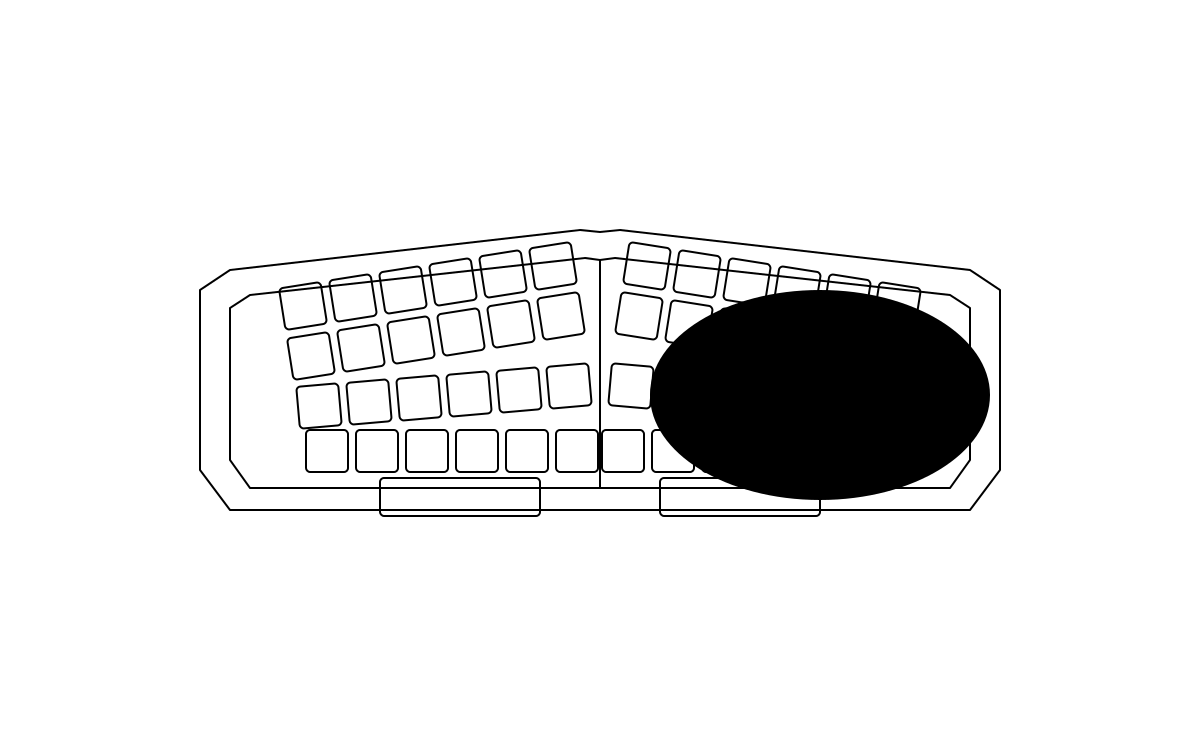
There was a stretch where every other build photo on the high-end side of the hobby was an Alice. The TGR Alice clones, the Keebio Iris cousins, the inevitable rosegold-anodized take on the splayed-alpha geometry — they were the look. Two and a half years later, the look has changed. Alice boards still ship, but the gravity has shifted, and the data is starting to make that shift hard to argue with.
What the data is showing
Alice is down 18 percent on the W19 tracker snapshot, with the trajectory unambiguously down across the eight-week window. That's not a collapse; for context, the same week has Mode Designs up 24 percent and the Gateron Oil King up 42. Alice isn't being abandoned, it's being out-gravitated by other categories.
Community-pulse signals back the read. Group-buy interest checks on the major Alice-style projects of the last twelve months have landed softer than the rosters from 2022. Used-board listings on r/MechanicalKeyboards mecha-market threads are turning over more slowly for Alice boards than for comparable 65% and 75% layouts at similar price tiers. Review-channel pickup rate — the loose proxy for "reviewers think their audience cares" — has thinned noticeably since late 2024.
None of those signals are decisive on their own. Together they form the same shape: enthusiasm cooling at the margins, while a core of loyal users keeps building. The score isn't crashing. It's draining.
Alice didn't fail. It got out-competed by ergonomics with fewer compromises, and by aesthetics that moved on.
Why it's cooling
Three forces are doing the work, and they reinforce each other.
The first is the ergonomic ceiling. Alice asks the user to accept a fixed splay angle and a fixed bar position chosen by the designer, and to live with whatever that geometry does to their hands. For people whose neutral posture matches the template, it's a revelation. For everyone else, it's a compromise that costs as much as a fully tuned tray-mount and delivers less ergonomic payoff than a true split. The layout can't tune itself to the typist; the typist has to tune to it.
The second is positioning. Alice almost never shows up at the budget tier. The geometry requires a custom plate and PCB, the cases tend to be premium aluminum, and the ecosystem inherited group-buy pricing from its enthusiast peak. The plate material choices on an Alice build — aluminium as the neutral default, polycarbonate for softness — are the same as any other premium custom, just in a narrower case geometry. A first-time ergo-curious typist looking around in 2026 sees Alice boards at $400 and up, sees pre-built splits at $250–$350 with hot-swap and wireless, and makes the rational call. Alice has priced itself into a niche it can't grow out of.
The third is the alternative. Split keyboards have spent the last three years going from fringe to merely uncommon. The Lily58, Corne, Sofle, and the wave of pre-built Keebio and ZSA-adjacent boards have all moved up in fit-and-finish. Wireless ZMK builds with sane battery life are no longer a science project. For someone whose interest in Alice was ergonomic in the first place, a split is now a less-compromised purchase at a similar price. For someone whose interest was aesthetic, the aesthetic has moved on — toward low-profile, toward unibody-CNC 65%, toward the gasket-mount revival in TKL.
There's a fourth factor worth flagging without overweighting: the modding scene around Alice boards has gone quiet. The PE foam, force-break, and tape-mod conversation that defined Alice build threads in 2022 has largely moved to other layouts, including the tactile-focused builds where factory-lubed options like the Drop Holy Panda X have removed the barrier the old frankenswitch era imposed. For the full acoustic physics behind those mods — how each targets a different layer of the sound stack — see the physics of thock. When the modding cohort migrates, the build photos migrate, and the build photos are most of how a layout stays culturally alive in this hobby.
What would reverse this
A pre-built Alice at the $200 tier with hot-swap, wireless, and a serious-but-not-precious aesthetic would probably do it. That's the gap: nobody has tried to make Alice the answer for someone who isn't already deep in customs. A second possibility is a split-Alice hybrid that lets users adjust the splay angle — at that point Alice stops being a fixed geometry and becomes a tunable one, which is most of what the splits are selling.
Neither of those products is on the public roadmap of any maker thock tracks closely. Until one shows up, the trend line is what it is. Alice isn't dying. It's just not the look anymore, and the data has caught up to what the build threads already showed.
Keep reading
- Deep Dives
How the 60% became the default custom-keyboard layout
Every custom-keyboard buyer's guide since the mid-2010s opens with the same four-term vocabulary — 60%, 65%, 75%, TKL — as though it always existed. It didn't. One open-source PCB out of a geekhack thread is most of the reason that taxonomy exists at all.
thock11 min read - Trends
Reading the Trends Tracker
thock's Trends Tracker is a weekly snapshot of what is rising, falling, or holding flat across the hobby — switches, keycaps, layouts, vendors, and brands, scored on a single -100 to 100 scale and updated each Monday. This is what the columns mean and what they do not.
thock5 min read - Trends
How 'thock' became an acoustic spec, not an accident
A decade ago a thocky board was the win condition of a $300 custom — the payoff for the right switches, the right lube job, the right patience. In 2026 the same sound is table-stakes for a $150 prebuilt: factory-lubed switches, silicone dampening, gasket-mounted plates, PBT doubleshot. The stack that used to be enthusiast-only is now what mid-tier vendors design toward from day one.
thock8 min read - Trends
How 75 percent became the default custom layout
Two years ago a custom-board recommendation defaulted to 65% with a polite note about 75% as the next step up. The KBD75 v3's staying power as a default recommendation, the QK75, and a crowded mid-tier have flipped that order. 75% is now the layout customs reach for first.
thock5 min read