OpenAI's first hardware is a Work Louder macro pad
Codex Micro, OpenAI's first piece of branded hardware, is a macro pad built by boutique vendor Work Louder on the bones of its $199 Creator Micro 2. It launched July 15, 2026 at $230, sold out within 24 hours, and now resells for $700-800+.
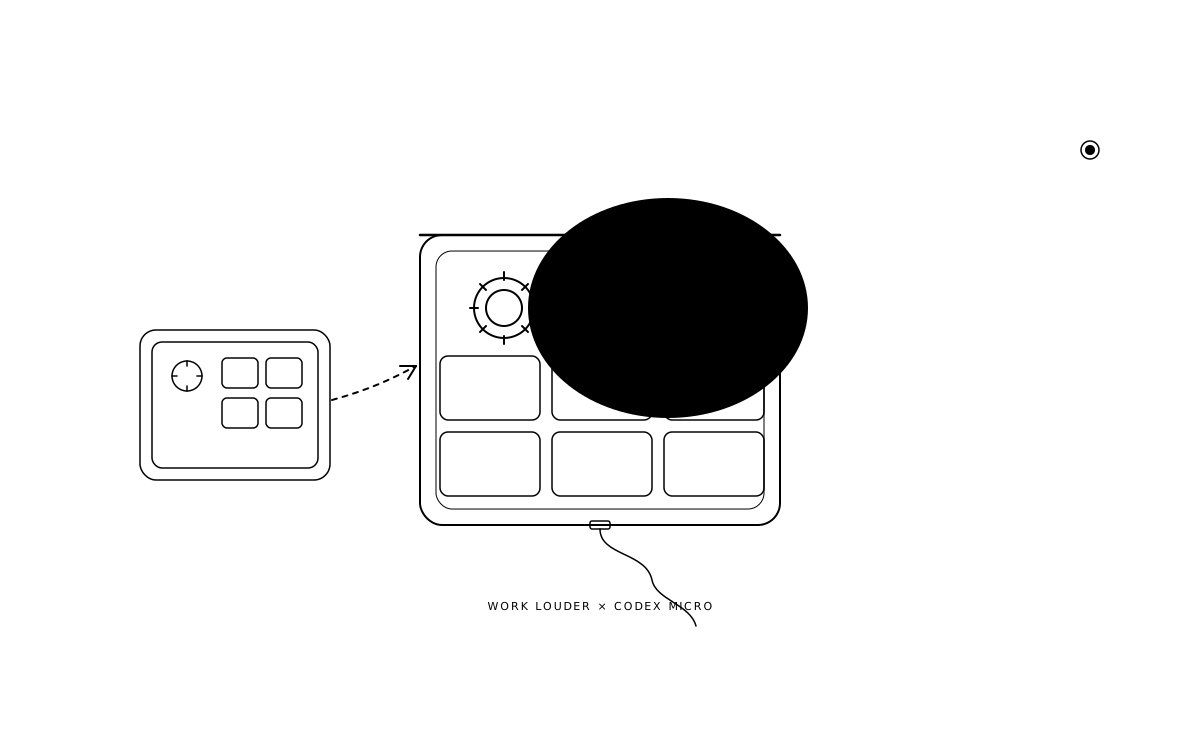
OpenAI writes software. On July 15, 2026, it starts shipping hardware — and the company didn't build it in-house. Codex Micro, OpenAI's first branded physical product, is a macro pad, and the vendor behind it is Work Louder, a boutique keyboard maker known inside the enthusiast space for small-batch macro pads rather than mass consumer electronics. For a hobby that mostly reads about big tech secondhand — a launch event covered by outlets that have never heard of gasket-mount or hot-swap sockets — this is a rare instance of a household tech name showing up as a customer of the enthusiast supply chain instead of a distant subject.
What's shipping
Codex Micro is built on top of Work Louder's existing Creator Micro 2, a $199 macro pad the vendor already sells under its own name. OpenAI teased the collaboration on June 29, 2026, and the trend notes behind this piece describe Codex Micro plainly: a Work Louder-built macro pad, based on the Creator Micro 2 platform, carrying OpenAI's branding, arriving July 15.
Beyond that framing, the public specifics are thin. There's no confirmed key count beyond what the Creator Micro 2 platform already ships with, no confirmed switch choice, and — the detail every enthusiast thread keeps circling back to — no announced price. What's on record is the base platform's price ($199 for the Creator Micro 2 itself) and the ship date. Everything Codex Micro changes relative to that base product is still unconfirmed.
Why a boutique macro-pad maker, not an OEM
The more interesting story here isn't the product — it's the choice of partner. OpenAI could have gone through any number of contract electronics manufacturers to stamp out a generic macro pad with its logo on it. Instead it went to Work Louder, a vendor whose entire reputation in the mechanical keyboard community is built on doing one narrow thing — small, dedicated macro pads — well enough that people who already own a full custom board still buy a second, tiny one just to wire in a handful of shortcuts.
That's a meaningful signal about what OpenAI is actually trying to sell. A macro pad's whole premise is dedicated physical shortcuts to a specific workflow — and pairing that premise with a company whose flagship product is a coding assistant (Codex) reads like a hardware companion for a specific software habit, not a general-purpose gadget. Partnering with a vendor whose existing customer base is people who already care about build quality and per-key programmability, rather than a faceless OEM, is also a legibility play: it borrows Work Louder's credibility with exactly the audience most likely to notice and care that OpenAI shipped hardware at all.
It's also a departure from how big tech has typically touched this hobby. Gaming-peripheral brands run their own in-house hardware programs and treat mechanical-keyboard aesthetics as a design language to borrow from, not a supply chain to buy into. A software company going the other direction — commissioning an existing boutique vendor's existing platform rather than building a lookalike in-house — is closer to how the enthusiast custom-keyboard scene already works internally, where small vendors collaborate on group buys and co-branded runs constantly. OpenAI just became a customer in that same pattern, at a scale the pattern has never seen before.
What's known, what isn't
Known, plainly: Work Louder built it. It's based on the Creator Micro 2 platform. It's OpenAI's first branded piece of hardware. It ships July 15, 2026.
Unannounced, as of this piece's publish date: price. Full spec sheet — whatever switch, hot-swap, and connectivity choices differentiate Codex Micro from the stock Creator Micro 2 haven't been detailed publicly. Retail channel — whether it sells through Work Louder's own storefront, an OpenAI-run page, or both. And whether Codex Micro does anything software-side beyond standard macro programming — an integration with OpenAI's own tools would be the obvious hook, but nothing to that effect has been confirmed.
Why the crossover matters
The enthusiast keyboard space gets outside-press attention fairly often — a celebrity spotted with a custom board, a gaming brand's marketing push — but those moments rarely pull genuinely new readers toward switch types, hot-swap sockets, or macro-pad vendors specifically. An OpenAI hardware launch is a different kind of magnet. Tech press that has never covered a keyboard vendor by name is now writing sentences that contain the words "Work Louder" and "macro pad," and some fraction of that audience is going to go looking for what a macro pad actually is, who else makes them, and what a $199 Creator Micro 2 gets you compared to the version with OpenAI's name on it.
That's visible directly in thock's Trends Tracker. The Work Louder x OpenAI Codex Micro row entered the tracker at a score of 58 the week the collaboration was teased, climbed to 68 the following week as outside-press coverage kept building with pricing still unconfirmed, and reached 94 in the run-up to the July 15 launch — one of the sharpest three-week climbs the tracker has logged for a vendor row in 2026. That's a discussion spike, not a slow build: most vendor rows that move this much do it across a group-buy cycle measured in months, not weeks.
What to watch
July 15, 2026 answers the open questions directly — pricing chief among them, along with whatever spec differences separate Codex Micro from the stock Creator Micro 2 it's built on. Whether Work Louder's existing customer base treats this as a legitimizing crossover event for boutique macro-pad vendors, or as a one-off branding exercise that fades once the news cycle moves on, will show up in how the tracker's score behaves after launch week — whether it holds near its current high or falls back toward baseline the way most launch-week spikes do.
The row to watch is the one already on the board: follow the Trends Tracker for the weekly read, and the W31 snapshot for the sellout and resale numbers.
Keep reading
- News
Wuque Studio's summer update, and the Ikki68 Aurora holdover
A July 26 product-update post from Wuque Studio sent buyers back to the Ikki68 Aurora's listing page. Mammoth V2 and Promise V2 remain forum speculation, and no group buy has opened.
thock7 min read - News
GMK Just Beachy's group buy opens August 18 across five vendors on five regions
GMK Just Beachy opens for orders August 18, 2026 at five vendors spanning five regions at once — Keebz N Cables, Divinikey, Prototypist, KBDfans, and Unikeys — capping an eight-week climb on thock's Trends Tracker that hasn't logged a single down week.
thock6 min read - News
GMK CYL Zombie's group buy, open through October 31, is already thock's steepest Halloween climb
GMK CYL Zombie, a Halloween-themed colorway running jointly through KBDfans and KeyAtlas from October 2 through October 31, 2026, has climbed to a score of 70 on thock's 2026-W42 trends tracker off an eight-week spark trail that hasn't flattened once. The buy is roughly a third of the way through its run, not winding down.
thock6 min read - News
Wooting's 80HE+ preorder starts shipping in two waves this fall
Preorders for Wooting's 80HE+ opened September 17, 2026, and the first units are headed out the door in two separate waves — ABS and Module boards in late October, the zinc case and Lekker Knob Large accessory in mid-December.
thock6 min read